
# How the Menstrual Cycle Affects Skin Quality The menstrual cycle has a significant impact on skin
The skin is not static. It changes every day, responding to stress, sleep, nutrition, and the seasons – but few people realise that one of the most significant factors that rhythmically and predictably transforms the appearance and feel of the skin is the menstrual cycle. For many women, this is a revelation: suddenly, those mysterious weeks when the skin glows without any extra effort make sense, as do those frustrating days when even the best skincare routine cannot prevent a breakout or sudden dryness. Understanding what happens in the body during each phase of the cycle means gaining a powerful tool for skincare that is, moreover, completely free.
Hormone levels – primarily oestrogen, progesterone, and androgens – fluctuate throughout the entire cycle and directly influence how the skin behaves. Sebum production, hydration, elasticity, sensitivity, and the tendency towards acne all change cyclically. Dermatologists and scientists are increasingly researching this area: for example, a review study published in the Journal of the European Academy of Dermatology and Venereology confirms that skin conditions are directly modulated by sex hormones, both in women with acne and in women with otherwise healthy skin.
Try our natural products
The follicular phase and ovulation: the golden age of skin
The cycle begins on the first day of menstruation. Paradoxically – even though these days are often physically the most demanding – oestrogen levels begin to rise quickly after menstruation, and with them, skin quality improves. The follicular phase, which lasts roughly from day 1 to day 14 of the cycle, brings gradual improvement. Oestrogen stimulates the production of collagen and hyaluronic acid, so the skin is firmer, better hydrated, and naturally radiant. Sebum production is low during this period, pores appear smaller, and make-up lasts longer.
Ovulation, which occurs approximately in the middle of the cycle, tends to be the peak of this process. Oestrogen levels reach their maximum, and a brief rise in testosterone is added to this, which paradoxically can contribute to a natural radiance and a confident appearance. It is no coincidence that many women describe this period as the days when they feel best in their own skin – both literally and figuratively. The skin is at its most resilient at this point, responds best to active ingredients in cosmetics, and can tolerate more demanding procedures such as chemical peels or more intensive treatments.
For women interested in targeted skincare, the follicular phase is the ideal window for introducing new products or ingredients – such as retinol, vitamin C, or acids. The skin is less reactive during this period and tolerates potentially irritating substances better. So if someone is planning to try a new serum or exfoliant, this is the right time.
An interesting real-life example: Jana, a thirty-four-year-old graphic designer, had complained for years about unpredictable skin. Sometimes it glowed, other times she was troubled by spots and sensitivity. It was only when she began tracking her cycle and recording her skin's condition in a simple diary that she noticed a clear pattern. "I stopped fighting my skin and started working with it," she says. She adapted her skincare routine to each phase, and the results came within two months.
The luteal phase: challenges that have an explanation
After ovulation, the luteal phase begins, lasting approximately from day 15 to day 28 of the cycle. This period is the most demanding for many women – both physically and in terms of skin condition. Progesterone, whose levels rise significantly during the luteal phase, stimulates the sebaceous glands to produce more sebum. The result is shiny skin, clogged pores, and an increased tendency towards acne. At the same time, mild water retention may occur in the body, manifesting as puffiness and a feeling of "tighter" or heavier skin.
Approximately one week before menstruation, during the late luteal phase, oestrogen and progesterone levels begin to fall. This decline can cause increased sensitivity, dryness, and skin reactivity. The skin's barrier function is weakened during this period, meaning the skin retains moisture less effectively and reacts more easily to external triggers – polluted air, stress, or unsuitable cosmetics. Women with sensitive skin or eczema often notice a worsening of their condition during these days.
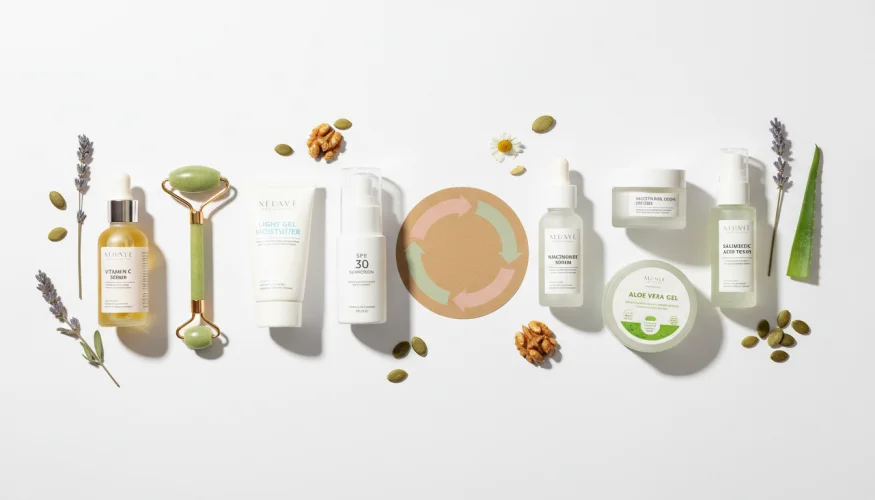
The luteal phase calls for adapted skincare. Switching to gentler cleansing products, avoiding aggressive exfoliants, and strengthening the moisturising routine can significantly reduce unpleasant symptoms. Products with soothing ingredients, such as niacinamide, panthenol, or aloe vera extract, are an excellent choice. Niacinamide is particularly valuable – it regulates sebum production, minimises pores, and simultaneously strengthens the skin barrier, addressing several of the luteal phase's issues at once.
When it comes to cycle-related acne, it is important to distinguish between a preventive and a reactive approach. Salicylic acid applied preventively during the first half of the luteal phase can help keep pores clear and prevent the formation of comedones. Conversely, aggressive cleansing and mechanical irritation of the skin once spots are already present generally worsens the situation. Dermatologists recommend approaching hormonal acne with patience and consistency rather than impulsive interventions.
It is worth noting that the intensity of hormonal fluctuations and their effect on the skin varies from woman to woman. Factors such as genetics, stress, nutrition, sleep, and overall health play a significant role in how pronounced the skin changes are. Women diagnosed with polycystic ovary syndrome (PCOS) or endometriosis may experience more pronounced hormonal fluctuations and thus more intense skin manifestations – in such cases, it is advisable to discuss skincare with a gynaecologist or dermatologist as well.
How to adapt skincare to the rhythm of the cycle
The idea of so-called cycle syncing – synchronising lifestyle, nutrition, and body care with the menstrual cycle – has been gaining increasing attention in recent years. It has been popularised, among others, by books such as Woman Code by Alisa Vitti and research from the Institute for Functional Medicine, which emphasises a holistic approach to women's health. Although the scientific foundation for some aspects of this approach is still growing, the basic principle – listening to the body and adapting to its natural rhythms – makes both intuitive and biological sense.
In practice, for skincare this means thinking about a cosmetic routine not as an unchanging ritual, but as a dynamic system that adapts to the skin's current needs. It is not necessary to buy dozens of different products or radically change an entire routine every week. It is enough to be aware of what is happening in the body and to make small, targeted adjustments.
During the follicular phase and ovulation, skincare can be bolder – active serums, peels, intensive treatments. The luteal phase, on the other hand, is a time for gentleness, hydration, and soothing. A few specific tips that many women find useful:
- Follicular phase: introducing new products, acids, retinol, vitamin C, lightweight moisturisers
- Ovulation: maintenance care, sun protection (oestrogen can increase sensitivity to UV radiation), antioxidants
- Luteal phase (first half): preventive anti-acne care, salicylic acid, gentle cleansing products
- Late luteal phase and menstruation: nourishing and soothing products, ceramides, panthenol, minimal exfoliation
Nutrition and hydration play an equally important role in this context as topical cosmetics. Omega-3 fatty acids, zinc, and antioxidants from fruit and vegetables support healthy skin throughout the entire cycle. Zinc is particularly interesting – research suggests it can help regulate sebum production and reduce inflammatory acne. Foods rich in zinc include pumpkin seeds, legumes, wholegrain cereals, and nuts – precisely the kinds of foods that form part of a balanced and sustainable diet.
Equally important is the impact of stress. Cortisol, the stress hormone, directly stimulates the sebaceous glands and worsens inflammatory processes in the skin. During the luteal phase, when the skin is naturally more sensitive, even mild stress can significantly worsen its condition. Stress management techniques – whether meditation, movement in nature, adequate sleep, or simply conscious breathing – are not merely a passing trend, but have a direct impact on skin health.
Understanding how the menstrual cycle and skin quality in each phase are connected is not merely an academic matter. It is a practical key to stopping feeling like a victim of one's own skin and beginning to work with it consciously. The skin speaks – and the cycle gives it a language with which it does so regularly, predictably, and with surprising precision. All that is needed is to learn to listen.