

# Involving Children in Household Chores According to Their Age
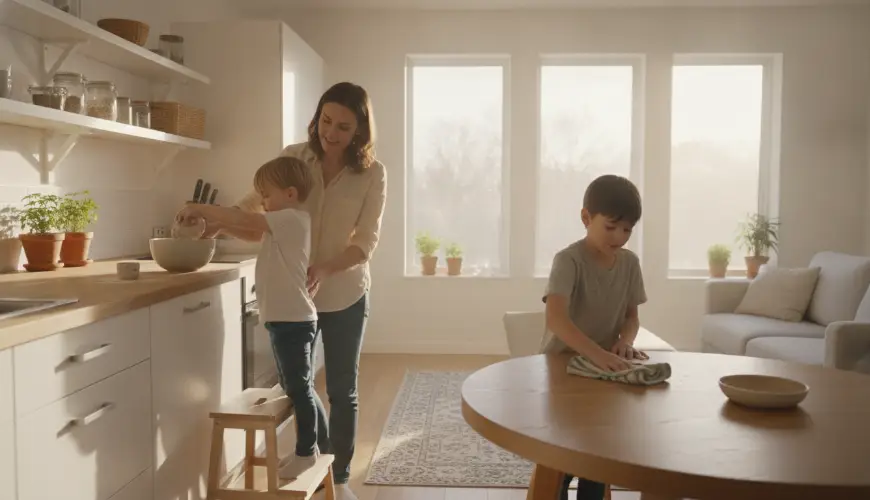
Every parent knows it – the effort to keep a household running while working, cooking, cleaning, and handling hundreds of other responsibilities sometimes feels like a never-ending marathon. Yet one of the most valuable solutions is sitting right at the table, doing homework or watching cartoons. Involving children in running the household is not just practical help for overwhelmed parents, but above all one of the most important parenting tools that modern families have at their disposal.
Children who participate in household chores from an early age grow up to be more self-confident, responsible, and independent adults. This conclusion is confirmed by a long-term study by Marty Rossmann of the University of Minnesota, which followed children from early childhood into adulthood and found that involvement in household tasks at an early age is one of the most reliable predictors of success in adult life. The key, however, is not to overburden children or assign them tasks beyond their abilities – it is about finding the right balance appropriate to their age and capabilities.
Try our natural products



Why household chores are so important for children
Before diving into specific tips, it is worth understanding why this topic matters at all. Many parents resist involving children in household tasks for various reasons – they worry the child will break something, that it will take too long, or they simply feel it is faster and more efficient to do everything themselves. Yet in doing so, they unknowingly deprive their children of a valuable opportunity for development.
Household chores teach children fundamental life skills that school simply does not cover. No one will teach them how to dust properly, how to sort laundry, or how to prepare a simple breakfast. These seemingly trivial skills are, however, the foundation of functioning adulthood. Moreover, regular participation in running the household builds in children a sense of belonging and responsibility – they come to understand that they are a valued member of the family, not merely a passive recipient of care. Psychologists from the American Psychological Association repeatedly emphasise that this very sense of contributing to the whole is essential for a child's healthy emotional development.
As American psychologist and parenting author Wendy Mogel once said: "We want our children to have a good childhood, but we are actually ruining it for them by protecting them from all effort." These words may sound harsh, but they contain a profound truth about how excessive care can paradoxically cause harm.
It is also important to mention that involving children in household tasks should never be used as a punishment. If a child is assigned to take out the rubbish as a sanction for misbehaving, they will begin to view household chores negatively. On the contrary, if these activities become a natural part of family routine, the child will accept them as a matter of course – much like brushing their teeth or getting dressed.

How to involve children in household tasks in an age-appropriate way
The biggest mistake parents make is either underestimating a child's abilities or, conversely, having unrealistic expectations. A three-year-old obviously cannot operate a washing machine, but they can put toys into a basket. A twelve-year-old, on the other hand, could prepare an entire dinner if their parents have gradually taught them the basics of cooking. Everything depends on the age, temperament, and prior experience of the individual child.
The youngest children, aged two to three, are surprisingly enthusiastic helpers – their natural desire to imitate adults is at its peak at this age. Parents should make the most of it while it lasts. Young children can bring small objects, put laundry in the basket, wipe up spills with a cloth, water plants with a parent's help, or fold napkins for the table. The result will not be perfect – and that is fine. What matters is participation, not precise execution.
The preschool years, from four to six, bring significant development of motor skills and understanding of rules. Children this age can tidy their room, wipe the table after meals, help carry shopping from the car, feed a pet, or help sort laundry by colour. It is also the ideal age for first experiences in the kitchen – mixing dough, cracking eggs, or cutting soft foods with a blunt knife under adult supervision are activities children love, while also developing their fine motor skills and patience.
Let us consider a specific situation: a five-year-old girl named Annie helps her mother bake bread every Saturday. She measures out the flour herself, adds the yeast, and kneads the dough. The result is not always a perfect loaf, but Annie looks forward to Saturday all week long. She has learned patience, precision in measuring ingredients, and above all experiences enormous pride when the family praises the bread. This is precisely the kind of experience that shapes a child's character in a lasting way.
The school-age years, from seven to ten, are a period when children can take on genuine responsibility for specific tasks. They can be in charge of washing dishes or unloading the dishwasher, vacuuming certain rooms, taking out the rubbish, helping prepare simple meals, or watering the garden. The key at this age is to move from "helping" to "responsibility" – the child should have their own regular task that belongs to them, rather than just occasional assistance.
Older children aged eleven to fourteen are capable of handling more complex household tasks almost independently. Doing and folding laundry, preparing simple meals for the whole family, mowing the lawn, shopping from a list, or caring for younger siblings are all achievable challenges for them. This age group also greatly appreciates it when parents explain the "why" behind each task – teenagers need meaning, not just instructions.
Older teenagers from fifteen onwards should be capable of functioning in the household practically independently. Where age and circumstances allow, it is worth involving them in planning the family food budget, coordinating household repairs, or organising family events. These experiences are direct preparation for the independent life that awaits them in just a few years.
A practical overview of household tasks by age:
- Ages 2–3: carrying objects, putting laundry in the basket, wiping up spills
- Ages 4–6: tidying toys, wiping the table, feeding pets, helping in the kitchen
- Ages 7–10: washing dishes, vacuuming, taking out rubbish, preparing snacks
- Ages 11–14: doing laundry, cooking simple meals, shopping, caring for siblings
- Ages 15+: complex cooking, managing the household, planning and organising
How to motivate children and maintain their interest
The theory is straightforward, but practice is often more complicated. What should you do when a child refuses to help, or when their initial enthusiasm fades? First and foremost, it is important to recognise that consistency matters more than perfection. A child who tidies their room imperfectly every day gains more than one who tidies it perfectly once in a while under pressure.
One of the most effective tools is working together. Children are naturally social beings, and working alongside a parent is motivating in itself. Instead of assigning a task and walking away, it is enough to say: "Come on, let's tidy it up together." This approach also strengthens the relationship and creates pleasant memories associated with household work.
Another important element is appropriate praise. Not excessive praise for every minor action, but genuine appreciation of effort and results. "I like how you did that" or "Thank you, that really helped me" are phrases that motivate a child far more than formal rewards. Research in child psychology repeatedly shows that intrinsic motivation – the sense of competence and belonging – is more effective in the long run than external rewards such as money or sweets.
Parents should also accept that a child will not complete a task in the same way they would themselves. And that is perfectly fine. If a parent corrects every small detail after the child or redoes the work "properly," the child will very quickly understand that their effort is not good enough – and will stop trying. Accepting imperfection as part of the learning process is often the most difficult step in the whole process for parents.
The way household chores are communicated within the family also plays a major role. Families that talk about cleaning, cooking, and caring for the home as a natural part of shared life raise children for whom this cooperation is a matter of course. Conversely, in families where household tasks are presented as a necessary evil or a punishment, children absorb these attitudes and carry them into adulthood.
It is also worth mentioning the ecological dimension of the whole matter. Involving children in household tasks is an excellent opportunity to teach them sustainable habits – sorting waste, conserving water and energy, choosing eco-friendly cleaning products, or growing their own herbs on the windowsill. Children who learn from an early age to see their home as a place that needs to be cared for naturally transfer this respect to the wider environment. These are values that then influence their decisions throughout their lives – from choosing appliances and shopping habits to their attitude towards nature.
Involving children in household tasks in an age-appropriate way is not about having a perfectly tidy home or raising little helpers. It is about building character, strengthening relationships, and preparing for life. And that is an investment that always pays off.