
Children and ecology start at home when you turn sorting and saving water into a game
When talking about ecology, it often sounds like a big topic for adults: carbon footprint, recycling, energy, plastics in the oceans. However, children and ecology are naturally connected more than it seems. Children explore the world without cynicism and with a desire to do things "right" if it makes sense to them. And that is the key: don't overwhelm, don't scare, but show connections in everyday life. At home, in the store, on a trip, at snack time. Ecology then does not become a school chapter but a part of everyday little things that hold together.
Some may think: isn't this too much for children? But the question is rather the opposite: when else to learn consideration if not when habits are being formed? According to UNICEF, the impacts of climate change affect children more significantly than adults – and it is also true that children can be strong carriers of change in families and communities. Not because they should bear responsibility for the world, but because they have the ability to remind adults of what easily gets lost in everyday hustle: that details matter.
Try our natural products


How to Teach Children About Ecology Without Moralizing
The basic rule is surprisingly simple: the best way to teach ecology is through experience, not preaching. A child doesn't need to hear that "plastic is bad" or that "we must save the planet" to start doing something. They need to understand what happens to the things they use – and that they have the power of choice. Phrases like "this goes here because..." work better than "this must be done this way."
A good starting point is language. Instead of abstract "ecology," one can talk about what is close to the child: a clean forest, water in the stream, animals living around, or even why it's nicer to breathe at home when aired and not overdone with chemicals. When combined with natural curiosity ("Where does that PET bottle go?"), half the work is done.
It also helps that ecological behavior is not one big heroic act but a series of small decisions that repeat. And repetition is key for children. The more "eco" is part of the routine, the less it needs to be talked about.
And one more important thing: children shouldn't feel like the "police" of the household. When ecology turns into a competition of who corrects whom, tension arises. It's better to create an environment where rules are naturally followed – perhaps by making the recycling bin accessible, bottles having their place, and the shopping bag hanging by the door.
"The best education is what children see, not what they hear." This sentence is attributed to various authors, but the meaning is clear: example is stronger than explanation. And it also relieves adults – it's not necessary to be perfect, just consistent and willing to improve.
Children and Ecology in Practice: The Household as the Best "Classroom"
When considering how to involve children in an ecological household, it often starts with waste separation. It's logical because it's visible and quick to understand. But the household offers much more – from water to energy to food and clothing. It's important to choose activities that match the child's age and, most importantly, have immediate meaning.
A great trick is "visibility of results." A child can easily understand that when the light is turned off, it's dark, and when the bathtub is filled to the brim, a lot of water flows. But it's harder for them to imagine what "emissions" mean. Therefore, it's practical to show ecology through things the child can see, touch, and influence.
A Real Example Known to Almost Every Household
Imagine an ordinary weekday evening. A parent is cooking dinner, the child wants to help but is also bored and "gets in the way." At this moment, the eco household can become a natural game: the child gets the role of "kitchen treasures manager." Their task is to monitor where peels, paper packaging, and glass go and prepare the shopping bag for tomorrow. Within a few days, it becomes a routine that doesn't delay but helps.
The point is not that the child manages everything perfectly. The point is that they have a role. And roles are often more important to children than the actual outcome.
How and What to Engage Children in an Eco Household (Without Big Words)
In the household, it works when things are prepared so the child can act independently. Low hooks for bags, sorting bins within reach, a small bottle for drinking that the child can wash themselves. When combined with simple rules, a system is created that can be maintained even on hectic days.
It's also good to choose "eco" activities that aren't a punishment. If saving water becomes a ban ("you can't play in the bathtub"), the child associates ecology with restriction. If it becomes a challenge ("let's try a shower to a song that lasts three minutes?"), it's a game.
And now the most important thing: an ecological household is not just about waste, but also about what is used for cleaning, how laundry is done, how shopping is done, and what is repaired. Children learn not only consideration but also practical skills.
Specific Tips: Small Steps That Kids Really Enjoy
The following tips are put together to be easily tried at home and cover different areas. It's not a list of "right" things, but an inspiration for what often works when finding a way to teach children ecology naturally.
Playing "Packaging Detective" During Shopping
In the store, an ordinary shopping trip can become a short mission: the child searches for products with less packaging or those that can be easily recycled. It's not about banning everything in plastic, but showing that packaging is part of the product. The child starts noticing that some things are unnecessarily "dressed" in several layers.
It helps when the child has their own task: for example, choosing fruit for a reusable bag or ensuring the cloth bag isn't forgotten. The important thing is praise for effort, not perfection.
Water as a Visible Story
Children are familiar with water "flowing somewhere." This can be utilized: when brushing teeth, the tap can be turned off, and when washing hands, an appropriate amount of water can be used. It works great when a simple tool appears at home – like a container to catch cold water before it turns hot, then used for watering plants.
Here, a broader context can be subtly linked. The Czech Hydrometeorological Institute regularly informs about drought and water status in the landscape; for adults, it's useful to follow the Intersucho portal, as it helps understand why it's sensible to handle water wisely even on regular days when "water still flows from the tap."
Waste Sorting as "Home Logistics," Not an Obligation
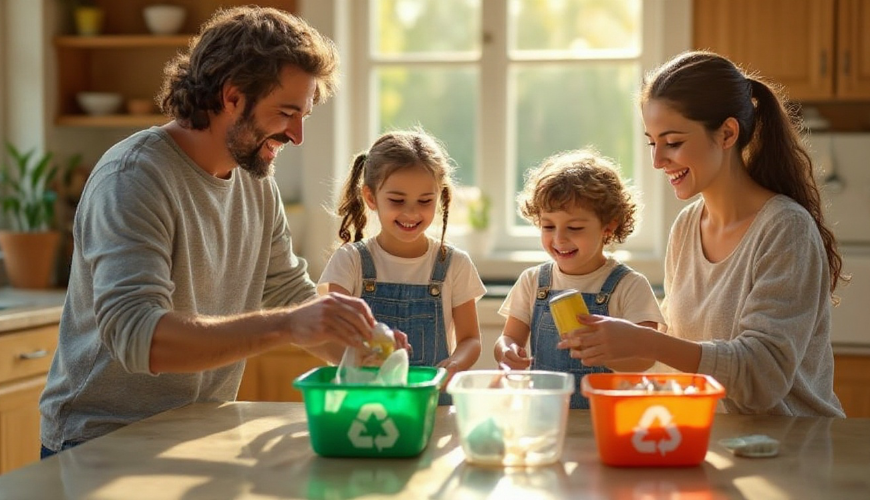
Sorting is understandable to children if it's simple. Colors, pictograms, clear place. It works great when sorting becomes part of a game: who finds three things in the kitchen that belong in paper? Or who correctly guesses where the yogurt box goes?
It's good to acknowledge that some things are confusing. When an adult makes a mistake and then it is corrected together, the child learns that a mistake is not a failure, but a part of learning. And that is fundamental for long-term habits.
Compost or "Peel Box"
If there is a garden, composting is ideal. If not, one can start with a small "collection" of bio-waste and taking it to a brown bin (if available) or using a community compost. A child is intrigued that an apple peel is not "waste forever" but something that can transform.
Here, children and ecology can beautifully connect with nature: when a child sees that bio-waste turns into soil, it makes sense without a single lecture.
Cleaning Without Excessive Chemicals as a "Home Ritual"
It is often forgotten that ecology is also about what we breathe at home and what we release into the water. Children can be easily involved in cleaning: cloth, warm water, gentle cleaning agent, joint table wiping. When mild products are used, which are not aggressive, it's more pleasant for the skin and nose.
It is also an opportunity to talk about how "clean" doesn't have to mean "scented a kilometer away." And sometimes less is enough. In the household, it is easier to build a relationship with things that are reusable – such as washable cloths instead of disposable ones.
Clothing: Repair, Swap, Pass On
Sustainability in the wardrobe is surprisingly easy to explain to children because they have an emotional attachment to some items. When a button falls off or a hole appears at the knee, it doesn't have to be the end. On the contrary: a small repair can be a "little project." A child can choose a patch, hold the fabric, or just watch that things can be saved.
This naturally teaches that the value of things is not just in them being new. And also that clothing can be passed on – to younger siblings, friends, or in a swap. It is a subtle but powerful lesson against the culture of "fast consumption."
Food: Planning and Leftovers Without Shame
Food waste is a topic that can be approached sensitively. A child doesn't need to hear that "somewhere people are hungry" to understand that wasting is a pity. It's enough to show that leftovers can be the base of another meal. Bread can be turned into croutons, leftover rice into quick fried rice with vegetables, overripe bananas into banana pancakes.
A child can be involved in planning: choosing one dinner for the week, helping check the fridge, or marking food that needs to be eaten first. This also teaches a practical skill that will be useful throughout life.
If one common denominator should be chosen, it's simple: children learn ecology best when they feel they are part of the household, not just listeners of rules. When they are given space to make decisions on small things, they begin to carry consideration outside – to school, activities, among friends.
And perhaps in the end, the biggest paradox is: ecological education is not primarily about the planet as an abstraction, but about the relationship to home, to things, and to people around. When a child understands that less waste means less work, that a repaired T-shirt can still be a favorite, and that water is not a given, they start behaving differently even without reminders. And adults often find that thanks to children, something returns to the household that is missing in a fast-paced world: attention to detail and the joy that things make sense.