

# Tame All Cables and Chargers in Your Home

Everyone knows it. You open the drawer by the sofa and a tangle of cables falls out at you, looking as though it had knotted itself into an indecipherable mess overnight. The phone charger merges with the headphone cable, the extension cord winds around the laptop power adapter, and somewhere in the depths lurks a cable whose origin no one can remember. This everyday chaos is not merely an aesthetic problem – cable clutter can cause stress, slow down daily routines, and in extreme cases even pose a safety risk. Fortunately, there are a whole range of smart and sustainable ways to take matters into your own hands.
Interestingly, the problem of cables in the home has deepened significantly over the past two decades. Back in the nineties, the average household had only a handful of electrical appliances with cables. Today the situation is entirely different – smartphones, tablets, laptops, wireless headphones, smartwatches, e-readers, game controllers, and dozens of other devices all require regular charging. According to a survey by the Consumer Technology Association, the average American household owns more than 25 connected devices, and similar figures apply to Europe, including the Czech Republic. The result is a literal cable jungle that grows year by year.
Try our natural products





Why cable organisation matters more than it seems
You may think this is merely a cosmetic problem that can easily be overlooked. But tangled and poorly stored cables have real consequences for everyday life. First, searching for the right charger at the moment your phone is dying at 2% battery is a frustrating experience that needlessly ruins your mood. Second, cables left loose on the floor or on tables are a potential hazard – you can trip over them, and this is doubly true in households with children or elderly people. Third, improper cable storage significantly shortens their lifespan. Cables that are repeatedly bent sharply, tangled, or pinched by furniture wear out or have their insulation damaged far more quickly, which can lead to malfunctions or even electrical short circuits.
And then there is the psychological dimension. Research in environmental psychology has long confirmed that visual clutter in the environment we live in raises levels of cortisol – the stress hormone. As writer and minimalism pioneer Joshua Becker once noted: "The fewer things that surround us, the more space we have for what truly matters." Taming cable chaos is therefore not just about aesthetics – it is an investment in your own wellbeing.
Where to begin? The most sensible first step is an audit. Go through the entire flat or house and gather all cables and chargers in one place. The result is often surprisingly revealing – most households discover that they own a whole range of cables for devices they no longer own, or several identical chargers for the same phone. Everything that has not been used for more than a year can be taken without a guilty conscience to an e-waste collection point. In the Czech Republic, a network of collection points is operated, for example, by the ASEKOL system, where older electronics and cables can be disposed of safely and ecologically.
Smart methods and tools for cable organisation
Once it is clear what you actually need, the organisation itself can begin. The market offers a whole range of practical accessories, many of which are also eco-friendly and aesthetically pleasing – ideal for those who want their home to reflect the values of sustainable living.
One of the most popular and versatile accessories is velcro and cable ties. Unlike conventional plastic zip ties, which are single-use and then end up in the bin, velcro straps are reusable and easily adjustable. Cables can be bundled into neat groups by room or by the device they belong to, and easily separated when needed. Particularly practical are straps integrated directly into the cable, or small figure-of-eight organisers onto which the cable is neatly wound.
For those seeking a more elegant solution, cable ducts and trunking are an excellent choice. These plastic or wooden profiles are fixed along the wall or behind furniture and route cables neatly and invisibly from one point to another. Combined with the wall colour or furniture material, they can be virtually invisible. There are even self-adhesive variants that require no drilling and are suitable for tenants who cannot make changes to the fabric of their flat.
Another elegant solution is acquiring a charging station – a central point where all devices charge simultaneously. Modern charging stations accommodate four, six, or more devices at once, have integrated cable management, and with just a single incoming cable they significantly reduce visual clutter. Some models are made from bamboo or recycled materials, which will appeal to anyone mindful of their household's ecological footprint. Such stations then find a natural place on the bedside table, work desk, or in the living room without disrupting the overall look of the interior.
Consider the situation of Martina, a thirty-year-old graphic designer from Brno who works from home. Her desk was overwhelmed by cables for many months – a MacBook charger, a USB hub, an external monitor cable, headphones, and a phone on top of that. After acquiring a simple charging station and cable trunking routed behind the desk, her workspace was transformed beyond recognition. "I stopped wasting time looking for cables and suddenly find it much easier to think at my desk," she says. Her experience is not exceptional – it is precisely the kind of small change that has a surprisingly large impact on everyday comfort.
A sustainable approach to chargers and cables
Organising cables is one thing, but from a sustainable lifestyle perspective it is also worth thinking about how we approach cables and chargers in a broader sense. The manufacture of electronics and their accessories is one of the most polluting industries in the world. Every new charger, every new cable means the consumption of raw materials, energy expended in production and transport, and ultimately electronic waste.
One of the most effective steps is switching to universal charging standards. In 2022, the European Union adopted legislation that from 2024 gradually introduces mandatory USB-C charging for a range of consumer electronics. This change is revolutionary from a sustainability perspective – instead of dozens of different chargers, just one is sufficient. If your devices support USB-C, it is worth investing in a high-quality, powerful multi-port charger and gradually retiring other proprietary chargers.
Quality over quantity is equally important. Cheap cables and chargers from unknown sources may be tempting in terms of price, but their lifespan is often a fraction of that of quality items from reputable manufacturers. A cable that lasts five years is not only more economical but also more ecological than three cheap cables that break in the same period. When choosing cables, it is worth looking for certifications such as MFi (for Apple products) or USB-IF certification, which guarantee safety and quality.
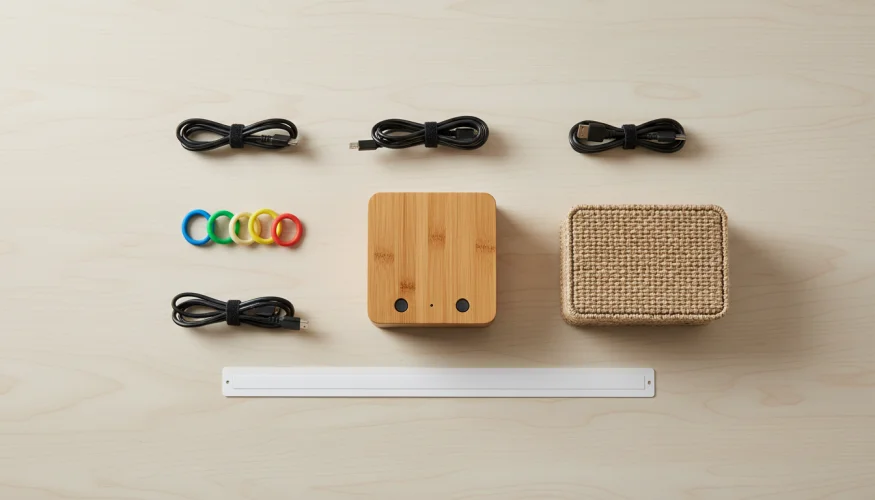
Simple labelling has also proven effective when organising cables at home. Small labels or coloured rings on the end of cables dramatically reduce the time spent searching and wondering what belongs to what. All it takes is a piece of adhesive tape and a marker, or you can purchase ready-made sets of coloured cable identifiers that are reusable. This seemingly trivial step is especially appreciated behind a power strip or in places where multiple cables converge.
Also worth mentioning is the approach of the so-called "cable box". This is a simple box or basket into which extension cords, chargers, and excess cable lengths are hidden away. The result is that on the surface of the desk or shelf you see only what you actually need, while all the technical clutter is concealed. Such boxes can be purchased in design variants made from bamboo, felt, or recycled plastic, so they complement modern interiors while also reflecting ecological values.
The approach to cable organisation differs from room to room. Different rules apply in the bedroom than in a home office or living room. In the bedroom, the key is minimisation – ideally one charging station on the bedside table into which the phone and watch are plugged in at night, and no other cables visibly present. In the home office, on the other hand, you will appreciate a more elaborate system of cable trunking, organisers under the desk surface, and clear labelling of every cable. The living room, in turn, calls for elegant solutions that are hidden behind furniture or integrated into the room's design.
Organising cables and chargers at home is not a one-off activity but rather an approach that gradually becomes part of everyday habits. It is enough to carry out a brief review every now and then – perhaps during a spring clean or when rearranging furniture – and make sure the system is still working. New devices arrive, old ones depart, and cable ecosystems change accordingly. Those who adopt this rhythm will find that chaos rarely returns to their home – and if it does, they know exactly how to deal with it.