

Set your movement minimum for more demanding weeks

Everyone knows it. A period arrives when the calendar fills to the brim, deadlines pile up like snowballs before they melt, and the idea of regular exercise seems like a distant memory from calmer times. A work project stretches into the evening hours, the children fall ill, family obligations escalate, and suddenly an entire week passes without a single intentional movement. Yet it is precisely in such moments that both body and mind may need movement more than anything else.
The problem is not a lack of willpower or laziness. The problem is that most people approach movement as an all-or-nothing matter — either they exercise fully, or they don't exercise at all. This approach works excellently during calm periods, but at the first onslaught of stress and busyness, the entire system collapses like a house of cards. The solution is not stronger willpower, but a smarter strategy: setting a movement minimum that survives even the most turbulent weeks.
A movement minimum is not giving up or compromising. It is a safety net that prevents a complete break in movement habits and keeps both body and mind in a functional state even when there is simply no time or energy for anything more.
Try our natural products



What a movement minimum actually is and why it matters
A movement minimum can be defined as the smallest amount of movement that a person can realistically maintain even during the most demanding weeks — while still feeling its benefits. It is not a training plan in the true sense of the word. It is a consciously established threshold below which one does not fall, regardless of circumstances.
The World Health Organization, in its physical activity recommendations for adults, states that an adult should complete at least 150 minutes of moderate-intensity movement or 75 minutes of high-intensity movement per week. These are figures for ideal conditions. A movement minimum can be considerably more modest — and still be meaningful.
Let us take a concrete example. Jana works as a project manager at a mid-sized company. During calm periods, she goes to the gym three times a week and takes longer walks on weekends. However, during quarterly closing periods, her working day extends to ten or more hours, travelling between branches consumes the remaining time, and by evening she barely has enough energy to prepare dinner. Previously, Jana would give up exercising entirely during such weeks — and then, after the demanding period ended, she felt guilty, tired, and found it difficult to regain her motivation. It was only when she consciously set a movement minimum — twenty minutes of walking daily and five minutes of stretching before bed — that she began to notice a significant difference. Not only physically, but above all psychologically.
The psychological component is, in fact, crucial. Movement influences cortisol levels, which is the primary stress hormone, and promotes the release of endorphins. Research published in Frontiers in Psychiatry repeatedly shows that even brief physical activity has a measurable effect on reducing anxiety and improving mood. During demanding weeks, when stress is at its peak, movement is therefore more of a necessity than a luxury.
Another reason why a movement minimum works is the principle of habit continuity. The brain builds habits through repetition — and breaking a habit, even temporarily, means returning to it with a significantly higher psychological barrier. Maintaining a minimal version of a movement habit is therefore a far more effective strategy than stopping exercise entirely with a promise to return to it "when things calm down."
How to set a movement minimum so it actually works
Setting a movement minimum is not a science, but it requires a certain degree of self-knowledge and realism. The most common mistake is that people set their minimum too high — for example, fifty minutes of exercise three times a week — and then fail to maintain it even during a demanding period, which renders the entire concept ineffective.
The basic rule is: a movement minimum must be so simple that a person could manage it even on a day when they are ill, exhausted, or extremely busy. This may sound like an exaggeration, but it is precisely this threshold that separates a functional minimum from yet another unattainable goal.
In practice, this can look different depending on lifestyle, health status, and available conditions. For some, a movement minimum is a ten-minute morning warm-up; for others, thirty minutes of walking during lunch; for others still, five minutes of stretching before bed or cycling to work. What matters is not the specific number, but that the minimum is realistic, recurring, and easily performed without special preparation.
When setting a movement minimum, it helps to consider several aspects. First, what type of movement naturally suits the person and does not require great motivation. Second, how much time is realistically available even in the worst possible scenario — not on an average day, but on the very worst one. Third, whether movement can be built into already existing activities, such as commuting to work or during a phone call.
Integrating movement into everyday obligations is one of the most effective tools. Experts in behavioural change call this approach "habit stacking" — attaching a new or maintained habit to one that is already established. If a person makes coffee every morning, they can add five minutes of stretching to it. If they go out for lunch, they can extend the route by ten minutes. If they have a regular call with a colleague, they can take it while walking.
As writer and habits expert James Clear once said: "It doesn't matter how good your results are, but whether you can maintain the system that leads to them." And a movement minimum is precisely that system — one that survives even the most demanding weeks.
Concrete tips for maintaining movement during an overloaded week
Theory is one thing, practice is another. So what specifically helps in a situation where both time and energy are at a minimum?
One of the most effective approaches is to shorten, but not cancel. If the usual training session is an hour, twenty minutes is enough during a demanding week. If the usual walk is sixty minutes, thirty will suffice. Shortening the activity preserves the habit, keeps the body moving, and psychologically avoids the sense of failure that would come with skipping it entirely.
The second approach is using micro-activities — short bursts of movement scattered throughout the day. Research shows that even movement in shorter blocks — for example, three times ten minutes per day — brings comparable physiological benefits to a single thirty-minute block. This insight significantly reduces the pressure of finding one large window in a packed schedule.
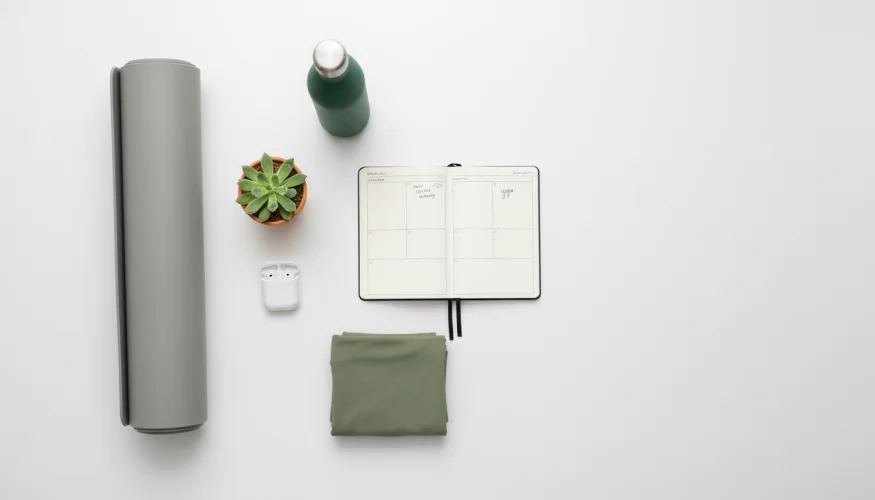
Another practical tool is preparing the environment so that movement requires as little decision-making as possible. Having sportswear laid out by the bed, a yoga mat unrolled in the living room, or trainers by the door — all of this lowers the threshold that needs to be crossed. During a demanding period, every saved unit of mental energy is precious.
It also helps to accept that a movement minimum does not need to look impressive. A short walk after lunch, a few squats while waiting for coffee, stretching in front of the computer — all of this counts. Movement does not need to be intense or structured to be meaningful. The body responds to movement as such, not to its aesthetic form.
Activities that have proven easy to incorporate even into the most overloaded schedule include:
- Walking — requires no equipment, preparation time, or specific conditions
- Stretching and mobility — can be done at home, in the office, anywhere
- Short bodyweight strength training — ten minutes of exercises such as squats, push-ups, or a plank yields real results
- Cycling as a means of transport — movement integrated into a necessary activity
- Dancing or free movement — a less structured but valid form of movement
Equally important is what surrounds the movement itself. Quality nutrition, sufficient sleep, and appropriate clothing for movement — whether functional sportswear or comfortable, eco-friendly materials — all influence how easy or difficult it is to maintain movement during a demanding period. If a person does not have comfortable and practical clothing they can quickly throw on, the psychological barrier is unnecessarily higher.
A movement minimum works best when it is part of a broader culture of self-care — not an isolated obligation, but a natural part of the rhythm of the day. This does not mean it needs to be complicated or time-consuming. On the contrary: the simpler and more accessible it is, the greater the chance it has of surviving even the most demanding weeks.
And what comes after a turbulent period? A movement minimum serves one more important function: it preserves the starting line. When calmer times return, there is no need to start from scratch. The body has maintained its basic fitness, the brain has maintained the habit, and the path back to a full movement programme is significantly shorter and easier. This is no small thing — it is, in fact, one of the greatest gifts a person can give themselves during a demanding period.