
How to Organize Your Home to Be More Practical, Calmer, and Sustainable
The household can transform into a silent to-do list that runs through your head long after the lights go out. Sometimes it's not so much about the mess as it is about things not having their place, and you end up dealing with the same things over and over every day: where are the spare batteries, where did the receipt go, why are there shirts piling up in the closet that no one wears? That's why there's increasing talk about how to organize the household so that it works for real life – not for a catalog photo. Good household organization isn't about perfectionism but about relief: less searching, less rearranging, fewer impulsive purchases "because I can't find it." And when combined with consideration for nature, it can go hand in hand with more sustainable choices.
Interestingly, order often hinges on small things. Whether the mail has one place, whether there's a basket for "things that belong upstairs," or whether cleaning is done in short bursts instead of one exhausting Saturday. And also on expectations: the household is not a museum. It's a living space where people eat, work, relax, sometimes play, and sometimes just survive a tough week. It doesn't mean giving up – just setting rules so they are sustainable for people, not just for the ideal version of oneself.
Try our natural products

How to Organize the Household to Maintain It Over Time
Many guides promise a quick transformation over the weekend. However, the household doesn't usually fall apart on a Saturday morning and doesn't get fixed with one big clean-up. Functional household organization is based on simple logic: things should be where they are used, and the system should be so easy that one can follow it even when tired. That's the real magic.
The first step is surprisingly invisible: clarifying what actually gets in the way at home. It's not always "too many things" but rather "too much decision-making." When cosmetics have three different drawers and cleaning products are half in the bathroom and half in the kitchen, friction occurs – and friction breeds disorder. A short inventory by categories, not by rooms, helps: clothing, papers, kitchen supplies, toiletries, hobbies, children's items. Categories are easier to assess because you can see how much there actually is.
Then comes a simple rule that sounds strict but is actually liberating: what doesn't have a place will lie around. The place doesn't have to be complicated. Often a box, basket, fabric bag, jar for small items, or drawer organizer is enough. It's important that the "home" for an item matches its nature: small items need boundaries, or they'll scatter. And items used daily need to be within reach, otherwise they'll start getting put aside "just for a moment" – and that moment turns into a week.
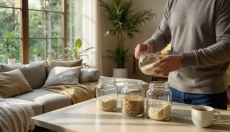
It's also very practical to think in zones. The entrance zone is typically where bags, keys, masks (formerly), and nowadays perhaps headphones or chargers accumulate. Just one extra hook, a bowl for keys, and a designated shelf for mail can immediately reduce chaos. Similarly, the kitchen works better when basic groceries (rice, legumes, oats) are in one part and baking supplies in another. Suddenly, you don't end up buying a third package of lentils just because the first two are hidden at the back.
At this point, it's worth remembering the psychology of space. Things we see "speak" to us. How the environment affects attention and stress is often discussed in more specialized contexts; for example, the World Health Organization and the topic of healthy housing can serve as a solid gateway – not because it recommends specific organizers, but because it reminds us that home is part of health. When the household is cluttered, the brain has nowhere to rest. Conversely, when the system is simple, cleaning happens almost "incidentally."
One thing is often underestimated: the outflow of things from the household. Organization isn't just about where to place things, but also about what shouldn't be at home anymore. It helps to set a natural rhythm – for instance, a small bag of items for donation once a month, a larger sorting once a quarter. And when the goal is a more sustainable life, it makes sense to send things onward: to reuse centers, swaps, charity shops, or among friends. Sometimes it's enough to remind yourself of a simple sentence that people use in various forms: "Fewer things mean fewer things to clean." And that's a truth that never ages.
Household Tips That Work Even on Weekdays
Once there's a basic system, small household tips come into play, which make the biggest difference. They aren't "before and after" tricks, but small habits that maintain order without much effort. It's often about reducing the number of steps: when the cloth for wiping the table is always in the same place, the table gets wiped immediately. When bags for sorted waste are easily accessible, sorting doesn't happen "sometime later."
The rule "one thing in, one out" works well, especially for clothes and kitchen utensils. It's not about asceticism, but about slowing down so the household doesn't fill up faster than you can live. Similarly practical is the rule "complete the cycle": when the mail is opened, immediately decide what needs attention, what belongs in the file, and what goes into sorted waste. Papers are a peculiar category – they don't look like clutter until a pile forms that starts spilling from the dresser to the table.
A big difference is made by the appearance of cleaning supplies. If the goal is not only an organized household but also a more eco-friendly one, it's worth thinking about what is consumed. Reusable cloths, a quality dish brush, refillable or concentrated products often reduce waste and simplify storage. Instead of ten bottles with similar purposes, a few more universal helpers suffice. As a useful and factual context for what "less chemistry" actually means and why composition matters, the European Chemicals Agency (ECHA) can serve, as it has long explained how substances are evaluated and labeled. It's not necessary to read studies – just knowing that label orientation and product simplicity make sense.
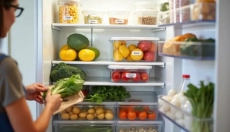
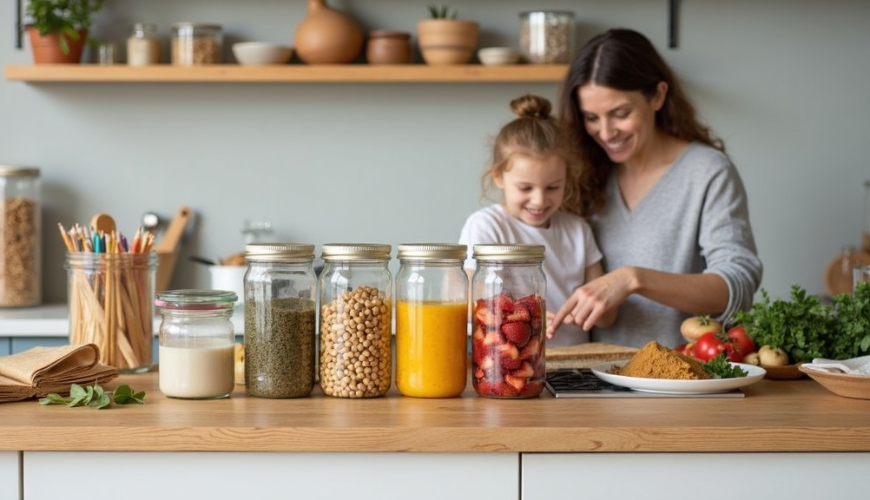
Then there's the kitchen, a place where organization manifests quickly. When groceries are in transparent jars or containers, you see what's running low. When there's a "rescue" shelf in the fridge for foods that need to be eaten soon, less is wasted. And when each group of items has its place, cooking is smoother – not because you're a better cook, but because there are fewer interruptions from searching.
A real-life example shows how little is sometimes needed. In a typical household with children, the situation often repeats: gloves are searched for in the morning, homework in the afternoon, a charger in the evening. In one such family, the problem was surprisingly simply solved: an "drop-off station" was created at the entrance – a bench with baskets where each family member has their space for a hat, gloves, and scarf, and next to it a bowl for keys. A small box for chargers and minor electronics was added in the living room to keep them from lying around the house. And in the kitchen, a drawer was introduced "just for school": scissors, glue, a notebook for notes, crayons. Suddenly, not only order changed, but also the atmosphere. Mornings no longer lost five minutes searching, and evenings didn't involve small home detective stories. Such changes are subtle but save energy every day.
When thinking about organization, bathrooms are often forgotten. Yet, a lot of visual chaos arises there: small items, bottles, bands, samples. It's helpful to do an "edit" of what's actually used. Everyday items can be in one compartment, the rest stored higher or in a closed box. And if the household aspires to be more eco-friendly, the bathroom is a great place for gradual changes: solid shampoos, reusable makeup remover pads, refillable soaps. Organization and sustainability naturally intersect here, as fewer packages often mean fewer items lying around the sink.
And what about cleaning itself? Instead of big plans that aren't followed, the rhythm of short blocks works. Ten minutes a day does more than three hours once every two weeks because the mess doesn't have time to "bake in." It's very effective to combine cleaning with something already happening: wiping the counter after morning coffee, quickly squeegeeing the water after a shower, unloading the dishwasher while waiting for the kettle. These are small things, but they make the difference between a household that's constantly catching up and one that's maintained.
If there were to be only one list worth having on display, it would be short, subtle – and realistic:
- One place for keys and mail, to avoid searching and piling up
- One "rescue" box for items that need to be returned to their place (and empty it once a day)
- One zone for supplies in the kitchen and one for toiletries, so you don't buy twice
- One small outflow of items: a donation bag, a box for electronic waste, a bag for textiles
Such a list isn't about discipline, but about giving the household clear signals: this belongs here, this doesn't. And once the system settles, it becomes pleasantly natural.
Household Organization as Part of a Sustainable Lifestyle
Orderliness has another aspect that's talked about less: it can also ease the burden on the planet. Not because a tidy shelf will save the world, but because household organization reduces unnecessary consumption. When you can see what's already at home, fewer duplicates are purchased. When food is organized, less is wasted. When the household has a system for sorting, recycling happens automatically, not "when there's time."
In practice, this often looks like people first looking for "better products" – and only then realizing they're missing a simple order. Yet, the order can be reversed: set up the system first, then add to it. For example, when space is freed up in the bathroom by removing unused bottles, it's suddenly easier to switch to a few quality items and store them without obstruction. When order is made in kitchen supplies, it makes sense to shop with your own containers or use package-free options because there's a place to store it. And when a spot is created at home for repairable items – a button waiting to be sewn on, or a zipper to be fixed – the odds of clothes unnecessarily ending up in the trash are reduced.
Sustainable organization also has one pleasant trait: it's visually calm. Instead of disposable plastic containers, jars, fabric bags, baskets made of natural materials, or reused boxes often work. It's not about aesthetics for aesthetics' sake, but about things lasting and not needing constant replacement. And when something is acquired, it's worth choosing helpers that will endure more than one season – quality hangers, sturdy containers, organizers that can be rearranged.
Perhaps the most important is the approach: the household is organized for life, not life for the household. Some days will be chaotic, and that's okay. A well-set system is recognized by how easily it can be restored. That when laundry piles up, there's a clear process to return to normal. That when guests come over, there's no need to frantically hide things in closets because closets are no longer the last refuge of chaos.
Thus, the question "how to organize the household" ultimately simplifies: it's about creating an environment that supports good habits and doesn't require constant willpower. When every item has its place, when there are a few smart routines, and when things don't unnecessarily accumulate at home, order stops being a project. It becomes a natural part of the day – just like brewing tea or opening a window wide for fresh air to enter the home. And isn't it actually one of the most pleasant feelings when a home, instead of adding stress, offers a quiet "this is a place where you can breathe"?