

# Where to Look for Omega-3 Beyond Fish and Why We're Lacking It
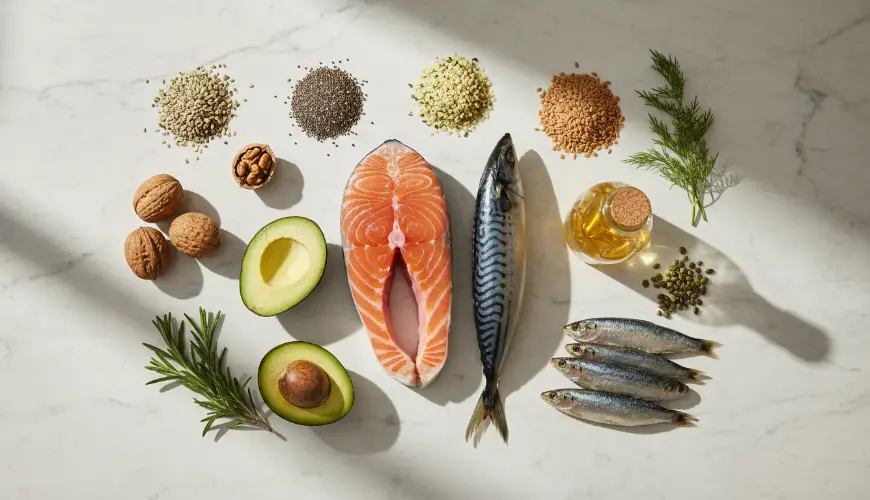
Omega-3 fatty acids are among those nutrients that most people have heard of at least once, but few realize what a fundamental role they play in the body's daily functioning. Even fewer people are aware that the Czech population is among those in European comparison that consume significantly less than would be desirable. And yet it's not just about eating more fish – there is a whole range of other sources that deserve attention.
The story of omega-3 fatty acids begins with a paradox. We live in an era when we have access to an enormous amount of information about nutrition, supermarket shelves are bending under the supply of dietary supplements and functional foods, and yet most Czechs consume omega-3 in amounts that don't even reach half of the recommended values. According to data from the State Health Institute and surveys of the Czech population's dietary habits, the average fish consumption in the Czech Republic is around four to five kilograms per person per year. For comparison – in neighboring Germany it's roughly double, and in coastal countries like Portugal or Iceland, consumption is around fifty or more kilograms. Fish, meanwhile, represent historically the best-known and most concentrated source of long-chain omega-3 fatty acids, specifically EPA (eicosapentaenoic acid) and DHA (docosahexaenoic acid).
There are several reasons why Czech omega-3 consumption is so low, and they are intertwined. The Czech Republic is a landlocked country without access to the sea, which has historically shaped the diet of the local population. Traditional Czech cuisine is built on pork, dumplings, sauces, and fatty cheeses – foods rich in saturated fats and omega-6 fatty acids, while omega-3 remains on the margins of attention. Carp, which regularly appears on Czech tables at Christmas, is a freshwater fish, but its omega-3 content is relatively modest compared to marine fish such as salmon, mackerel, or sardines. Add to that the price factor – quality marine fish are more expensive in Czech stores than in coastal countries, which represents a barrier for many households.
But the problem isn't just about fish. The overall shift in dietary habits in recent decades toward highly processed foods, refined vegetable oils (especially sunflower and soybean), and fast food has led to a dramatic disruption of the omega-6 to omega-3 fatty acid ratio in the diet. While the ideal ratio should be somewhere around 2:1 to 4:1, in the real Czech diet we commonly encounter a ratio of 15:1, sometimes even 20:1. This imbalance is not just an academic curiosity – it has entirely concrete health impacts.
Try our natural products

Why omega-3 fatty acids are so important and what happens when they're missing
Omega-3 fatty acids are classified as essential nutrients, meaning the human body cannot produce them on its own and must obtain them from food. Their role in the body is remarkably broad. DHA forms a significant component of cell membranes in the brain and the retina of the eye, where it participates in the transmission of nerve signals and the processing of visual information. EPA, in turn, plays a key role in regulating inflammatory processes in the body – it functions as a kind of natural anti-inflammatory mechanism.
Scientific studies repeatedly confirm the connection between adequate omega-3 intake and a lower risk of cardiovascular diseases. The American Heart Association (AHA) recommends consuming fish at least twice a week precisely for the protection of the heart and blood vessels. Meta-analyses published in prestigious journals such as The Lancet or JAMA show that people with higher omega-3 intake have a statistically lower risk of myocardial infarction, stroke, and other cardiovascular events. But heart health is just the tip of the iceberg.
Omega-3 deficiency also manifests in the area of mental health. Research suggests a connection between low levels of DHA and EPA and a higher incidence of depressive disorders, anxiety, and cognitive decline in old age. For pregnant women, adequate DHA intake is crucial for the proper development of the fetal brain and nervous system – the European Food Safety Authority (EFSA) recommends that pregnant and breastfeeding women consume an additional 200 mg of DHA daily beyond the standard recommendation. And it is precisely in the Czech Republic, where fish consumption is so low, that this group may be particularly at risk.
Then there is chronic inflammation – a silent, inconspicuous process that takes place in the body for years without a person feeling anything, yet it stands behind a range of civilization diseases from type 2 diabetes through autoimmune diseases to certain types of cancer. Omega-3 fatty acids help regulate this type of inflammation and keep it under control. When omega-6 predominates over omega-3 in the body, the balance shifts in favor of pro-inflammatory processes. As Professor Andrew Stoll of Harvard Medical School aptly summarized: "Omega-3 fatty acids are not a cure-all, but their deficiency is one of the most underestimated risk factors of the modern era."
So if Czechs eat few fish and at the same time consume an excess of omega-6 from common vegetable oils and processed foods, a situation arises that practically calls for a solution. And here comes the more interesting part – where can you actually find omega-3 if fish aren't part of your daily diet?
Omega-3 beyond fish: surprisingly rich sources you might already have in your kitchen
When you say omega-3, most people automatically picture a salmon steak or fish oil capsules. However, the plant kingdom offers a whole range of sources worth attention – albeit with one important caveat. Plant sources predominantly contain ALA (alpha-linolenic acid), which the body must first convert into the more active forms EPA and DHA. The efficiency of this conversion is unfortunately quite low, estimated at only 5–10%, and in some individuals even less. But that doesn't mean plant sources are worthless – ALA has its own health benefits, and with sufficient intake, it can significantly contribute to the overall omega-3 balance.
Flaxseeds and flaxseed oil are among the absolute champions of plant-based omega-3 sources. One tablespoon of ground flaxseeds contains approximately 1.6 grams of ALA, which exceeds the recommended daily intake. Simply add them to your morning porridge, yogurt, or smoothie. Flaxseed oil is even more concentrated, but it needs to be stored in the refrigerator and not used for cooking, because omega-3 fatty acids are sensitive to high temperatures and oxidize easily.
Chia seeds have become a popular superfood in recent years, and rightly so – two tablespoons contain around five grams of ALA. Moreover, they are rich in fiber, calcium, and antioxidants. Like flaxseeds, they can be easily incorporated into a regular diet.
A lesser-known but exceptionally valuable source is hemp seeds. In addition to omega-3, they also contain omega-6 in a ratio close to ideal, which is quite rare among plant oils. Hemp oil thus deserves a place in the kitchen as a salad dressing or an addition to cold dishes.
Walnuts are another easily accessible source – a handful of walnuts a day (about 30 grams) provides approximately 2.5 grams of ALA. Unlike other nuts, which contain predominantly omega-6, walnuts have a significantly more favorable ratio. And what's important, walnuts are commonly available in the Czech Republic and reasonably priced.
An interesting alternative that overcomes the limitations of plant sources is algae and algae oils. Algae are in fact the original source of omega-3 for fish themselves – fish don't produce omega-3 but obtain it precisely from algae in the food chain. Dietary supplements based on algae oil thus provide EPA and DHA directly without the need to consume fish, which is a solution of interest not only for vegans and vegetarians but also for anyone who simply doesn't like fish or can't afford to buy it regularly.
Let's imagine a specific situation. Mrs. Markéta from Brno is a mother of two children, works full-time, and her family doesn't eat much fish – the children refuse it and her husband prefers classic Czech dishes. When Markéta became interested in omega-3 after reading an article about their effect on children's concentration at school, she started adding ground flaxseeds and chia seeds to her morning oatmeal. For salads, she started using hemp oil instead of sunflower oil. And for herself, she got algae oil capsules as a dietary supplement. No radical lifestyle change, no expensive exotic foods – just a few small adjustments that, taken together, can make a fundamental difference.
It is precisely this approach – gradual, gentle incorporation of omega-3 sources into a regular diet – that proves to be the most sustainable strategy. Most people cannot maintain radical diets and strict meal plans long-term, but adding a spoonful of seeds to porridge or switching the oil on a salad is something practically anyone can do.
There is one more aspect worth mentioning. The quality of omega-3 in foods depends on how they are processed and stored. Omega-3 fatty acids are highly unstable and prone to oxidation, which means that improper storage or heat treatment can significantly reduce their content. Oils rich in omega-3 should be cold-pressed, stored in dark bottles in the refrigerator, and consumed as soon as possible after opening. Nuts and seeds should not be exposed to light and heat for prolonged periods. And if someone does eat fish, it's better to choose gentle preparation methods – baking, stewing, or steaming rather than frying in a pan with hot oil.
For those considering dietary supplements, it's important to pay attention to the quality and purity of the product. Fish oil should list the EPA and DHA content (not just total omega-3 content), should be tested for heavy metals, and should have independent laboratory certification. Similar rules apply to algae oils. A cheap supplement with unclear composition can do more harm than good – oxidized fish oil is paradoxically a source of free radicals instead of health benefits.
In conclusion, it's worth remembering that omega-3 fatty acids are not an isolated element – they work best in the context of an overall balanced diet rich in vegetables, fruits, whole grains, legumes, and quality proteins. No single nutrient can save health on its own, but omega-3 is among those whose chronic deficiency can have far-reaching consequences. And in the Czech basin, where the tradition of landlocked cuisine and modern dietary habits conspire to keep omega-3 intake as low as possible, it's worth paying a bit more attention to this topic than we have been accustomed to.