

# Exercises for Deep Neck Muscles Against Headaches

Headache is one of the most common health complaints of modern times. According to the World Health Organization, nearly half of the adult population worldwide suffers from recurring headaches. Yet a large proportion of these headaches do not originate in the brain or internal organs, but surprisingly — in the neck. Specifically, in the deep muscles of the cervical spine, which most people never consciously exercise, yet strain every single day.
Just picture a typical workday: eight hours in front of a monitor, head slightly pushed forward, shoulders pulled up, neck under constant tension. Every centimetre the head moves forward from the body's axis increases the effective load on the cervical spine by approximately four to five kilograms. With a forward shift of just five centimetres, the neck muscles bear a load equivalent to nearly thirty kilograms — continuously, hour after hour. No wonder the deep neck muscles gradually lose their function and headache becomes a daily companion.
Try our natural products





Why deep neck muscles cause headaches
Not everyone knows that there is a direct anatomical connection between neck tension and headaches. The deep neck flexors — muscles positioned closely along the cervical spine — are responsible for stabilising the head and keeping it balanced over the body. When these muscles weaken or shorten, the superficial muscles take over their work, such as the trapezius muscle or the levator scapulae. However, these muscles are not built for such loads. They become overloaded, stiffen, and begin to refer pain into the head, temples, behind the eyes, or into the back of the skull — this is known as cervicogenic headache, meaning headache originating from the cervical region.
This is precisely why exercise focused on strengthening and releasing the deep neck muscles is proving to be one of the most effective non-pharmacological methods for relieving or entirely preventing this type of headache. Physiotherapists and neurologists are increasingly agreeing on this fact, and cervical spine exercise is becoming a standard component of rehabilitation programmes for patients suffering from chronic headaches.
One example is a thirty-year-old office worker who suffered from recurring headaches almost every week. After visiting a physiotherapist, she discovered that the cause was not stress or dehydration — as she had originally assumed — but weakened deep neck muscles and significantly shortened superficial neck muscles. After six weeks of regular exercise, which took only ten to fifteen minutes per day, the frequency of her headaches decreased to a minimum.
It is important to understand that this is not a coincidental connection. The deep neck muscles form a kind of internal support for the cervical spine, much like the deep abdominal muscles form support for the lumbar spine. If this internal support fails, the entire area becomes unstable, overloaded, and painful. And the pain then spreads exactly where we least expect it — into the head.
Specific exercises for the deep neck muscles
The good news is that exercising the deep neck muscles requires no equipment or gym membership. They can be performed at home, in the office, even in a car while waiting at a traffic light. The key is not intensity, but regularity and correct execution. As leading Czech physiotherapist Pavel Kolář says: "Movement is the best medicine, but only when performed correctly."
The foundation is the so-called cervical nodding movement, or chin tuck, referred to in Czech as "zasunutí brady" (tucking the chin). It is performed sitting or standing: the chin is slowly drawn back and slightly downward, as if the person wanted to create a double chin. The movement should be smooth and free of tension. In this way, the deep neck flexors are activated while the shortened superficial neck muscles are simultaneously stretched. The exercise is recommended to be repeated ten times and performed three times a day, with each position held for approximately five seconds.
Another effective exercise is isometric resistance, in which the muscles are activated without visible movement. The palm is placed on the forehead and the head gently pushes into the palm, while the palm resists and the head remains stationary. The same principle can be applied from the side — palm against the temple, head pressing sideways, palm resisting. This type of exercise strengthens the muscles very effectively, as it forces them to work at their full strength capacity without any joint movement occurring. Isometric exercises are particularly suitable for people who have a sensitive or painful neck, as they do not provoke additional movement stimuli that could worsen the pain.
Equally important is stretching the short neck extensors — the small muscles at the base of the skull — which, when overloaded, directly cause pain in the back of the head and behind the eyes. It is performed simply: the chin is drawn back and the head tilts slightly forward, as if the person wanted to read text on their chest. The sensation of stretching should be felt precisely where the skull meets the neck. The exercise is held for twenty to thirty seconds and repeated three times.
An interesting complement is exercising the mobility of the upper cervical spine through slow rotations. The head turns slowly from side to side, but the movement originates from the deepest part of the neck, not from the superficial muscles. Visually, it is the same movement as turning the head, but conscious attention is directed inward — toward the sensation of the vertebrae moving, rather than toward the contraction of superficial muscles. This approach, referred to in rehabilitation as "motor re-education," helps restore correct movement patterns that have been lost through poor habits.
For completeness, it is worth mentioning the release of the suboccipital muscles through self-therapy. These small muscles lie just beneath the skull and are one of the most common sources of tension headaches. They can be released by lying on one's back, supporting the back of the head with two tennis balls placed inside a sock, and allowing the weight of the head to naturally press against the balls. Simply lying quietly for five to ten minutes allows the muscles to gradually release. It is a simple yet surprisingly effective way to help oneself.
To make the overview of exercises clear and easy to remember, they can be summarised as follows:
- Chin tuck — 3× daily, 10 repetitions, hold for 5 seconds
- Isometric resistance from the front and side — 3× daily, 10 repetitions, hold for 5 seconds
- Stretching the short neck extensors — 3× daily, hold for 20–30 seconds
- Slow rotations with conscious attention — 2× daily, 10 repetitions on each side
- Tennis ball self-therapy — 1× daily, 5–10 minutes
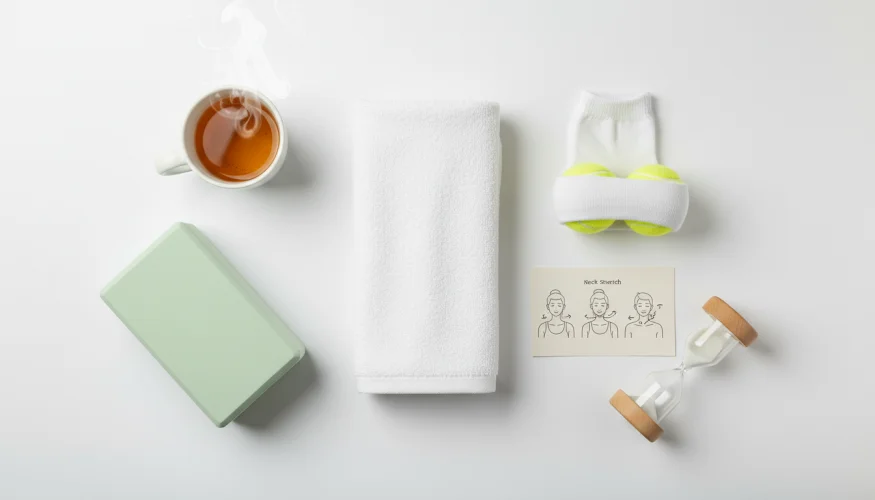
How to incorporate exercise into everyday life
Knowing the exercises is one thing, but real change only comes from performing them regularly. And this is precisely where most people fail — not because the exercises are demanding, but because they forget about them. A tried-and-tested trick is to attach the exercises to existing habits. The chin tuck can be performed every time you wait for a page to load in your browser. Isometric resistance is something anyone can manage during their morning coffee. Neck stretching is ideally incorporated as part of a morning or evening routine.
Regularity is more important than the duration of exercise. Ten minutes a day over six weeks will produce significantly better results than an hour of exercise once a week. The brain and muscles need repetition to build new movement patterns and strengthen weakened structures.
Alongside the exercises themselves, it is worth paying attention to the ergonomics of your workstation. The monitor should be at eye level so the head does not need to tilt down or back. The keyboard and mouse should be positioned so that the shoulders remain relaxed. These seemingly minor details have a significant impact on the health of the cervical spine — and together with regular exercise, they form the foundation of cervicogenic headache prevention.
It is also interesting to note that research published in the Journal of Orthopaedic & Sports Physical Therapy has repeatedly confirmed that the combination of deep neck muscle strengthening with mobilisation techniques leads to more pronounced and longer-lasting improvement in patients with cervicogenic headaches than the use of analgesics alone. Movement truly does heal — and in this case, directly at the source of the problem.
It is important to distinguish when self-directed exercise is appropriate and when it is instead necessary to seek professional help. If a headache is very intense, sudden, or accompanied by other symptoms such as visual disturbances, dizziness, or tingling in the hands, consultation with a doctor should always come first. The exercises described in this article are intended for common tension and cervicogenic headaches, not for conditions requiring medical intervention.
For those seeking a comprehensive approach to musculoskeletal health, it may also be helpful to turn to supportive products — whether ergonomic aids that help maintain correct posture, or natural preparations supporting muscle tissue recovery. The health of the neck and spine is not just a matter of exercise, but of overall lifestyle — movement, sleep, nutrition, and a conscious approach to one's own body.
Headache does not have to be a fate that one simply learns to live with. Often, all it takes is devoting a few minutes each day to muscles that work silently throughout life — and only when they fail do they make themselves known in the loudest way possible.