
What is friluftsliv or the Scandinavian philosophy of spending time outdoors
There is a word that Scandinavians use for something that other nations struggle to describe in a single expression. Friluftsliv – a Norwegian concept that could be translated as "life in the fresh air" or "free life in nature" – is not merely a hobby or a social media trend. It is a way of thinking, a deeply rooted attitude toward the world that says: nature is not a place you visit on weekends. It is a home to which we belong every day, in all weather, in every season.
While Czech culture has a warm relationship with nature – think of the tradition of cottage life or mushroom picking – the Scandinavian approach goes one step further. In Sweden, Norway and Denmark, a walk in the rain is neither an exception nor a heroic act. It is simply part of the day, as natural as breakfast or a morning coffee. And it is precisely this matter-of-factness, this quiet everyday quality, that experts consider one of the keys to the mental wellbeing that Scandinavians have maintained at a remarkably high level over the long term.
Try our natural products


What friluftsliv actually means and where it comes from
The word friluftsliv was first used by the Norwegian playwright and writer Henrik Ibsen in a poem from 1859. Ibsen used it to describe the liberating feeling a person experiences when leaving the cramped urban environment and heading out into open countryside. Since then, the concept has become part of Scandinavian identity – so much so that Norway has a law called allemannsretten, meaning "the right of all", which guarantees access to nature for everyone without distinction. Anyone may freely walk through forests, camp on uncultivated land or swim in lakes, regardless of who owns the land. Nature is not a private luxury – it is a shared heritage.
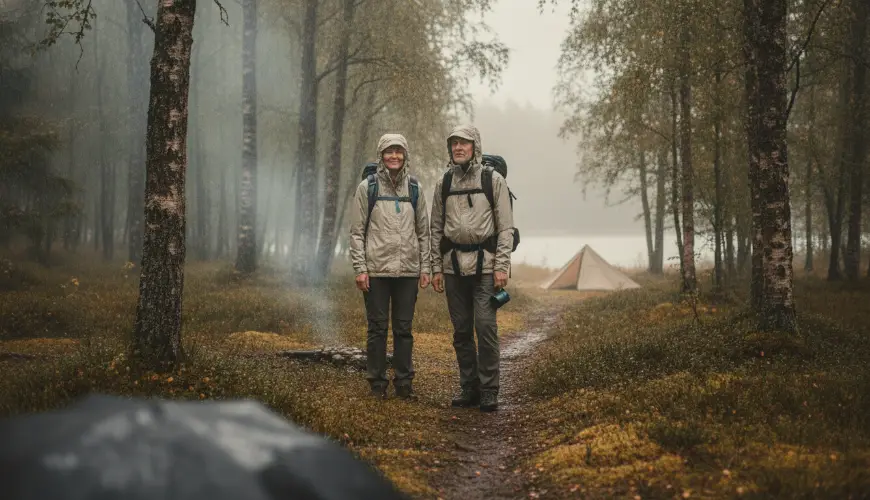
This philosophy differs from what most people in the Western world imagine when they think of "spending time in nature". Friluftsliv is not about performance, conquering summits or Instagram photographs on a rocky cliff. It is more about quiet presence – sitting by a fire, listening to rain drumming on a tent, wading through a bog or simply standing in a forest and letting the mind wander freely. The key is not adrenaline, but calm.
This distinction is fundamental, because it is here that the therapeutic power of the Scandinavian approach lies. The modern world bombards us with stimuli, challenges and a constant need to be productive. Friluftsliv offers a counterbalance – a space where nothing needs to be proved and where the value of a moment lies not in sharing it, but in experiencing it.
An interesting example comes from a research project in the Norwegian city of Bergen, where local psychiatric clinics began incorporating regular nature excursions into their treatment programmes. Patients with severe depression and anxiety disorders who participated in weekly group walks in the surrounding countryside showed marked improvement in mood and a reduction in depressive symptoms after eight weeks – even compared to groups receiving only pharmacological treatment. Nature did not function here as a supplement to therapy. It became the therapy itself.
The science behind why nature heals
It would be easy to dismiss friluftsliv as a romantic myth or a cultural peculiarity of the Nordic nations. Yet the scientific evidence speaks clearly and with an ever-louder voice. Research from the past two decades shows that regular time spent in natural environments has measurable positive effects on the brain, body and psyche.
The Japanese concept of shinrin-yoku – "forest bathing" – has been extensively studied by scientists at Nippon Medical School in Tokyo. Results published in the prestigious journal Environmental Health and Preventive Medicine showed that just two hours of walking in a forest reduces cortisol levels (the stress hormone), slows the heart rate and strengthens the immune system. Nature literally changes the chemistry of our bodies.
Behind this effect are, among other things, phytoncides – volatile substances that trees release into the air as a natural defence against bacteria and fungi. When humans inhale them, their natural killer cells of the immune system are activated. But it is not only about biochemistry. It is also about how nature influences attention and thinking.
American psychologist William James distinguished between two types of attention: directed attention, which requires concentration and effort, and involuntary attention, which is activated spontaneously in response to natural stimuli – the sound of water, the movement of leaves, birdsong. The attention restoration theory, developed by psychologists Rachel and Stephen Kaplan at the University of Michigan, argues that nature heals us precisely because it activates involuntary attention and allows directed attention – the kind that becomes depleted through work and city life – to rest. The result is a feeling of mental freshness and emotional balance familiar to anyone who has ever returned from an extended stay in nature.
As Norwegian philosopher Arne Næss, one of the pioneers of deep ecology, said: "Nature is not out there. Nature is us." This sentence may sound like poetic hyperbole, but neuroscience is increasingly confirming it. The human brain evolved over hundreds of thousands of years in a natural environment, and only in the last few hundred years – and particularly in the last few decades – has it been spending most of its time in an artificial, digital world. It is little wonder that it does not always feel at home there.
Depression and anxiety disorders are today the most widespread mental illnesses in the world. According to the World Health Organization, more than 280 million people suffer from depression. Yet studies repeatedly show that people living near greenery, parks or natural areas have a statistically lower incidence of depressive episodes and cope better with stress. Friluftsliv offers an accessible and inexpensive response to the mental health crisis that is also affecting the Czech Republic.
How to bring the Scandinavian approach into Czech life
You do not need to move to Norway or invest in expensive outdoor equipment to live in the spirit of friluftsliv. The essence of this approach is in fact very simple and democratic – accessible to anyone regardless of age, fitness or financial means.
The basic principle is: go outside, regularly, in all weather. Scandinavians have a saying that goes roughly like this: "There is no such thing as bad weather, only bad clothing." This mentality is key. Friluftsliv does not depend on conditions – it does not wait for the perfect sunny day, for a holiday or for the weekend. It is an everyday practice, not an occasional escape.
Consider the example of Markéta, a thirty-year-old teacher from Brno, who after reading an article about friluftsliv began getting up half an hour earlier each morning to take a short walk in a nearby park – without her phone, without headphones, without any specific destination. At first it seemed pointless and a little dull to her. After three weeks she noticed that she was waking up more easily, was less troubled by anxious thoughts and was concentrating better at work. She had done nothing revolutionary. She simply went outside.
Friluftsliv can be practised in many ways that naturally suit the Czech environment and traditions:
- Walks without a specific destination – wandering through a forest or across fields without a map and without time pressure
- Mushroom picking and herb gathering – a traditional Czech activity that is in fact friluftsliv in its purest form
- Outdoor breakfast or lunch – eating in nature, even just in a garden or park, changes the way we experience it
- Observing nature – watching birds, following clouds, listening to the sounds of the forest without any need to document anything
- Night walks – less common, but extraordinarily effective for restoring contact with the natural rhythms of the world
It is important to abandon the performance mentality. Friluftsliv is not about how many kilometres you walk or how many calories you burn. It is about the quality of presence, not the quantity of movement. This shift in thinking – from performance to experience – is perhaps the most difficult, yet also the most valuable, thing that Scandinavian philosophy has to offer.
For those who wish to go further, there are growing communities in the Czech Republic focused on mindful time in nature, forest therapy or so-called "forest bathing" following the Japanese model. A number of psychotherapists and coaches now work outdoors – sessions take place while walking in the forest rather than in office chairs, and the results are, by their own account, surprisingly good.
For most of human existence, nature was our natural environment. Only recently have we become detached from it – and we are paying the price in the form of growing anxiety, burnout and depression. Friluftsliv brings us nothing new. It simply reminds us of what we have always known but gradually forgotten: that trees, wind, rain and the silence of the countryside possess a power that surpasses any app, any wellness trend and any pill. And the best part is that this power is freely available – you only need to open the door and step outside.