

Soup as lunch is a full-fledged meal that will fill you up and provide your body with all the necess
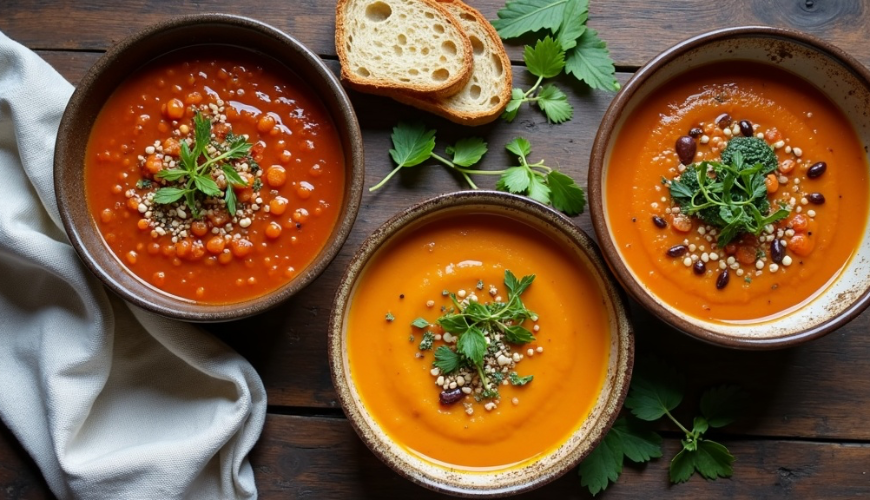
There is a food that can warm you up in winter, refresh you in summer, satisfy you after a hard day, and still give your body everything it needs. It's not some novelty or trendy fad – it's ordinary soup. But the word "ordinary" actually does it an injustice. Soup as lunch is neither a concession nor an emergency solution. It's a complete meal with a tradition stretching back thousands of years, and with potential that many people still don't fully realize.
In Czech cuisine, soup has always held a privileged position. Lunch without soup was as if it weren't lunch at all – that's what our grandmothers used to say, and they were profoundly right. But usually it was an appetizer, a first course, after which "the main thing" came. What if soup itself were the main thing? What if a single bowl of thick, fragrant broth with a hearty portion of vegetables, legumes, and quality protein were enough as an entire lunch?
This is exactly the direction more and more people are heading who are looking for a balanced diet without unnecessary complexity. And they have compelling reasons – from saving time to better digestion to financial savings. Let's take a look at why soup as a complete meal makes sense, how to prepare it so it truly satisfies, and where to find inspiration for nutritious soup recipes that will become a permanent part of your menu.
Try our natural products






Why Soup Is More Than Just an Appetizer
The notion that soup is "just water with vegetables" is one of the most persistent myths of Czech gastronomy. In reality, a well-prepared soup is one of the most nutritionally complete meals imaginable. Bone broth contains collagen, minerals, and amino acids. Legumes provide plant protein and fiber. Vegetables bring vitamins and antioxidants. And if you add whole-grain pasta, potatoes, or barley, you also have quality complex carbohydrates that will maintain stable energy levels throughout the afternoon.
Studies published in the scientific journal Appetite showed that people who eat soup as a main course tend to consume fewer total calories during the day while feeling more satiated. The high water content in soup helps stretch the stomach walls, which sends satiety signals to the brain sooner than when we eat dry food. This doesn't mean soup is a diet trick – it means it is naturally gentle on the digestive system while still being able to provide all the necessary nutrients.
The cultural context is also interesting. In many Asian cuisines – Vietnamese, Japanese, Korean – soup is a perfectly common main course. Vietnamese phở, Japanese ramen, or Korean kimchi jjigae are not light appetizers. They are hearty, complex bowls full of flavors, textures, and nutrients. And no one in these countries doubts that soup can be a complete lunch. As Harvard T.H. Chan School of Public Health notes, diversity of ingredients in a single meal is one of the keys to healthy eating – and soup offers this diversity like few other dishes can.
But we don't need to go all the way to Asia. Just think of Czech potato soup with mushrooms, which is so thick that you truly don't need anything else after it. Or bean soup with smoked meat, which everyone coming in from the frost appreciates in winter. These recipes for nutritious soups have existed in Czech tradition since time immemorial – we've just somewhat forgotten them in favor of schnitzels and dumplings.
A young family from Brno, Markéta and Tomáš, started experimenting with soups as a main meal two years ago after their second child was born. "We didn't have time to cook two-course lunches, but we didn't want to eat just convenience foods either," Markéta describes her experience. They started with simple recipes – lentil soup with carrot and caraway, creamy broccoli with cheese, minestrone full of seasonal vegetables. They gradually discovered that the kids love soups, preparation takes a fraction of the time compared to a traditional lunch, and the whole family feels better. "What surprised us most was that we stopped having the afternoon slump. After soup we have energy, but not that heavy feeling like after fried food," Tomáš adds. Their story is not unique – more and more Czech households are discovering that soup as lunch is a practical, healthy, and surprisingly satisfying solution.
How to Prepare Hearty and Balanced Soups
The key to making soup truly replace an entire lunch lies in balancing macronutrients. It's not enough to reach for a light vegetable broth – you need to think about proteins, healthy fats, and carbohydrates, which together ensure long-lasting satiety. Tips for hearty and balanced soups can be summarized in a few simple principles that work universally, whether you're cooking for one or for the whole family.
The foundation is quality broth. Whether it's bone broth simmered for several hours, a vegetable stock from root vegetables, or a quick broth from miso paste – a good base is half the battle. Bone broth is exceptionally rich in minerals such as calcium, magnesium, and phosphorus, and it also contains gelatin, which supports joint and gut health. Those who don't have time to make broth from scratch can prepare it in larger quantities and freeze it in portions for later.
Protein is essential. A soup that is meant to replace an entire lunch needs a source of protein. This can be chicken, beef, fish, eggs, tofu, tempeh, or legumes – lentils, beans, chickpeas. Legumes are absolutely ideal in this regard, because in addition to protein they also provide fiber and complex carbohydrates. Red lentils also cook down to a creamy consistency in fifteen minutes, making them a perfect ingredient for quick nutritious soup recipes.
Vegetables in abundant quantities. The rule here is: the more colorful, the better. Carrots, celery, parsley root, potatoes, sweet potatoes, squash, kale, spinach, tomatoes, peppers – each vegetable brings different vitamins and minerals. Seasonal vegetables are also cheaper and tastier. In autumn and winter, squash and root vegetables reign supreme, while in spring and summer it's peas, zucchini, and fresh herbs.
Healthy fats add flavor and satiety. A spoonful of quality olive oil, a teaspoon of ghee, or a splash of coconut milk can transform a soup. Fats also help absorb fat-soluble vitamins (A, D, E, K), so it's not just about taste but also about better utilization of nutrients from the entire dish. A few drops of sesame oil at the end, a handful of toasted seeds, or slices of avocado – these are all simple ways to enrich a soup.
Carbohydrates for energy. Potatoes, sweet potatoes, whole-grain pasta, rice, barley, buckwheat, or a piece of quality bread alongside the soup – these are energy sources that ensure you won't deplete your glycogen stores within an hour after lunch. Those who avoid gluten can reach for buckwheat bread or rice noodles.
For inspiration, it's worth checking out the recipe database on the Cookpad website, where Czech home cooks share hundreds of tried-and-tested soup recipes, or classic Czech cookbooks that offer proven ingredient combinations. Those looking for a more modern approach will find rich inspiration in books focused on nutrition and healthy cooking – for example, in the publications of Czech nutritional therapist Margit Slimáková, who has long promoted simple, balanced eating based on real foods.
As the famous French chef Auguste Escoffier said: "Soup is to dinner what an overture is to an opera – not just a beginning, but a promise of what is to come." In the case of soup as a main course, that promise is satiety, comfort, and a good feeling from food that truly benefits the body.
The practical side of things is also worth mentioning. Soup is actually one of the most economical meals of all. A kilogram of lentils costs around thirty crowns and lasts for several servings. Root vegetables are just a few crowns when in season. Bone broth can be made from bones that would otherwise end up in the bin. And one large batch of soup lasts three to four days in the refrigerator or can be easily frozen. For families, individuals, and students alike, it's a solution that saves time, money, and energy – without compromising the quality of the diet in any way.
Soup has yet another quality that is increasingly valued in today's hectic times: it's a food that slows you down. You can't wolf down soup standing up in three minutes like a sandwich. It requires a spoon, a bowl, a moment of calm. And it is precisely this slowing down, this small ritual in the middle of the day, that has value not only for the body but also for the mind. In an age when many people eat lunch at their computers or behind the wheel, a bowl of warm soup can represent a moment of mindful pause that helps with better digestion and an overall sense of well-being.
For those who want to start with soups as a main meal, a simple plan presents itself: try it three times a week for one month. Start with tried-and-true classics – potato soup, lentil soup, goulash soup, or creamy pumpkin soup – and gradually experiment with new ingredients and cuisines. Add a quality piece of bread to the soup, perhaps whole-grain or rye, and fresh herbs as a garnish. Observe how the feeling after eating changes, your energy level, and overall satisfaction with your diet.
Soup as a complete meal is not a compromise. It's a choice – conscious, smart, and surprisingly easy. In a time when healthy eating is often presented as a complicated, expensive, and time-consuming affair, soup comes with a simple message: all you need is a pot, a few quality ingredients, and a little patience. And the result? A warm, fragrant bowl that nourishes body and soul and reminds us that good food doesn't have to be complicated – it just needs to be prepared with thought and from honest ingredients.