
# How to Save a Burnt Pot Without Scrubbing

Everyone who cooks regularly knows it. A moment of inattention, a phone call at the wrong time, or simply a flame that's too high – and the result is a pot with a black layer of burnt residue on the bottom that seems practically impossible to remove. Panic, the first instinct to reach for a wire scrubber, and hours of scraping are fortunately unnecessary. Saving a burnt pot without hard work is actually much easier than it might seem, and the right techniques can save not only your nerves but the cookware itself.
Burnt food leaves carbonised residue on the bottom of the pot that chemically bonds to the surface of the metal or enamelled cookware. The longer the residue dries and hardens, the more difficult it is to remove – but even that doesn't mean the situation is hopeless. The key to success is choosing the right method based on what material the pot is made of, and above all, having a little patience.
Try our natural products
-1-m.jpg)
-1-m.jpg)
-1-m.jpg)
-1-m.jpg)
-1-m.jpg)
Why wire scrubbers and brute force aren't the solution
Before we get into specific tricks, it's worth understanding why aggressive scraping is the worst thing you can do. A wire scrubber will visually remove the burnt residue, but it will also scratch the surface of the pot – whether it's stainless steel, enamel, or a non-stick coating. Each scratch then creates microscopic grooves where food catches even more easily than before, and the whole cycle repeats. With Teflon pans, the situation is even more serious, because a damaged coating can release unwanted substances into food.
The right approach to cleaning a burnt pot is always chemical or physical, never mechanical. This means letting natural or synthetic substances do the work for us, rather than scrubbing away. And this is exactly where methods come in that work surprisingly reliably while requiring almost no effort.
Tried-and-tested methods for saving a burnt pot
Water and time – the simplest rescue
The first and most basic step is simply to fill the pot with water and let it soak. It sounds trivial, but many people skip this step and go straight to scraping. Yet even a few hours of soaking can soften a large portion of the burnt residue enough that it can be wiped away with a sponge without any pressure at all.
If cold water alone isn't enough, adding a little washing-up liquid and briefly bringing the contents to a boil will help. Simply pour enough water into the pot to cover the entire bottom, add a spoonful of dish soap, bring to a boil, and let it bubble for a few minutes. Once it has cooled, the burnt residue will usually peel away on its own or can be wiped off completely effortlessly. This method is suitable for most types of cookware and is worth trying first before reaching for more aggressive methods.
Baking soda and vinegar – domestic chemistry in practice
The combination of baking soda and vinegar is one of the most popular household tricks, and it genuinely works when it comes to burnt pots. The principle lies in a mild chemical reaction, in which the released carbon dioxide helps to mechanically break up the burnt layer. The process is simple: sprinkle a layer of baking soda onto the bottom of the pot, pour over white vinegar, and wait for the reaction to subside. Then add a little water, bring to a boil, and leave it to work for a while.
The results are often surprising – the burnt residue begins to separate from the bottom and can simply be wiped away with a soft cloth or plastic scraper. Baking soda is completely gentle on the surface of cookware and is also natural, so it can be used without hesitation even on pots used to cook food for children. For those looking for eco-friendly alternatives to chemical cleaning products, this method is an ideal choice.
Lemon and salt for enamel and stainless steel
For enamelled or stainless steel cookware, a combination of salt and lemon juice works wonderfully. The salt acts as a gentle abrasive, while the citric acid dissolves carbonised deposits. Simply sprinkle coarse salt over the bottom of the pot, add the juice of half a lemon, leave it to work for at least an hour, and then wipe with a soft sponge. This method also leaves the cookware beautifully shiny and free from any limescale marks.
Citric acid in powder form works in a similar way and can be purchased at a drugstore or health food shop. A spoonful of powder dissolved in hot water and left in the pot overnight can tackle even very stubborn burnt residue without any scrubbing required.
The dishwasher tablet method
A lesser-known but highly effective trick involves using a dishwasher tablet. The tablet is placed in the pot, covered with hot water, and left to dissolve and work for several hours, ideally overnight. The enzymes and surfactants in the tablet work slowly but thoroughly – in the morning, simply pour out the contents and rinse the pot. This method is particularly suitable for large pots or casseroles where other methods might be less practical.
It is worth bearing in mind, however, that dishwasher tablets contain fairly strong chemical substances, so after using them it is important to rinse the pot thoroughly. For those who prefer a more eco-friendly approach, tablets with an ecological certification are also available on the market, which are gentler on the environment and on the surface of cookware.
Cola as a surprising helper
Yes, you read that correctly – a fizzy drink like cola can help with a burnt pot. The phosphoric acid and carbonic acid contained in the drink have the ability to dissolve deposits and burnt residue. Simply pour cola into the pot to cover the burnt area, bring to a gentle boil, and leave it to work for a while. The results are surprisingly good, although this method works better as a complement to other approaches rather than as a standalone solution.
How to deal with Teflon cookware
Non-stick surfaces require special care. Any abrasive methods are completely out of the question, which is why the best option here is long soaking in warm water with washing-up liquid. If that isn't enough, you can try bringing water with a little baking soda to a boil directly in the pot. With Teflon pans and pots, it is essential never to exceed the recommended cooking temperatures – this is in fact the most common cause of burning and surface damage at the same time.
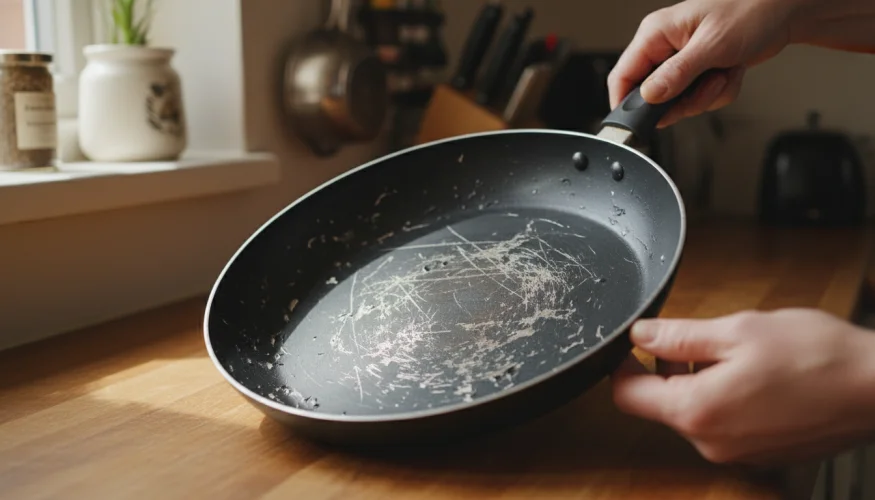
If the coating is scratched or peeling, no cleaning method will save the situation and it is time to invest in new cookware. Quality non-stick cookware with a ceramic or titanium coating lasts considerably longer and withstands higher temperatures without damage.
Prevention is always better than cure
Take a common scenario as an example: Jana is cooking rice porridge for the whole family, the phone rings and she steps into the next room for five minutes. When she returns, the bottom of the pot is black and the smell of burning drifts through the entire flat. Instead of scraping for hours, she fills the pot with water and a spoonful of baking soda, brings it to a boil, and leaves it to cool. An hour later, the pot is clean without any scrubbing whatsoever.
Exactly this kind of scenario plays out in thousands of households every day. And that is precisely why it is worth knowing the right methods in advance – not only to save the cookware, but also to save time and energy.
Preventing burning can also be significantly aided by having the right equipment. Pots with a heavy base that distributes heat evenly greatly reduce the risk of burning compared to cheap cookware with a thin base. Cooking on a lower flame with a longer preparation time also helps – the food takes longer to cook, but the flavour is better and the risk of burning is considerably lower. As the French culinary saying goes: "Good cooking requires time, not fire."
Another practical aid is silicone mats or heat diffusers, which are placed between the hob and the pot. These simple tools dramatically reduce direct contact with the heat source and are particularly useful with electric cookers, where temperature regulation is less precise. More about choosing eco-friendly and functional cookware and kitchen accessories can be found in the recommendations of the organisation ECEAT, which focuses on sustainable living.
It is also worth mentioning that choosing the right oil or fat can help prevent burning. Fats with a high smoke point – such as clarified butter, coconut oil, or avocado oil – withstand high temperatures without breaking down and forming deposits better than, for example, extra virgin olive oil, which is better suited to lower temperatures. The website Healthline provides a clear overview of which oils are suitable for different methods of heat preparation.
Ultimately, even the best pot and the best cooking technique won't prevent every accident. A burnt pot is part of every kitchen and there is no reason to make a tragedy of it. With a little patience, a handful of baking soda, and the right approach, rescuing cookware is a matter of minutes, not hours of hard work. And next time the phone rings in the middle of cooking, simply turn down the flame – or take the pot off the heat entirely. Your cookware and your nerves will thank you.