

Strong feet as the foundation of healthy balance
Few people think of their feet as the foundation of the entire body – and yet it is precisely they that bear the full weight of every step, jump, and stance. Feet are an architectural marvel: each one consists of 26 bones, 33 joints, and more than a hundred muscles, tendons, and ligaments that work together to provide movement, shock absorption, and balance. Yet foot care is practised by only a fraction of the people who otherwise diligently train their backs, abdominals, or shoulders. The result is unstable gait, knee, hip, and back pain – or, in worse cases, falls, which are particularly dangerous for older people.
The good news is that strengthening the feet is neither complicated nor time-consuming. All it takes is knowing the right exercises and principles, which can easily be incorporated into everyday life – and the results come surprisingly quickly.
Try our natural products
Why strong feet are the key to whole-body balance
Balance is not merely a matter of the inner ear or concentration. It depends primarily on the quality of information the brain receives from the feet. The soles of the feet contain thousands of nerve endings – proprioceptors – that continuously sense the body's position in space and send messages to the central nervous system. If the muscles of the foot are weak or shortened, these signals become inaccurate and balance deteriorates. This is not theory: studies published in the Journal of Electromyography and Kinesiology have repeatedly confirmed that training the small muscles of the foot improves postural stability in people of all age groups.
Consider Markéta, a forty-year-old teacher who had long complained of knee pain when climbing stairs. An orthopaedic specialist referred her to physiotherapy – and the surprise was that a large portion of the exercises focused precisely on the feet and the ankle joint. After six weeks of regular exercise, the pain subsided significantly, without the need for medication or surgery. The cause was not in the knee itself, but in the insufficient support that the feet were providing to the knee.
There are thousands of such stories. Weak feet cause a chain reaction: compensatory tension travels upward through the ankles, knees, and hips all the way to the lumbar spine. Conversely, strong and mobile feet act as a solid foundation from which healthy posture and safe movement derive.
The modern lifestyle does little to help this foundation. Most of us spend hours in rigid footwear with thick soles, which, while protecting against hard surfaces, simultaneously deprives the foot of its natural work. Muscles weaken from inactivity just as a bicep does when you stop training it. Hard shoes also prevent the foot from bending and distributing weight naturally, which gradually worsens proprioception – that essential ability to perceive one's own position in space.
Exercises that actually work
When it comes to strengthening the feet, no expensive equipment or hours at the gym are required. Most of the most effective exercises can be performed at home, while watching television, or even at the office. The key is regularity and conscious muscle engagement, not speed or intensity.
One of the fundamental and most effective exercises is the so-called "short foot exercise". The goal is simple: shorten the length of the foot by drawing up the transverse arch without curling the toes. Try sitting in a chair, placing a bare foot on the floor, and attempting to "pull" the big toe toward the heel without bending the toes. At first this may be difficult – the muscles are simply not accustomed to such work. But with weeks of regular practice, activating the arch becomes natural and strengthens the intrinsic muscles of the foot, which are the most important for balance.
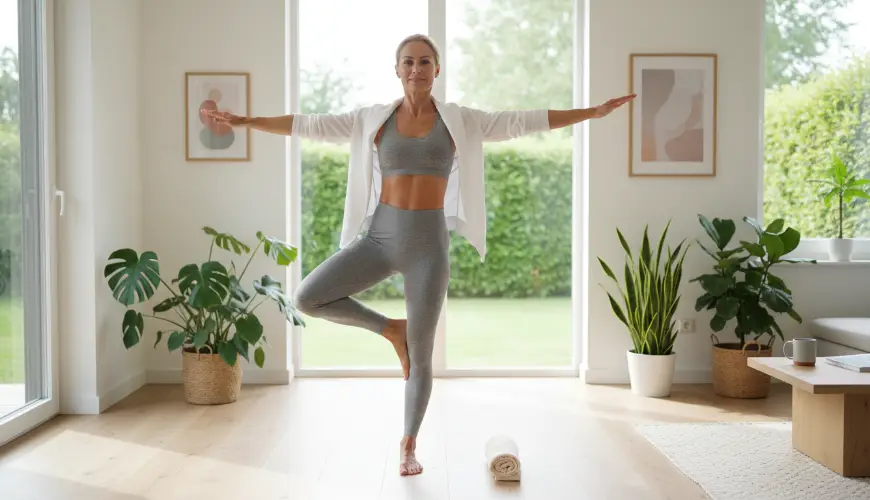
Another excellent exercise is single-leg standing. It seems trivially simple, but try performing it on an unstable surface – such as a folded towel or a special balance board – and you will suddenly feel how hard the muscles from the toes to the calf are working. Begin with eyes open and gradually add the challenge of closing your eyes or moving your arms. The American Physical Therapy Association recommends single-leg standing as one of the most accessible ways to train balance and proprioception in people of any age.
A favourite exercise among physiotherapists is also picking up objects with the toes. Place a small towel, a ball, or pebbles on the floor and try to grasp them with your toes and move them to another spot. This seemingly playful exercise is enormously effective for strengthening the small muscles of the foot and improving coordination. Children do it naturally – and it is no coincidence that their feet are usually strong and mobile.
Do not forget calf raises, i.e. rising onto the toes. Perform them slowly, with full control of the movement, and pause briefly at the highest point. For greater effect, perform them on the edge of a step, where a negative movement is also possible – lowering the heel below the level of the step. This exercise strengthens not only the calf muscles, but also the tendons and ligaments around the ankle, which are absolutely crucial for stability. Add a single-leg version and you have a challenge that will keep you in good shape for a long time to come.
As a complement to exercise, walking barefoot is very beneficial. Whether on grass, sand, or a wooden floor at home, barefoot walking naturally activates the entire foot and stimulates nerve endings in a way that no shoe can replace. There is no need to go barefoot all day – even twenty minutes a day can have a noticeable effect. As biomechanics expert Katy Bowman says: "Feet are like hands – the more you use them through their full range, the stronger and more sensitive they become."
A practical overview of exercises for a daily routine:
- Short foot exercise – 3 × 10 repetitions on each foot, daily
- Single-leg standing – 3 × 30 seconds on each leg, progressing to an unstable surface
- Picking up objects with the toes – 5 minutes daily as a game or warm-up
- Calf raises – 3 × 15 repetitions, slow tempo with a pause at the top
- Barefoot walking – at least 15–20 minutes daily on various surfaces
Choosing the right footwear and everyday habits
Exercise alone is not enough if the feet spend the rest of the day confined in unsuitable footwear. The choice of footwear has an enormous impact on foot health, yet most people pay insufficient attention to it. An ideal shoe should have enough room for the natural spread of the toes, minimal or zero heel drop, and a thin, flexible sole that allows the foot to work naturally.
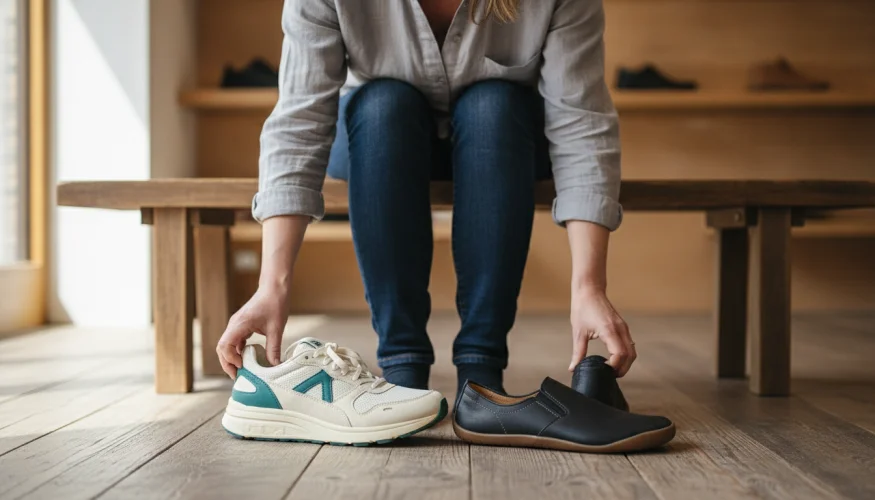
In recent years, interest in so-called "barefoot" footwear, which meets these principles, has been growing. This is not a passing fashion trend – the scientific basis is solid. A study published in Scientific Reports showed that people transitioning to minimalist footwear experienced significant strengthening of foot muscles and improved balance after several months. However, the transition should be gradual: feet accustomed to conventional shoes need time to adapt, otherwise overloading and injury are a risk.
Alongside footwear, everyday habits also play a role. Simple things such as standing on one leg while brushing your teeth, walking barefoot around the house, or conscious "active standing" – that is, standing with slightly bent knees and activated foot muscles rather than passively shifting weight onto the ligaments – can gradually transform the way the body manages balance. These are not major changes, but small habits that accumulate over time.
For those looking for suitable home training aids, balance boards or half-dome balance pods are an excellent choice. They provide an unstable surface that forces the feet and ankle joints to work intensively. Regular exercise on such a surface – even just ten minutes a day – yields measurable results in the form of better balance and a reduced risk of ankle sprains.
Ageing naturally impairs balance, as proprioception weakens with age and muscles lose strength. This is precisely why strengthening the feet is especially important for people over fifty. Falls are one of the leading causes of serious injuries and hospitalisations among older adults – and yet they are largely preventable. The World Health Organization states that exercise programmes focused on balance and lower limb strength reduce the risk of falls by up to thirty per cent.
Strengthening the feet is not just a matter for athletes or people with pain. It is an investment in the quality of movement that pays off at any age. Strong, mobile, and sensitive feet allow the body to move naturally, efficiently, and without unnecessary tension. And that is the foundation on which – quite literally – everything else stands.