

Try homemade instant cup soups
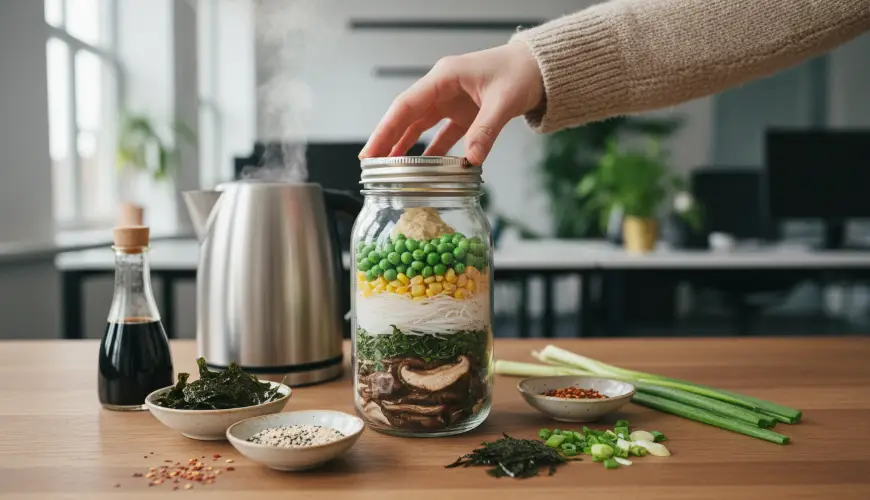
Who wouldn't know that feeling – it's half past eleven, your stomach is growling in the office, and the only quick option is an oversalted instant soup from a packet or a burnt sandwich from the vending machine on the ground floor. Yet there's an elegant solution that combines the convenience of instant food with the quality of home cooking: hand-prepared mug soups that you simply pour hot water over right at your workplace.
This trend, which gained popularity in recent years first in Japan and Korea under the name "jar soups" or "mug soups", is slowly making its way into Europe as well. And no wonder – it's a clever way to enjoy a warm, nutritious lunch without a plastic bag full of glutamate, palm fat and colourings. A homemade instant mug or jar soup is nothing more than layering fresh or dried ingredients that hot water brings to life in just a few minutes.
Try our natural products




Why it's worth preparing your soup at home
Industrially produced instant soups are undoubtedly convenient, but their ingredients rarely impress. According to data from the European Food Safety Authority (EFSA), excessive sodium intake is one of the main risk factors for cardiovascular disease – and packet instant soups are one of the biggest sources of salt in the average European's diet. A single packet can contain 60–80% of the recommended daily sodium intake for an adult.
The homemade version, on the other hand, offers complete control over the ingredients. You decide how much salt to add, what stock to use, whether to opt for protein-rich legumes or vitamin-packed vegetables. Moreover, the preparation is surprisingly undemanding – most recipes take just 10 to 15 minutes the evening before, and in the morning you simply grab the mug and go.
It's not just a matter of health, but also of economics. A single homemade mug soup costs on average 20 to 40 Czech crowns, while a comparable purchased option – whether instant or from a bistro counter – starts at 60 crowns and above. Over five working days a week, that represents a considerable saving.
Take Klára, a thirty-three-year-old project manager from Brno, as an example. A year ago she started bringing glass jars to work, layered with dried vegetables, miso paste, rice noodles and herbs. "At first my colleagues told me I was crazy," she laughed. "Now half the office asks me to send them recipes." Klára's story is not exceptional – just look at social media, where the hashtag #jarsoups attracts hundreds of thousands of posts.
How to prepare a homemade instant mug soup
The basic principle is simple: ingredients are layered in a mug or airtight jar, starting with those that need the most time to "cook" in hot water, through to the most delicate ones that would suffer from excessive heat. Hot water is poured over at the workplace, the mug is covered with a saucer or lid, left to stand for 3 to 5 minutes, and the soup is ready.
The key to success is choosing the right ingredients. Not everything is suitable – raw vegetables such as carrots or celery will remain hard unless sliced very thinly or blanched in advance. Dried vegetables, frozen peas, thin rice noodles, instant buckwheat or pre-cooked legumes, on the other hand, work perfectly.
The flavour base forms the foundation of every good soup. This is where ingredients such as the following come into play:
- miso paste (a rich source of probiotics and umami flavour)
- dried stock without added additives and glutamate – ideally homemade or a quality organic variety
- soy sauce or tamari for a gluten-free version
- coconut milk powder for creamier Asian soups
- dried mushrooms such as shiitake or porcini, which release an intense flavour into the water
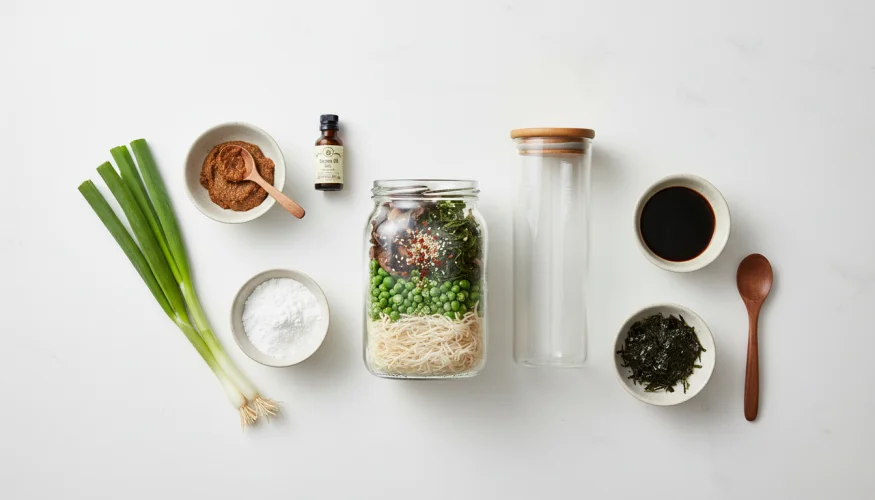
On top of this base, dried or frozen vegetables are layered – spinach, sweetcorn, peas, dried tomatoes, sliced spring onions. Then come the carbohydrates: rice noodles, glass noodles, buckwheat noodles or small pasta shapes such as orzo or pastina. And finally the protein – tofu cut into cubes, pre-cooked beans, edamame or dried shrimp for those who enjoy seafood.
The final layer consists of aromatic ingredients and garnishes: sesame seeds, chilli flakes, dried nori seaweed, dried basil or coriander leaves, a drop of sesame oil in a small separately packed container. It's precisely these details that elevate a simple soup into a truly memorable experience.
As British chef and advocate of simple cooking Yotam Ottolenghi once noted: "The best food is not the most complicated – it's the food that brings you joy where you least expect it." And a warm homemade soup in the middle of a hectic working day is exactly such a moment.
Tips for different tastes and diets
What's wonderful about homemade instant mug soups is their complete adaptability. Lovers of Japanese cuisine can put together a classic miso shiru with tofu, wakame seaweed and spring onions. Fans of Thai flavours can reach for a combination of coconut milk powder, dried lemongrass, ginger, rice noodles and shrimp. A European-style version might contain dried tomatoes, Provençal herbs, small pasta shapes and white beans – essentially a minestrone in a mug.
For vegans and vegetarians, preparation is particularly straightforward, as most traditional Asian soup bases are naturally plant-based. Miso paste, soy sauce, dried mushrooms and vegetables form a foundation that is fully satisfying even without meat or animal products. People with coeliac disease will appreciate that rice and glass noodles are naturally gluten-free, and tamari can replace regular soy sauce.
The choice of container also matters. A classic ceramic mug will do the job, but more practical is a thermal mug with a lid or a glass jar with a sealing cap. Glass has the advantage of not absorbing odours or flavours, is easy to clean and aligns with an ecological approach – no single-use plastic. On Ferwer.cz you can find, for example, bamboo and glass containers that are perfectly suited for this purpose while also fitting beautifully into a sustainable lifestyle philosophy.
Preparation, storage and practical tips
One of the greatest advantages of this concept is the possibility of preparing for the entire week in advance. Simply assemble five mugs or jars on Sunday evening, store them in the fridge, and take one with you each morning. Dry ingredients will keep in a sealed container at room temperature for several days, while combinations with fresh ingredients – such as tofu or blanched vegetables – are best consumed within two to three days.
Proper pouring is also key. In the workplace, most people have access to a kettle or a hot water dispenser. The water should be truly boiling or just below boiling point – water that is too lukewarm will not soften the noodles and vegetables sufficiently. After pouring, it's best to cover the container and leave it to stand for 4 to 5 minutes, so that all the ingredients heat through evenly and the noodles soften.
As for the amount of water, the general rule is that approximately 300 to 400 millilitres is sufficient for one serving. The resulting consistency depends on personal preference – those who like a thicker soup use less water, while those who prefer a light broth can add a little more. It's therefore advisable to prepare the flavour base somewhat more intensely than you would want in the finished soup, as the hot water will naturally dilute it.
Noodles deserve a special mention. Thin rice noodles or glass noodles (so-called glass noodles) can simply be placed in the mug dry – hot water will soften them in 3 to 4 minutes. Thicker buckwheat or wheat noodles are better pre-cooked to al dente, cooled, lightly coated in sesame oil to prevent sticking, and only then placed in the container. This step adds just a few minutes to the preparation, but the result is well worth it.
The psychological dimension of the whole thing is also not to be overlooked. Bringing a homemade soup to work is a small act of self-care in the middle of an otherwise chaotic day. Research in the field of behavioural psychology repeatedly shows that a conscious meal break – however brief – improves concentration, reduces stress and increases overall productivity. According to a study published in the Journal of Occupational Health Psychology, people who take a genuine lunch break show significantly better cognitive performance in the afternoon than those who eat at their computers or skip the break entirely.
And so the homemade instant mug soup becomes something more than just a practical solution to hunger. It is a small daily routine that connects healthy eating, ecological thinking and mindful self-care. Preparing it takes no more than a quarter of an hour, yet the pleasure it brings in the middle of a working day is hard to quantify. It's worth giving it a try – and who knows, perhaps a one-off experiment will become a habit that lasts for years to come.