

Cold Japanese noodles for hot days
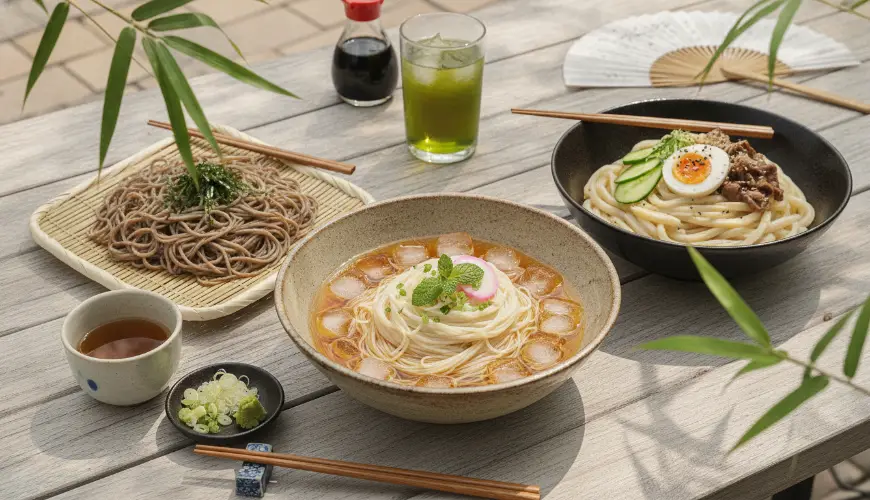
Japanese cuisine is one of those that can surprise with its ability to adapt to the seasons. While in winter the Japanese warm themselves with thick ramen soups or nourishing hot pots, summer brings an entirely different philosophy of eating. Cold Japanese noodles are considered in Japan to be one of the best ways to survive sweltering hot summers – and it's no wonder this tradition is slowly but surely finding its way into Czech kitchens as well.
Imagine it's thirty-five degrees outside, the air is shimmering with heat, and the thought of a hot meal feels almost unbearable. It's precisely in such moments that a Japanese household will prepare a bowl of cold noodles topped with chilled broth or sauce, garnished with slices of cucumber, a boiled egg, and a touch of wasabi. The result is refreshing, light, and yet surprisingly filling. This simplicity is the product of centuries of culinary development, not coincidence.
Try our natural products




The Three Queens of Japanese Cold Noodles
Japanese cuisine offers a wide variety of noodle types, but three have established themselves most prominently in cold summer dishes – somen, soba, and udon. Each has its own character, flavour, and method of preparation, and although they may look similar at first glance, an experienced diner can easily tell them apart.
Let's start with somen – the most delicate and thinnest of the three. These wheat flour noodles are so thin that their diameter does not exceed 1.3 millimetres, and they cook in just two minutes. This makes them ideal for hot weather, when no one wants to stand by the stove for hours. Somen are traditionally served in a bowl with ice and a cold dipping sauce called tsuyu – soy sauce flavoured with dashi fish stock and lightly sweetened sake. One curious tradition is nagashi somen, in which noodles slide down a bamboo flume on a stream of cold water and diners must catch them with chopsticks. It is one of those Japanese customs that combines food with play and a communal experience – and it perfectly captures how the Japanese approach summer.
Soba, by contrast, is a noodle with a stronger character. It is made from buckwheat flour, sometimes combined with wheat flour, and has a distinctive nutty flavour that sets it apart from the others. Cold soba, known as zaru soba, is served on a bamboo tray sprinkled with sliced nori seaweed, with tsuyu dipping sauce and fresh spring onions. Buckwheat flour is not merely a matter of taste – buckwheat is naturally gluten-free and contains rutin, a flavonoid that supports vascular health, as noted in a study published in the academic journal Nutrients. For those seeking a more nutritionally valuable alternative to ordinary noodles, soba is an excellent choice.
And then there is udon – thick, white wheat flour noodles with a characteristically chewy texture. Of the three, udon are the most filling and the least "light," yet they too are served cold in summer. So-called hiyashi udon is served with various toppings – from sesame paste to fresh vegetables to slices of beef or pork. Udon are particularly popular in the Kagawa region on the island of Shikoku, where they receive almost cult-like attention. Local restaurants serve udon from the early morning hours and people come for them the way others come for their morning coffee – this is not an exaggeration, but the genuine everyday reality of the local culture.
What Makes Cold Noodles So Special
You may wonder why cold Japanese noodles deserve such attention when cold pasta dishes or salads also exist in the Czech Republic. The answer lies in a combination of several factors that together create a unique culinary experience.
The first of these is texture. Japanese noodles are prepared so that after chilling in ice water they acquire a firmer, more springy consistency that behaves completely differently in the mouth than overcooked pasta. The key is to rinse them immediately in ice-cold water right after cooking – this stops the cooking process and allows the noodles to retain their structure. This step is considered absolutely essential in Japanese cuisine and cannot be skipped.
The second factor is tsuyu sauce, which forms the basis of most cold noodle dishes. Tsuyu is a fascinating example of how Japanese cuisine works with umami – the fifth basic taste, which gives food depth and fullness. The combination of soy sauce, mirin, sake, and dashi stock made from katsuobushi dried tuna flakes creates a flavour that is salty, slightly sweet, and rich in glutamates. It is precisely thanks to umami that cold noodles, despite their apparent simplicity, feel like a complete meal rather than a mere refreshment.
The third aspect is nutritional value. Japan is one of the countries with the highest average life expectancy in the world, and the Japanese diet is one of the factors that researchers repeatedly cite as a possible explanation. As noted in a World Health Organization report, Japanese cuisine is characterised by low saturated fat content, a high proportion of fibre, and fermented foods. Cold noodles fit perfectly into this pattern – they are easily digestible, calorically moderate, and do not burden digestion in the heat.
Also noteworthy is the perspective of seasonality. Japanese cuisine is deeply rooted in the concept of shun – eating at the right time and using ingredients that are currently in season. Cold noodles are not merely a fashionable trend or a practical solution to the heat, but part of a cultural rhythm that determines what is eaten, when, and how. As the Japanese proverb goes: "Hara hachi bu" – eat until you are eight-tenths full. Cold noodles are a precise embodiment of this approach: they satisfy without overwhelming.
How to Prepare Cold Japanese Noodles at Home
The good news is that preparing cold Japanese noodles requires neither years of culinary training nor exotic equipment. Somen, soba, and udon are today available in many Asian grocery stores or well-stocked supermarkets, and tsuyu sauce can be bought ready-made or easily prepared at home.
The basic procedure for preparing cold noodles involves several steps:
- Cook the noodles according to the instructions on the packet – somen typically 2 minutes, soba 4–5 minutes, udon 8–10 minutes
- Immediately after cooking, rinse them under cold running water, then place them in a bowl of ice or ice-cold water
- Leave them to chill for at least 2–3 minutes, then drain
- Prepare the tsuyu dipping sauce – ideally in a ratio of 1 part soy sauce, 1 part mirin, 3 parts dashi stock
- Serve the noodles in a bowl or on a bamboo tray with toppings of your choice
Almost anything you have on hand can be used as a topping – slices of cucumber, radish, boiled egg, avocado, nori, sesame seeds, or fresh herbs. It is precisely this flexibility that makes cold Japanese noodles an ideal dish for hot days when you don't want to spend hours deciding what to cook.
One concrete example: Jana, a thirty-year-old graphic designer from Brno, started making cold soba after trying it at a Japanese restaurant in Prague. "At first it seemed strange to eat noodles without hot broth, but after the first bite I understood what it was all about. It's a kind of refreshment that actually fills you up," she says. Today she makes soba every week, combines it with various ingredients, and makes her own tsuyu from ingredients she orders online.
This kind of personal experience shows that cold Japanese noodles are not an exotic speciality reserved for fans of Asian cuisine – they are simple, accessible, and exceptionally tasty dishes that anyone can enjoy. The key is to overcome initial doubts and try them just once.
The world of cold Japanese noodles is, moreover, far broader than it may seem. Alongside somen, soba, and udon, there are dozens of regional variants, seasonal adaptations, and modern fusions that combine traditional recipes with local ingredients. In recent years, for example, restaurants have been proliferating in Japanese cities that offer cold ramen – originally a winter dish – in summer versions with lighter broth and an abundance of fresh vegetables. Japanese cuisine has never stopped evolving, and it is precisely this that makes it so fascinating and continuously relevant even today.
So if on the next hot day you're wondering what to have for lunch, try reaching for a packet of somen or soba instead of the usual salad or sandwich. Preparation takes less than a quarter of an hour, the result is surprisingly sophisticated, and your body will thank you for a light, nourishing meal in the heat. The Japanese have known this for centuries – and now it's time for those of us living far from Tokyo or Kyoto to know it too.