

Try seaweed in Czech cuisine in seven ways
Seaweed long remained the domain of Japanese restaurants and macrobiotic enthusiasts. In recent years, however, the situation has been changing – and significantly so. More and more Czech households are discovering that these underwater plants are not just the basis for sushi, but a fully-fledged ingredient capable of transforming soups, salads and baked goods. And at the same time, they bring nutritional values that many "superfoods" cannot match.
It is no wonder that interest in seaweed is growing even in countries without direct access to the sea. Czech cuisine has traditionally drawn from what Central European nature has to offer, but globalisation and a growing interest in healthy living have opened doors to ingredients our grandmothers had no idea existed. Yet seaweed is nothing new – in Asia it has been consumed for more than a thousand years, and in Ireland and Scotland it was a staple food of poor fishing communities for centuries.
Try our natural products





What seaweed actually is and why it is worth trying
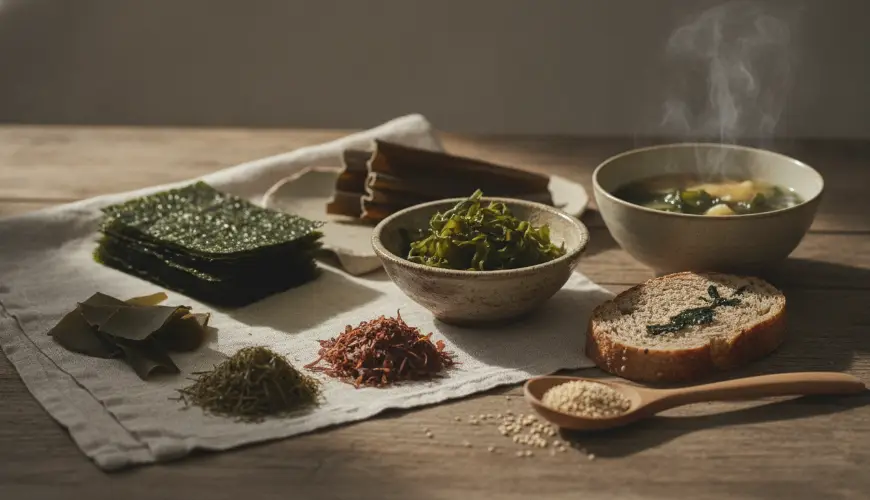
Before we get into specific recipes, it is useful to understand what we are actually working with. Seaweed is not one specific plant – it is a broad group of marine organisms that differ in colour, texture, flavour and nutritional composition. In the kitchen, we most commonly encounter several varieties: nori are thin, dark green sheets dried into leaves, wakame has a milder flavour and after soaking resembles spinach, kombu is a firm brown seaweed ideal for stock, dulse offers a slightly salty, almost smoky flavour, and arame is characterised by a delicate structure suitable for salads or stir-fried dishes.
From a nutritional standpoint, seaweed is truly exceptional. It contains iodine, which is chronically insufficient in the Czech diet – as the National Institute of Public Health points out, iodine deficiency is one of the most widespread nutritional deficiencies in our population. In addition to iodine, seaweed offers iron, calcium, magnesium, B vitamins and unique antioxidants not found in land plants. Wakame, for example, contains fucoxanthin, a compound being studied for its potential beneficial effects on fat metabolism. And yet seaweed is very low in calories – 10 grams of dried seaweed typically contains fewer than 30 calories.
You may be wondering: all well and good, but how do you actually incorporate this into everyday cooking without turning lunch into a scientific expedition? The answer is surprisingly simple – just start gradually, with one or two varieties, and let your taste guide you.
Take a real-life example. Jana, a thirty-year-old teacher from Brno, started adding dried nori to home-baked bread after reading about its iodine content. "I expected it to taste like an aquarium," she says with a laugh, "but it actually gave the bread a subtle saltiness that made me stop adding so much salt." Today she uses seaweed regularly, and her family has not even noticed they are eating something "alternative."
Seven ways to incorporate seaweed into Czech cooking
Let us move on to the most interesting part – specific recipes and ideas that require neither a specialised Asian kitchen nor hours spent over the stove.
Potato soup with kombu is perhaps the simplest entry point. Kombu is traditionally used in Japanese cuisine to prepare dashi stock, but it works equally well as a base for Czech potato soup. Simply add one or two pieces of dried kombu to cold water at the start of cooking, remove them after 20 minutes, and continue preparing the soup as usual. The result is a stock with a fuller, deeper flavour and a significantly higher mineral content – without the soup tasting "of the sea." This technique is also used in macrobiotic cooking, which continues to enjoy a steady following in the Czech Republic.
Another excellent way to use seaweed is a buckwheat salad with wakame and sesame. Simply soak wakame in cold water for 10 minutes, drain it, cut it into smaller pieces, and mix with cooked buckwheat, grated carrot, fresh spring onion and a dressing made from tamari, rice vinegar, sesame oil and a touch of honey. The result is a nutritious, satisfying salad that tastes fresh and unusual without feeling exotic. Wakame has a surprisingly delicate texture after soaking, making it perfectly suited to cold dishes.
The third recipe is home-baked bread with nori and sea salt. Nori can be blended or torn into small pieces and added directly to the dough. Three to four sheets of nori per loaf is sufficient – they give the bread a darker colour, a subtle saltiness and increase its iodine content. This approach works for both sourdough and yeast-leavened bread. For regular bakers, it is an unobtrusive change with a significant nutritional impact.
The fourth idea is red lentil patties with dulse. Dulse is a lesser-known reddish-brown seaweed with a distinctive, slightly smoky flavour that works wonderfully in vegetarian and vegan dishes as a substitute for cured meat. Add it to a mixture of cooked lentils, oat flakes, garlic and spices, fry in a pan and serve with a yoghurt sauce and fresh vegetables. The result has a surprisingly "meaty" depth of flavour that will please even those sceptical about meat-free eating.
The fifth option is using arame in garlic stir-fried vegetables. Arame has a delicate, mildly sweet flavour and after soaking forms thin, dark strands that are excellent for stir-frying. Combine it with courgette, pepper, garlic and ginger, stir-fry in coconut or sesame oil and serve as a side dish with rice or quinoa. This dish can be prepared in under twenty minutes while serving something truly special.
The sixth recipe involves miso soup with tofu and wakame – and even though it sounds like a Japanese classic, it is simpler to prepare than Czech svíčková. Miso paste, wakame and tofu are available in any larger health food shop or online. Simply heat some stock, add soaked wakame and diced tofu, and at the end stir in a tablespoon of miso paste (do not boil it – just stir it into the finished soup). This soup is ready in ten minutes, satisfying, and contains probiotics, plant-based protein and minerals from the seaweed. As the Harvard T.H. Chan School of Public Health notes, regular consumption of seaweed is associated with a range of health benefits, including support for thyroid function.
The seventh and perhaps most original approach is adding nori or spirulina to smoothies and breakfast bowls. Spirulina is technically not a seaweed in the strictest sense, but it belongs to the same group and shares similar nutritional properties. A teaspoon of spirulina in a green smoothie with banana, spinach and coconut milk adds a striking colour and nutritional value without significantly affecting the flavour. For those who enjoy experimenting with breakfast, it is a quick and effective way to enrich their diet.
Where to buy seaweed and what to watch out for
Seaweed is more accessible today than ever before. You can find it in health food shops, Asian supermarkets, and increasingly in mainstream supermarkets in the organic products section. When purchasing, it is important to pay attention to origin – seaweed from polluted waters can contain heavy metals, so it is advisable to choose products with certification and a clearly stated place of origin. Japanese, Korean, Irish and Norwegian seaweed are generally considered quality choices.
Dosage also matters. Seaweed is rich in iodine, and while its deficiency is a problem in the Czech Republic, excessive intake can conversely burden the thyroid gland. The European Food Safety Authority EFSA recommends a daily iodine intake of around 150 micrograms for adults – while 10 grams of dried kombu can contain several thousand micrograms. It is therefore sensible to use kombu primarily as a flavour base for stock (and then remove it) rather than consuming it directly. Varieties such as nori, wakame and dulse have significantly lower iodine content and are suitable for direct consumption in ordinary quantities.
As the pioneer of modern nutrition Michael Pollan once said: "Eat food. Not too much. Mostly plants." Seaweed is a plant in the purest sense of the word – it grows without fertilisers, pesticides or agricultural land, naturally filters water and has a minimal ecological footprint. From a sustainability perspective, it is one of the most promising foods of the future, as confirmed by the UN report on sustainable food systems.
Czech cuisine has always been able to adapt to new ingredients – potatoes, tomatoes and peppers were also once exotic novelties, yet today they are an inseparable part of our table. Seaweed may be on a similar journey. It does not need to replace svíčková or dumplings, but it can become that understated ingredient that enriches a stock, gives bread a new dimension, or transforms an ordinary salad into something guests will be talking about for a long time to come.