
Why monotonous manual work is good for us
We live in an era that constantly bombards us with stimuli. Notifications, emails, meetings, deadlines – modern working and personal life demands constant attention, quick decision-making, and switching between dozens of tasks at once. And yet – or perhaps precisely because of this – more and more people are consciously returning to something seemingly outdated: repetitive manual work. Knitting, chopping wood, washing dishes by hand, gardening, or repeatedly sanding wood in a workshop. What drives this? And why does such "boredom" do us so much good?
The answer is not as simple as it might seem, and it reaches deep into how the human brain, body, and psyche function.
Try our natural products


What happens in the brain during repetitive physical activity
When a person performs a simple, repetitive movement – whether stirring dough, repotting houseplants, or sorting beans – the brain switches into a specific mode. Neuroscientists call it the default mode network, a state in which the conscious, analytical part of the mind slows down and makes room for a different kind of thinking. It is precisely in this state that creative ideas are born, emotions are processed, and the brain essentially "tidies up" – sorting through experienced information, consolidating memories, and finding connections it would never discover under full concentration.
Research in cognitive science, such as studies published in Psychological Science, repeatedly shows that mildly monotonous activities support divergent thinking – the ability to come up with new, unexpected solutions. It is no coincidence that many people get their best ideas in the shower, while walking, or during routine manual work. The brain is not working less at these times – it is working differently.
Also interesting is what happens at the neurochemical level. Repetitive movements – especially rhythmic ones, such as knitting, sawing, or rhythmic stirring – stimulate the release of serotonin, the neurotransmitter associated with feelings of calm, well-being, and emotional stability. This mechanism is similar to what happens during meditation or while walking in nature. The body simply responds to rhythm as a signal of safety.
Psychologist and author of The Creativity Cure, Carrie Barron, writes: "Handwork returns us to our bodies and to the present moment in a way that no digital activity can replace." And she is right – manual work forces a person to be physically present, to perceive the texture of materials, temperature, and resistance. This sensory feedback is something a screen simply cannot offer.
The transition from theory to practice is not complicated. It simply requires reflecting on what we do in everyday life – or, conversely, what we have stopped doing because it seemed "unnecessary" or "inefficient."
Everyday examples that confirm this
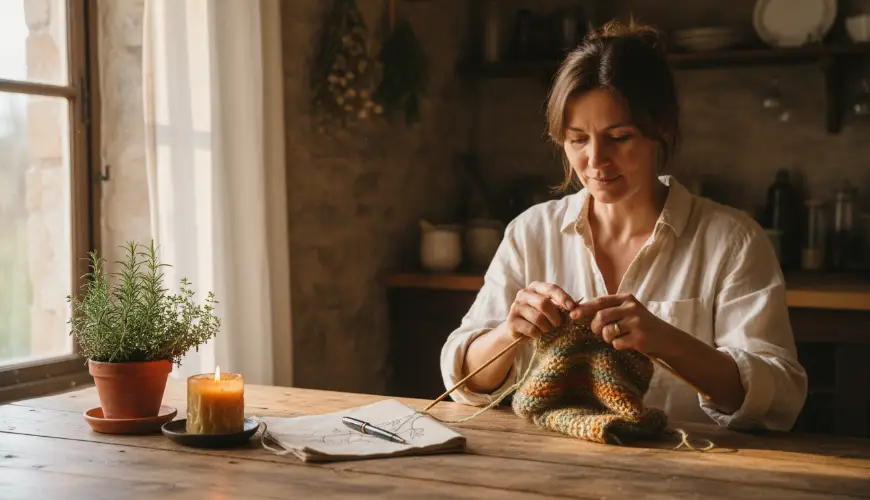
Take the example of Martina, a forty-year-old project manager from Brno who knits by hand every evening. She admits that burnout led her to it – after years of overwork, she was looking for something to "switch her off." She initially found knitting boring, but after a few weeks discovered that evenings with yarn were the only time of day she felt truly at peace. She stopped checking her phone, stopped thinking about work problems, and began sleeping better. Nothing dramatic, no therapy – just regular, repetitive manual activity.
Martina's story is not exceptional. Thousands of people around the world share similar experiences, and science backs them up. The British organisation Mind, which focuses on mental health, explicitly lists manual and creative activities in its recommendations as effective tools for managing stress and anxiety. Gardening, cooking, craftwork – all of these feature as legitimate supports for psychological well-being, not merely as hobbies.
Chopping wood or working in the garden functions similarly. This physical exertion has an added value: it produces a tangible result. A pile of chopped wood, a weeded flower bed, a finished jar of jam – these are concrete evidence of work done, something the modern office worker rarely experiences in daily life. Most intellectual work is invisible, endless, and difficult to measure. Manual work, by contrast, offers a clear beginning and a clear end. And that is enormously valuable for the psyche.
It is worth noting that precisely during the onset of the Industrial Revolution, when people began moving en masse from manual work to factory production, the incidence of what was then called "nervous exhaustion" also rose. Historians and psychologists agree that the disconnection from physical, meaningful work with one's hands had a significant impact on the human psyche – and we are still repaying this debt today.
Slowness as a form of resistance and self-care
In recent years, an entire cultural wave has formed around this topic. The slow living movement promotes conscious deceleration, a return to simple activities, and a rejection of the cult of productivity at all costs. People grow their own vegetables, learn to ferment, make soaps, or mend clothing instead of discarding it. And it is not merely a lifestyle – it is a conscious choice about how to manage one's own attention and energy.
This approach also extends into the realm of sustainability. When a person makes or repairs something with their own hands, they form a personal relationship with that object. Handmade things are not discarded as easily as mass-produced goods. A person who has spent hours sewing a shirt or making a candle relates to it in an entirely different way than to something bought for a few coins in a supermarket. Manual work thus naturally fosters a more sustainable relationship with objects and with the environment.
Psychologists speak of a concept known as the "IKEA effect" – people assign greater value to things they had a hand in creating. Research by Michael Norton of Harvard Business School demonstrated that a self-assembled or handmade object is subjectively more valuable to its creator than an identical object purchased ready-made. And this holds regardless of objective quality. Hands, it seems, invest a piece of identity into things.
Also interesting is how monotonous manual work affects our ability to concentrate over the long term. At a time when average attention spans are declining – Microsoft research highlights a dramatic shortening of the attention window over the past two decades – regular practice of manual activities may function as attention training. Knitting, woodcarving, or calligraphy, for example, demand patience and presence that cannot be rushed. And this ability to stay with one thing then transfers to other areas of life as well.
It is worth mentioning that many prominent figures around the world acknowledge that manual work is part of their mental hygiene. Former US President Barack Obama cooks, British author Neil Gaiman writes first drafts of his books by hand with a pen on paper, and many top executives spend their leisure time on carpentry or ceramics. This is no coincidence – it is a conscious strategy for keeping the mind in balance.
And none of this requires doing anything extraordinary. Very little is enough – baking bread every week, washing cups by hand instead of using the dishwasher, planting herbs on the balcony, or learning the basics of crochet. The key is not the result or perfection, but the process itself – repeated, rhythmic, physical. A process that gives both body and mind space to breathe.
The modern world offers countless ways to save time and rid ourselves of "unnecessary" effort. Robots, apps, automation – everything done for us. And yet it seems that the more work we hand over to machines, the more we miss that specific feeling that comes from creating something with our own hands. A feeling of competence, completion, presence.
Perhaps it is time to stop viewing monotonous manual work as a waste of time and begin to see it for what it truly is – one of the most natural forms of self-care. The body and brain are evolutionarily wired for physical activity, for rhythm, for tangible results. And when we allow them this, they reward us with calm, creativity, and the feeling of being here – whole and present.