
Fragrant elderflower syrup without cooking thanks to cold maceration
Every summer brings a fragrant opportunity that many people overlook. The white umbrella-shaped flowers of elderberry open for only a brief period – and that is precisely when the chance arises to prepare something truly exceptional. While most home recipes for elderflower syrup involve boiling and long cooking on the stove, there is another way: cold maceration, which fundamentally changes the processing of elderflowers and delivers a result that surprises many.
Preparing syrup without heat treatment may seem like an alternative fad, but it is actually a method deeply rooted in folk tradition. Before people had access to modern stoves, they simply left herbs, fruit and flowers to steep in sugar or water. Cold maceration is therefore not really anything new – it is a return to great-grandmother's methods, which survived for centuries not by chance, but because they work.
Try our natural products

What actually happens during cold maceration
The word maceration comes from the Latin macerare, meaning to soften or steep. In practice, it is a process in which the raw material – in this case elderflowers – releases its active compounds into the surrounding medium without the application of heat. Sugar or water acts as a medium that gradually draws out essential oils, polyphenols, flavonoids and other compounds from the plant material. Time here replaces the energy of the hob.
Elderflowers are an ideal raw material in this regard. They contain essential oils, flavonoids such as rutin and quercetin, as well as various organic acids. These compounds are responsible for the characteristic aroma and flavour of the syrup, but they are also sensitive to high temperatures. During cooking, some of them break down or evaporate along with the steam – and the resulting syrup, though fragrant, may be less complex in flavour than it could be.
Cold maceration elegantly circumvents this problem. Because the temperature never exceeds room temperature, the essential oils are preserved almost in their entirety. The resulting syrup is described as more vibrant, fresher and aromatically richer – as though it has captured the very scent of a summer morning when the elderflower is in bloom.
The scientific basis for this approach is also supported by research focused on the processing of plant materials. Studies published in specialist food science journals repeatedly show that gentle processing without heat better preserves polyphenolic compounds, which have antioxidant properties. For elderflowers, this is doubly true, as their aromatic profile is exceptionally rich and thermally unstable.
How elderflower syrup is prepared by cold maceration
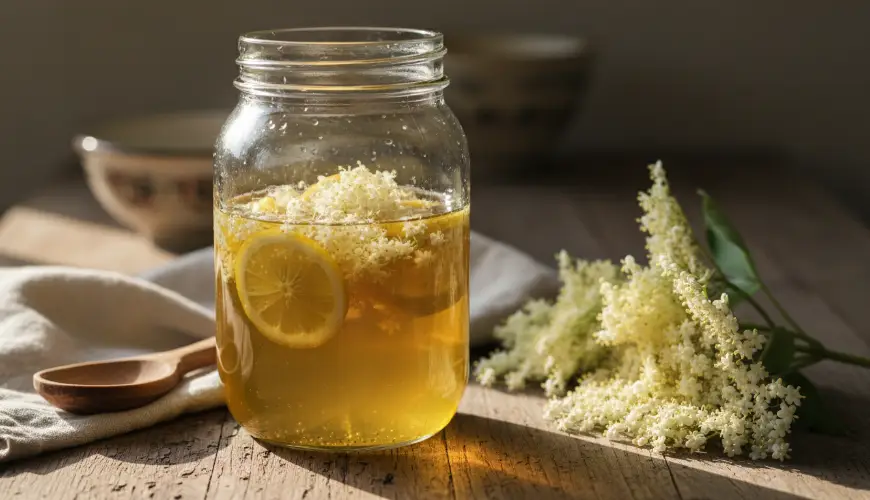
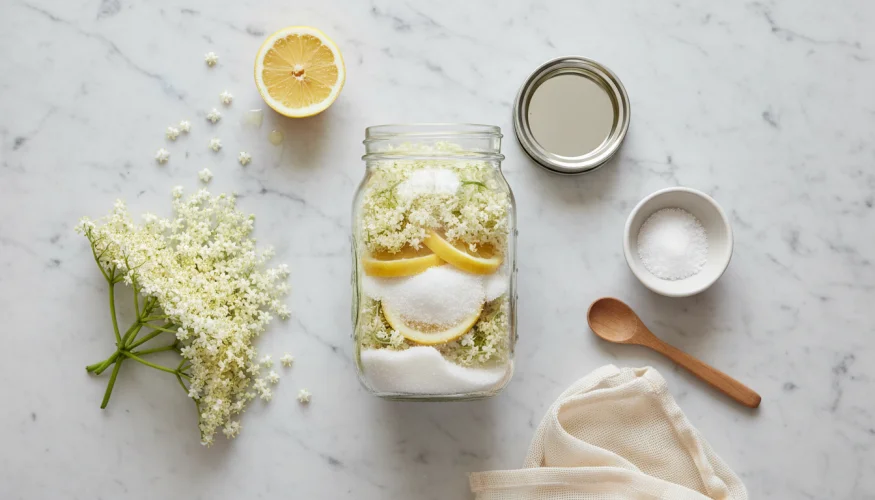
The process is surprisingly simple, though it requires a little patience. The basis is freshly picked elderflowers – ideally harvested on a dry morning when they are fully open and at their most intensely fragrant. The stalks should be removed as much as possible, as they contain compounds that would lend bitterness to the syrup. The flowers themselves are then mixed with sugar and lemon juice or citric acid, which serves as a natural preservative while also bringing a pleasant tartness to the flavour profile of the syrup.
The mixture is placed in a clean container, covered and left to macerate at room temperature or in the refrigerator for 24 to 72 hours. The sugar gradually draws the juice from the flowers along with all the aromatic compounds, dissolving in the process and creating a thick, fragrant syrup. Once the maceration period is complete, all that remains is to strain everything through a fine sieve or muslin cloth, add a little water if desired for the right consistency, and the syrup is ready.
Some people add slices of lemon or lime to the macerate, while others experiment with vanilla or ginger. Each such variation yields a slightly different result, and part of the magic lies in the fact that everyone can adapt the recipe to their own taste.
It is worth mentioning one practical point: syrup prepared by cold maceration does not have as long a shelf life as boiled syrup. Without heat sterilisation, it is recommended to store it in the refrigerator and consume it within two to four weeks. Those wishing to preserve the syrup for longer can add a little alcohol or a higher concentration of citric acid – both approaches extend the product's shelf life without the need for boiling.
Consider a specific example: Jana, an enthusiastic gardener from southern Moravia, picks elderflowers from her own garden every summer. For years she made syrup the traditional way – on the stove, with boiling and skimming. Then she tried cold maceration and described the difference as follows: "It was as though I was finally tasting elderflower as it truly is. Boiled syrup is good, but the cold-macerated one – it smells different, more alive." Her experience is not unique. Anyone who tries both methods side by side will generally notice the difference immediately.
Why this method is also suited to the modern household
At a time when more and more people are thinking about what they eat and how they handle food, cold maceration is taking on new meaning. It is not merely a matter of taste, but also of approach to cooking. The method requires no energy – no stove, no electricity-consuming equipment. All that is needed is a bowl, a spoon and time. In terms of ecological footprint, it is one of the most considerate ways of processing seasonal ingredients.
This aspect resonates with values that are becoming increasingly important today. A sustainable lifestyle does not only mean buying organic products – it also means thinking about the way food is prepared, about energy waste and about how seasonal ingredients are handled. Elderflower syrup prepared by cold maceration is in this sense a small but meaningful gesture towards a more conscious way of life.
Moreover, elderberry – Sambucus nigra – is a plant with a remarkable history. The World Health Organization includes it in its overviews of traditional medicinal plants, and it has been used in European folk medicine for centuries to support immunity and relieve the symptoms of colds. Modern research largely confirms these traditional findings – elderberry extracts do indeed exhibit antioxidant and immunomodulatory properties. A syrup prepared by a gentle method that preserves the maximum number of bioactive compounds can therefore be not only a delicious drink, but also a meaningful addition to the diet.
It is worth noting that cold maceration is not limited to elderflowers. The same method can be used to process rosehips, chamomile, lemon balm or lavender. Each of these plants brings its own character to the syrup or infusion, and anyone who once understands the principle of maceration opens the door to a whole range of home preparations. It is in fact a form of alchemy accessible to everyone – without laboratory equipment, without complex procedures, with nothing more than a little attention and respect for the natural material.
As the German herbalist and writer Markus Kobelt once wrote: "Plants give us the best of themselves when we allow them to work at their own pace." This thought applies to cold maceration better than to almost anything else. It is not about haste, not about maximising yield at any cost – it is about listening to the process and trusting that time itself is a valuable ingredient.
For those who want to get started, it is worth knowing that the quality of the resulting syrup depends above all on the quality of the raw ingredient. Elderflowers should be fresh, free of brown spots, and harvested when in full bloom – typically during May and June depending on altitude and the season. Those without access to their own garden or open countryside can turn to dried elderflowers from trusted sources, though fresh ingredients will always yield an aromatically richer result.
Sugar is another key factor. Standard white sugar works well, but cane sugar or honey add an interesting depth of flavour to the syrup. Honey is also a natural preservative, so a combination of honey and elderflowers in maceration produces a product with a longer shelf life even without boiling. Citric acid or fresh lemon juice are then almost indispensable – not only for preservation, but because without their tartness the syrup would taste overly sweet and one-dimensional.
The resulting syrup is ideal in lemonades, cocktails, as an ingredient in desserts, or simply diluted with cold water as a refreshing summer drink. Those who enjoy experimenting in the kitchen can also use it as a topping for pancakes, as part of a salad dressing or as the base for elderflower vinegar. The possibilities are surprisingly varied, and each use reveals a new dimension of the flavour that cold maceration has managed to coax from the modest white blossoms.
Summer comes and goes quickly. Elderflowers bloom and fall within just a few weeks, and those who hesitate miss out on the ingredient for an entire year. But therein lies part of their magic – they are rare in their transience, and the syrup made from them carries something of that irrepeatable quality. Cold maceration captures this transience perhaps better than any other method – quietly, without haste, just as the elderflower itself blooms.