
# Proper Freezer Organization Will Save You Time and Money
How many things have already disappeared into the depths of the freezer, only to be discovered half a year later – frozen solid, tasteless, and practically unusable? Nearly everyone knows that unpleasant feeling of rummaging through an overstuffed, frost-covered compartment, pulling out unlabelled bags, meat of mysterious origin, and vegetables that date back to last summer. Proper freezer organisation is one of the most underrated topics in household management – yet a few simple changes are all it takes to know exactly what you have, where it is, and how long it can stay there.
It's not just about aesthetics or tidiness. It's about money, about food that doesn't get thrown away, and not least about time spent wondering what to cook for dinner. According to European Commission data, the average Czech household throws away approximately 70 kilograms of food per year, with a large portion coming from forgotten supplies in the fridge and freezer. Yet the freezer is one of the most effective tools for extending food shelf life – provided it is used correctly.
Try our natural products

Why freezer organisation truly matters
A freezer works a bit like an archive. When it's well organised, it serves you brilliantly – you quickly find what you're looking for, nothing gets lost, and supplies are regularly rotated. But when it's chaotic, it becomes a black hole where things disappear and never make it back onto a plate. A poorly organised freezer leads not only to food waste, but also to unnecessarily high energy consumption – an overstuffed or, conversely, half-empty freezer operates less efficiently, which shows up on electricity bills.
A good real-life example is a situation many families know: a larger quantity of meat is bought on sale, put into the freezer "as is," and three months later it turns out that half of it is frozen together in one inseparable mass, the other half is freezer-burned, and nobody can even remember what exactly was in there. The result? Throwing it out and buying again. The entire original saving not only evaporates but is replaced by additional costs.
The key to making sure nothing gets lost is an approach that can be summed up in one sentence: what comes in first must go out first. This principle, known in English as FIFO (first in, first out), is used by professional kitchens around the world and works equally well in a home setting. It means that newly stored items are placed at the back or bottom, while older supplies are automatically moved to the front, where they are more easily accessible and more likely to be used first.
But how do you put such a system into practice? It starts before anything goes into the freezer.
How to organise your freezer step by step
The first step is a so-called big audit. Once every few months – ideally before a major shop – it's worth completely emptying the freezer, going through all the contents, and deciding what is still worth keeping and what it's time to throw out. This is also a good opportunity to defrost and clean the freezer if the model requires it. Modern No Frost freezers eliminate this concern, but it's still worth wiping the interior once a year with a damp cloth and a little vinegar.
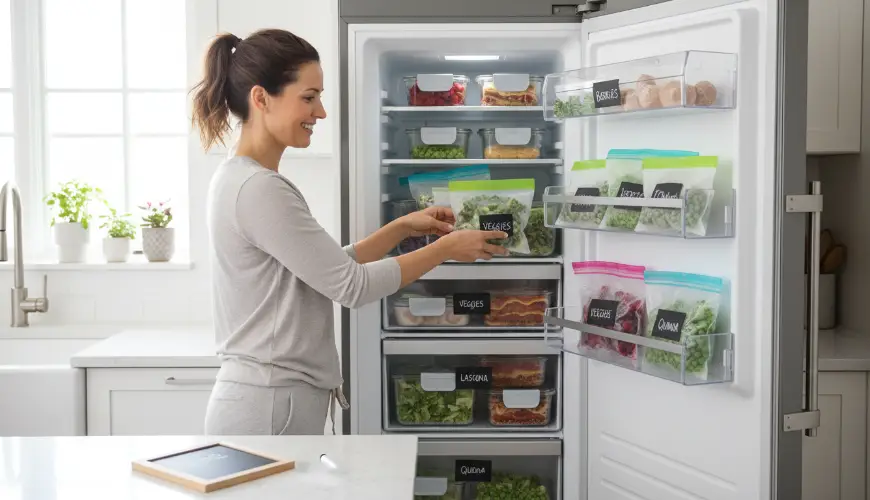
After cleaning comes sorting. Food in the freezer should be divided into logical categories – meat and fish separately, ready meals separately, vegetables and fruit separately, baked goods separately. Transparent boxes, baskets, or labelled bags are a great help here. There is a wide range of eco-friendly and sustainable options on the market, such as reusable silicone bags, which are not only practical but also kinder to the environment than single-use plastic bags.
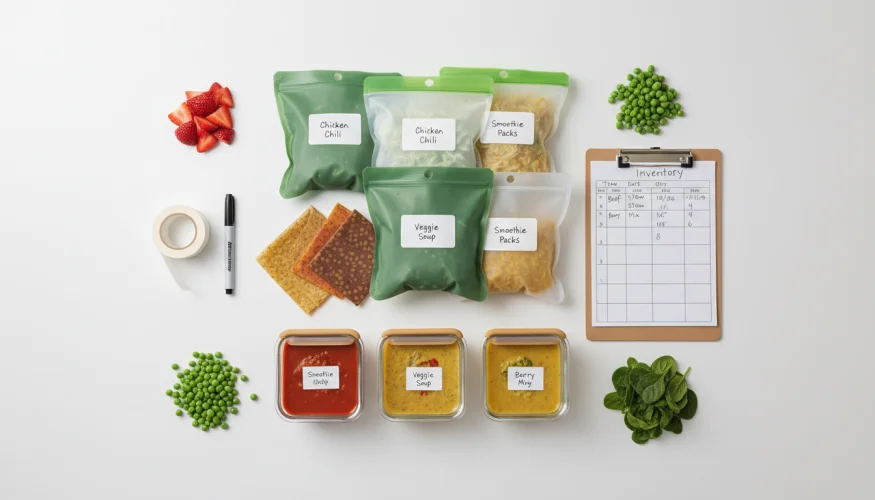
Labelling is an absolute must. Every item that goes into the freezer should be marked with a name and the date it was stored. A strip of paper tape and a marker, or special freezer labels, are all you need for this. Without this simple step, even the most carefully organised freezer quickly becomes an impenetrable mess. As writer Michael Pollan aptly put it: "Buy food, not products." – and the same applies here: store food, not mysteries.
It's also important to respect recommended storage times. The freezer does stop bacterial growth, but it doesn't stop fat oxidation or changes in food texture. Beef keeps in the freezer for approximately 4 to 12 months, poultry 9 to 12 months, fish 3 to 6 months, ready meals 2 to 3 months, and baked goods approximately 3 months. A detailed overview of recommended storage times is available from, for example, the American food safety authority FoodSafety.gov, whose recommendations are equally applicable to European households.
A practical tool is a so-called freezer inventory – a simple list of what is stored in the freezer, when it went in, and in what quantity. It can be kept on paper stuck to the freezer door, in a spreadsheet on your phone, or in one of the apps designed specifically for managing household supplies. This approach may seem like unnecessary bureaucracy, but once you get into the habit of maintaining it, it saves not only money but also a great deal of stress when planning everyday meals.
A sustainable freezer as part of an eco-friendly household
Freezer organisation is closely linked to the broader topic of sustainable living. Less wasted food means fewer methane emissions from landfill, less unnecessary consumption of resources, and less money spent on nothing. The freezer can be a powerful tool for reducing food waste – if used wisely.
One way to make full use of the freezer is so-called batch cooking, or cooking larger quantities at once. Instead of cooking from scratch every day, a larger portion of one dish is prepared, some is eaten straight away, and the rest is frozen in individual portions. The result is a quick homemade alternative to ready meals – healthy, affordable, and without unnecessary packaging. The same applies to vegetables and fruit that ripen too quickly: strawberries, bananas, spinach, or peas are ideal for freezing at the peak of their freshness, rather than waiting for them to spoil.
Another environmental aspect is the choice of suitable containers and bags. Single-use plastic bags remain the most widespread way of storing food in the freezer, but alternatives are now readily available and affordably priced. Reusable silicone bags, glass containers suitable for the freezer, or beeswax wraps – all of these are options that significantly reduce the amount of plastic waste from the household. Glass containers have the added advantage of being transparent, so the contents are visible at a glance.
It is also worth mentioning that a properly functioning and organised freezer is more energy-efficient. A full freezer – but not an overstuffed one – maintains its temperature better than a half-empty one, because frozen food acts as a thermal accumulator. Conversely, an overstuffed freezer where air cannot circulate freely forces the compressor to work harder to maintain the required temperature. The ideal state is a freezer that is approximately three-quarters full.
A specific category is seasonal supplies. Summer is the ideal time to freeze fruit from your own garden or from a farmers' market – strawberries, raspberries, blueberries, plums, or apricots. These supplies can then be used during the winter months as a base for smoothies, desserts, or cakes, with their flavour and nutritional value significantly higher than fruit bought in winter that has travelled thousands of kilometres. Similarly, herbs can be frozen in summer – basil, parsley, or dill – either whole or processed into cubes with olive oil.
A natural part of sustainable freezer organisation is also regular stock reviews. It's not enough to set up a system once and then forget about it. Once a month, it's worth going through the freezer contents, checking dates, and adjusting the meal plan as needed so that older supplies are used up first. This habit, once it becomes part of a routine, takes no more than ten minutes, but its benefits are incomparably greater.
In the end, everything comes back to a simple principle: the freezer is a helper, not a storage unit. It is there to preserve food so that it is actually eaten – not to hide food from sight and let it be forgotten. A well-organised freezer saves time, money, and the planet – and that is a combination well worth investing a few hours in once a season.