
A single-person household doesn't have to mean waste
Living alone has its undeniable charms. Silence when you need it, the freedom to decide on every detail of the household without compromise, and complete control over what gets bought, cooked, or recycled. Yet this very freedom brings specific challenges that shared households never face. A single-person household operates by entirely different rules – and those who don't grasp this early enough needlessly waste money, squander food, and burden the environment far more than they need to.
The statistics speak clearly: according to data from the Czech Statistical Office, single-person households make up approximately one third of all households in the Czech Republic, and their share has been growing steadily. This isn't just about seniors or students – more and more people in their thirties and forties are consciously choosing to live without flatmates or a partner. This group has entirely specific consumer needs that the market largely ignored until recently.
Try our natural products





Why standard household advice doesn't work for people living alone
Most advice about economical shopping, eco-friendly households, or healthy eating is created with the implicit assumption that a household contains at least two to four people. Buy the large pack, you'll save money. Cook a bigger portion, there'll be leftovers for tomorrow. Get a dishwasher, it's more eco-friendly than washing by hand. All of this may be true – but only under certain conditions that single-person households often don't meet.
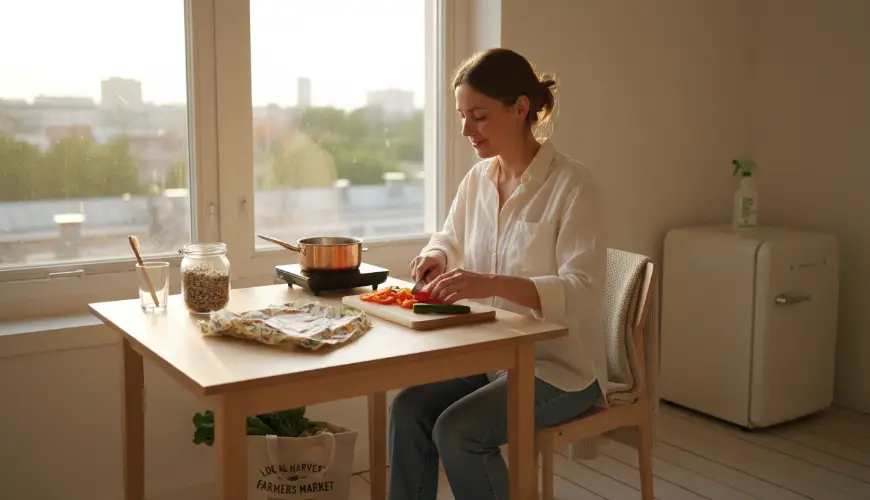
Take a concrete example: Jana, a thirty-three-year-old graphic designer living alone in a Brno flat, had long told herself she should switch to a more eco-friendly lifestyle. She started buying vegetables in organic quality and larger quantities, because it worked out cheaper per kilogram. The result? Half of it ended up in the bin because she couldn't use it in time. She switched to smaller quantities from a local farmers' market and suddenly found she was wasting significantly less, with overall costs comparable or even lower. Ecology and economy go hand in hand – but only when you buy in quantities that match your actual needs.
Food waste is a society-wide problem of enormous proportions. According to a report by the United Nations Food and Agriculture Organization (FAO), approximately one third of all food produced for human consumption is wasted globally. Single-person households contribute a disproportionately large share to this figure, precisely because they buy products sized for larger families.
The solution isn't complicated. It's about a shift in thinking – stopping following rules designed for a different type of household and starting to build your own system that reflects the real life of one person. This applies not just to food, but to virtually every area of running a home: cleaning products, energy consumption, kitchen equipment, or approaches to sustainable fashion.
The key is concentration and quality over quantity. A person living alone doesn't need ten different cleaning products for every surface – they need two or three universal products that work reliably and are kind to both the environment and their wallet. The same logic applies to kitchen equipment: smaller pots, smaller pans, a smaller blender. Or conversely – one quality multi-function appliance instead of four cheap ones that take up space and break down.
A sustainable approach to living alone
Sustainability tends to be presented in the media as a matter of grand gestures – solar panels on the roof, an electric car in the garage, a complete switch to veganism. In reality, however, a sustainable lifestyle is built from dozens of small decisions, which are all the more accessible when you live alone. Without needing to negotiate with other household members, a solo dweller can introduce changes immediately and consistently.
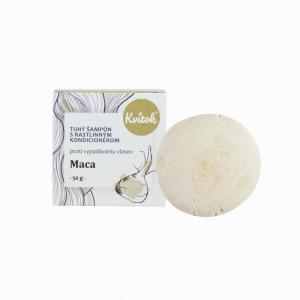
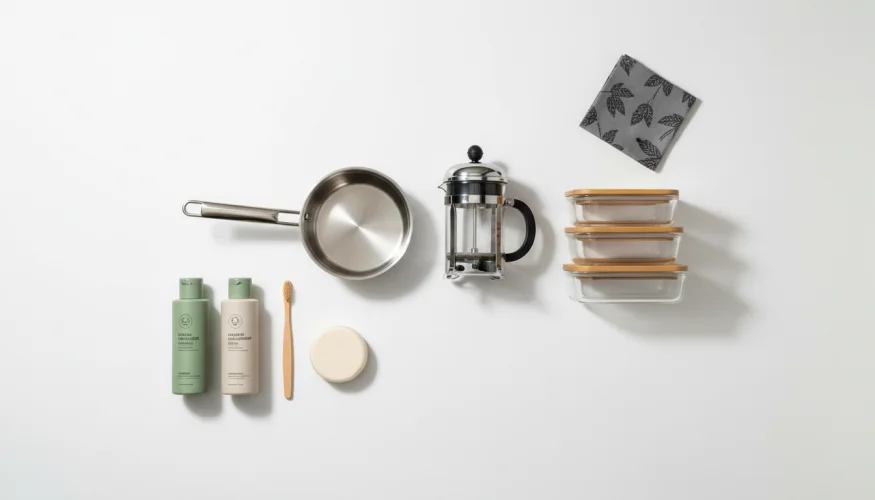
One of the most effective areas is switching to eco-friendly cleaning and hygiene products. Solid shampoo bars, bamboo toothbrushes, natural cleaning products in concentrated form, or refillable bottles – all of this makes sense for a single-person household not only ecologically, but practically too. Lower consumption means fewer supplies, less space needed in the cupboard, and less waste. As environmental activist and author Anne-Marie Bonneau, known as the Zero-Waste Chef, says: "We don't need a handful of people doing zero waste perfectly. We need millions of people doing it imperfectly."
This approach is particularly relevant for people living alone. It's not about becoming an overnight zero-waste hero, but about gradually replacing old habits with better alternatives. One refillable dispenser for washing-up liquid instead of three plastic bottles a year. One well-considered reusable shopping bag instead of a pile of plastic bags. One well-thought-out shopping list instead of impulse buying that leads to waste.
Energy consumption is an interesting chapter. While a single-person household consumes less energy overall, consumption per person can paradoxically be higher than in larger households – the washing machine runs at half capacity, the oven heats up for a single tray of food, the heating warms an entire flat for one person. The solution? Full washing machine loads even if it means washing less frequently, cooking in a smaller pot, or using a microwave instead of a conventional oven for smaller portions, managing energy use with smart plugs and thermostatic radiator valves. It's not about deprivation, but about setting up a smart routine.
The approach to clothing works similarly. Sustainable fashion isn't just about what you buy, but how much you buy. People living alone – and particularly women living alone – tend, according to surveys, to buy clothes more frequently, because they don't have a partner with whom to share household costs, and fashion becomes a form of self-expression or reward. Yet fast fashion is one of the planet's greatest polluters. According to data from the Ellen MacArthur Foundation, every second, the equivalent of a truckload of textiles ends up in landfill or incineration. The alternative is consciously buying fewer items but of better quality – or using second-hand shops, which have been experiencing a genuine renaissance in recent years.
How to set up a single-person household practically and smartly
Moving from theory to practice means thinking about specific areas where a single-person household functions differently from a family one. The kitchen is a good place to start, as it presents the greatest challenge for many solo dwellers.
Cooking for one has a bad reputation – it seems laborious, uneconomical, and frustrating. In reality, it's simply a matter of learning to scale recipes correctly and plan ahead. Batch cooking – preparing larger quantities at once and then freezing individual portions – is a strategy that saves solo dwellers both time and money. One Sunday spent cooking can cover lunches for an entire week. The key is having the right equipment – quality freezer containers, smaller pots and pans, and ideally a food vacuum sealer that extends the shelf life of fresh ingredients.
Another practical step is to reconsider your shopping rhythm. The large weekly shop that works for a family can be a trap for waste when you live alone. A better alternative is often a combination of a smaller basic shop for non-perishables once a week, supplemented by fresh ingredients two or three times in smaller quantities. Farmers' markets, local shops, or community vegetable box schemes are ideal for this purpose – they offer smaller quantities of better quality without the need to buy kilogram packs.
When it comes to home appliances, one basic rule applies for solo dwellers: less is more. A coffee machine that only makes espresso may be a better choice for one person than a full automatic machine costing twenty thousand. A small fridge-freezer combination instead of a large American-style fridge. A compact washing machine or a washer-dryer combo that saves space. Each of these decisions has an impact not only on your wallet, but also on the household's ecological footprint.
It's worth mentioning the psychological dimension of living alone too. Without sharing space and responsibility with someone else, it can be easier to slip into unsustainable habits – ordering food every day because cooking for one doesn't seem worthwhile, or shopping impulsively because no one else can see. Becoming aware of these patterns is the first step towards change. What behavioural economists call a "commitment device" can help – pre-set rules that automate good decisions. A shopping list, a regular cooking day, an app tracking energy consumption. Small systems, big results.
Finally, it's worth remembering that living alone doesn't mean living in isolation from the community. A shared garden, a community composter, group purchases from local farmers, or clothing swap events are all ways to compensate for the disadvantages of a single-person household while also building social connections. A sustainable lifestyle is always a community matter too – regardless of how many people live under one roof.
A single-person household is not a scaled-down copy of a family household. It is a distinct way of life with its own logic, its own needs, and its own rules. Those who understand this and adapt their habits accordingly will find that living alone can be not only liberating, but surprisingly sustainable – for their wallet, for the planet, and for their own wellbeing.