
# Why Is It So Hard for Women to Ask for Help
There is one silent assumption that many women carry within themselves for so long that they have almost stopped noticing it. The assumption that managing everything on your own is a virtue. That being self-sufficient means being strong. That asking for help is something you do only when there is no other option – and even then with an apology on your lips and a feeling that you are being a burden. This pattern is not an exception. It is an experience shared by an enormous number of women across generations, cultures, and social classes.
This is not merely a personal habit. It is a deeply rooted social script that says: a woman nurtures, organises, holds the family together, manages work, the household, and relationships – and does it all with a smile. When she finds herself on the verge of exhaustion, the first thing she does is look for ways to manage even more, not how to pass part of the burden on to someone else.
Try our natural products


Why asking for help is so difficult
Psychologists speak of a phenomenon known as "superwoman syndrome" – the belief that a proper woman must be a perfect mother, a high-achieving professional, a caring partner, and at the same time look after her own health, look good, and still find time to bake homemade bread. This syndrome is not just a fashionable term. Research published in the journal Psychology of Women Quarterly repeatedly shows that women who have internalised these excessive demands suffer from higher levels of stress, anxiety, and burnout than women who are able to ask for help.
Part of the problem lies in childhood. From an early age, girls are praised for being good, quiet, and helpful. Boys for being brave and independent. The result is that adult women have a deeply ingrained reflex: to take care of others before themselves. And asking for help? That goes against everything they were raised to believe.
Added to this is the fear of judgement. What will people think of me? Will I look incompetent? Will I disappoint their expectations? This fear is real and not irrational – research shows that women in the workplace are genuinely judged more harshly when they show weakness or uncertainty, while men displaying similar behaviour are perceived as authentic. This creates a vicious cycle: women are afraid to ask for help because it can have real social consequences, and at the same time they take on an ever-greater burden that worsens their situation.
Let us add one more dimension: guilt. Many women feel guilty when they accept help – as if they were admitting that they are not up to what they expect of themselves. This feeling is particularly strong among mothers. Asking for help with children, with the household, or even with their own mental health can be perceived as a failure of the maternal role, even though it is precisely the opposite of the truth.
Consider a specific example. Jana is a forty-year-old accountant, a mother of two children, who cares for her sick mother while trying to maintain her career. Every evening she falls asleep feeling she has not done enough. Every morning she wakes up knowing that a never-ending list of tasks awaits her. When a friend asks how she is, she replies: "Fine, I'm managing somehow." Yet she knows that is not true. But telling the truth would mean admitting that she does not just need help – she desperately needs it. And that is too great a vulnerability for Jana to be able to name out loud.
Jana's story is not exceptional. It is the story of millions of women who every day choose to carry their burdens in silence, because no one ever taught them that sharing the load is a form of strength, not weakness.
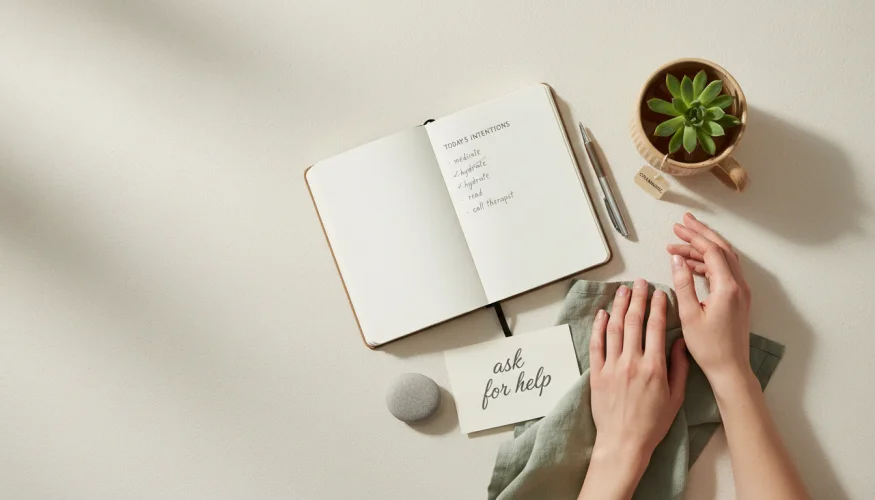
How to ask for help – practically and without guilt
The transition from managing everything alone to accepting help is not a one-time moment. It is a gradual process that requires reassessing deeply held beliefs. And it begins long before a person opens their mouth.
The first step is naming your own needs. This sounds simple, but for women accustomed to suppressing their own needs in favour of others, it can be genuinely challenging. A recommended method is to pause regularly for honest self-reflection – for example, asking yourself each evening: What did I need today and not receive? What exhausted me? What will I need tomorrow? Therapist and author Nedra Tawwab, who specialises in healthy boundaries, says: "We cannot communicate needs that we have not acknowledged to ourselves."
The second step is reframing what asking for help means. Culturally, we are conditioned to perceive it as a sign of weakness. In reality, it is an act of trust – towards other people and towards ourselves. Telling a partner, friend, or colleague "I need help with this" is not a surrender. It is an invitation to a relationship that works in both directions. The people around us are usually happy to help – they just need to know how and with what.
The third step is to be specific. One of the greatest obstacles when asking for help is vagueness. "I need help" is difficult to act on. "Could you pick the children up from school today?" or "I need someone to check this document" – these are requests that can be answered. Specificity lowers the barrier on both sides. The person asking does not feel as though they are demanding too much, and the other party knows exactly what is needed.
The fourth step is to accept that help does not have to be perfect. One of the less obvious reasons why women do not ask for help is perfectionism. If they believe someone else would do it differently – or better – they would rather do it themselves. But this logic leads directly to exhaustion. Learning to accept that the dishes might be washed differently from how we would do them, or that a partner may buy different things at the shop but will still go shopping, is part of the process of letting go of control. And letting go of control is one of the healthiest things you can do for yourself.
The fifth step – and perhaps the most important – is seeking professional help when the situation calls for it. Psychological burden, burnout, anxiety, or a sense of loss of meaning are not things that can be managed through willpower alone. Psychotherapy, counselling, or even support groups are tools that exist precisely for these situations. According to data from the World Health Organization, women suffer from depression at twice the rate of men – and one of the key factors is precisely isolation and the refusal to accept support.
It is also important to mention the role of physical health in this entire process. Chronic stress, which arises from overload and the suppression of one's own needs, has measurable physical consequences – from sleep disorders to a weakened immune system to cardiovascular disease. Self-care – whether it involves movement, quality sleep, nutrition, or conscious slowing down – is not a luxury. It is a prerequisite for sustainable functioning. And here too, it holds true that sometimes the best form of self-care is asking for help with what is overwhelming us, so that there is actually time and energy left for self-care.
Communities and relationships play a crucial role in this process. Research published in the Harvard Study of Adult Development, one of the longest-running studies of human happiness, shows that the quality of interpersonal relationships is the strongest predictor of mental and physical health in adulthood. In other words: people who are able to ask for help and maintain deep relationships live longer and healthier lives. Isolation and self-sufficiency at all costs come at a price – and we pay it with our health.
There is one more aspect that is less often discussed: the example we pass on. Women who grow up with mothers or other close women who never admit fatigue, never ask for help, and always manage everything on their own adopt this pattern as the norm. By contrast, a woman who is able to say "I cannot manage this alone today, I need help" and does so without dramatisation and without self-blame, conveys to those around her – her children, friends, and colleagues – an entirely different message: that being vulnerable is human and that asking for help is acceptable.
Asking for help is not failure. It is an act of courage, self-respect, and maturity. It is the decision to stop carrying everything alone and instead to lean on the people around you – not because you are not enough, but because you are part of a network of relationships that has meaning precisely when it works in both directions. Women who learn this do not lose their strength. On the contrary – they stop wasting it on maintaining a façade and begin investing it where it truly matters.
And perhaps the most important question is ultimately a simple one: Who could we call today and say "I need help"? And what is stopping us from doing so?