

Try cold water hardening by walking already this winter
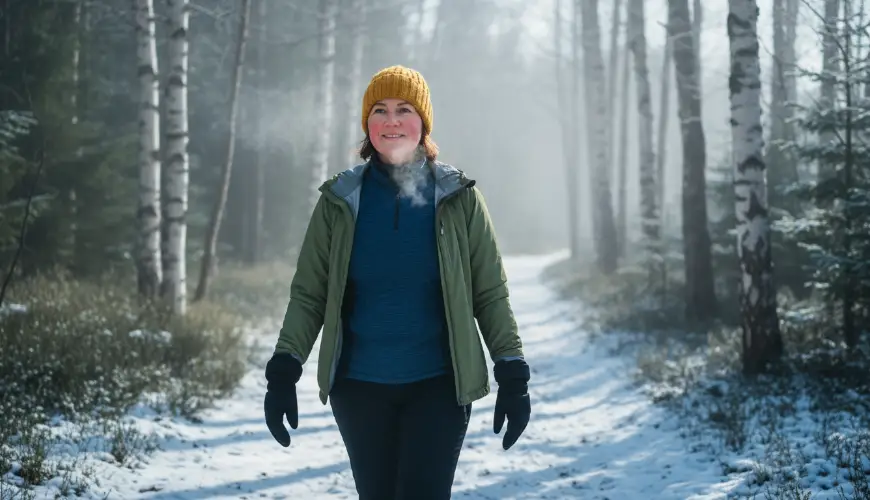
When autumn arrives and temperatures begin to drop, most people instinctively reach for a thicker jacket, shorten the time spent outdoors, and move their activities into heated interiors. This is understandable — yet in doing so, they miss out on something their bodies may need more than they realise. Cold-weather walks are not merely a substitute for summer exercise. They are a distinct form of training that strengthens the immune system, hardens the body, and delivers benefits that no air-conditioned gym can match.
Cold hardening has deep roots in human culture. Scandinavians and Finns have practised it for generations — alternating between the sauna and a cold plunge into a lake or snow is part of everyday life there, not an eccentricity. In recent years, however, a less radical form of cold exposure has been gaining public attention, one that does not require jumping into icy water. Walking in the cold — regularly, mindfully, with gradually increasing duration — is an accessible way to begin training the body's resilience to low temperatures. And the results it delivers are scientifically supported.
Try our natural products






What happens in the body when you step outside in the frost
To understand why walking in the cold has such an effect, it is useful to look beneath the surface of physiology. As soon as the body senses a drop in the temperature of its surroundings, an entire cascade of reactions is triggered. Blood vessels in the peripheral parts of the body — in the hands, feet, and on the surface of the skin — constrict to limit heat loss and protect the vital organs. The heart begins to work more intensively to ensure adequate blood flow. Metabolism accelerates, because the body needs to produce more heat. All of these processes together represent a genuine challenge for the organism — and challenge is the very foundation of any training.
Repeated exposure to cold leads to the body gradually adapting to these situations. Thermoregulation improves, blood vessels respond more flexibly, and the immune system is activated. Research published in the scientific journal PLOS ONE has shown that regular cold exposure can increase the number of white blood cells and strengthen the body's natural defences. This is therefore not mere folk wisdom — specific biological mechanisms underlie the effects of cold hardening.
Particular attention deserves the so-called brown fat, scientifically known as brown adipose tissue. Unlike white fat, which serves as an energy store, brown fat burns energy — precisely in order to produce heat. Walking in the cold demonstrably increases its activity. This has a direct impact not only on thermoregulation, but also on overall metabolism, blood sugar levels, and body weight.
And yet relatively little is required. There is no need to walk in a T-shirt at minus ten degrees. The body responds even to mild cooling — to a walk in a lighter jacket at five degrees Celsius, to consciously slowing one's pace so that one feels the cold on one's face and hands. It is precisely this moderation that makes cold-exposure walking a method accessible to virtually everyone.
Mental resilience as a by-product of winter walks
The physical benefits of cold are discussed fairly often, but the mental dimension of cold hardening tends to be overlooked — even though it is equally fascinating. Walking outdoors in inclement weather trains not only the body, but also the mind. Overcoming resistance, getting dressed, and stepping outside at a moment when it would be more comfortable to stay at home is in itself an exercise in willpower.
Psychologists describe this phenomenon as the strengthening of so-called behavioural flexibility — the ability to act in accordance with one's intentions even when it is not pleasant. People who regularly practise small discomforts as part of their daily routine demonstrate greater resilience to stress, a better ability to concentrate, and an overall more stable mood. As Finnish researcher and pioneer of cold-exposure research Hannu Rintamäki put it: "The cold does not weaken us. It teaches us that we are stronger than we think."
Winter walks also have a direct effect on serotonin levels. Sunlight — even the weak, winter kind — stimulates its production. The combination of movement, fresh air, and natural light creates a cocktail that can effectively combat seasonal depression, known as SAD (seasonal affective disorder). According to the World Health Organization, up to ten percent of the population in northern countries suffers from this form of depression to varying degrees — and regular time spent outdoors is among the recommended non-pharmacological interventions.
Consider a practical example: Jana, a forty-four-year-old teacher from Brno, began two years ago taking a thirty-minute walk every morning — regardless of the weather. At first it was difficult, she admits. But after a few weeks she noticed that she slept better, fell ill less often, and above all — felt mentally more resilient even in demanding work situations. She has no scientific measurement of her progress, but the description of her experiences corresponds to what research repeatedly documents.
How to start cold-exposure walking correctly and safely
One of the biggest mistakes people make when attempting cold hardening is being overly ambitious at the outset. The body needs time to adapt — and when given that time, it responds surprisingly willingly. If it is not, the risk is overexertion, catching a cold, or simply disappointment and giving up.
A sensible approach begins with clothing. The key principle is layering, not a single thick jacket. Three thinner layers are more effective than one thick one — they allow body temperature to be regulated according to current exertion and outdoor temperature. The base layer should wick moisture away from the body, the middle layer should provide warmth, and the outer layer should protect against wind and any moisture. For cold-weather walks, materials such as merino wool or modern functional synthetics are ideal.
Another important aspect is gradualness. One can begin with shorter walks — twenty to thirty minutes — and gradually increase both the duration and the degree of cold exposure over the course of weeks. There is no need to go out every day; three to four times a week is entirely sufficient frequency for a beginner. What matters is consistency over the long term, not heroic feats right from the start.
Particular attention should be paid to the extremities. Hands, feet, ears, and nose are the most vulnerable points at low temperatures. Good gloves, a hat, and warm socks are not a luxury, but essential equipment for anyone who wants to practise cold hardening safely and sustainably. For those who wish to go further, there are also specialist thermal undergarments made from natural materials, which offer excellent thermal comfort while maintaining breathability.
Cold-exposure walking is suitable for the vast majority of healthy adults. Caution is warranted for people with cardiovascular conditions, Raynaud's syndrome, or other conditions in which cold may pose a health risk. In such cases, it is advisable to consult a doctor before proceeding.

Nature as a gym without a membership fee
It is interesting how modern culture has expended enormous resources on creating artificial environments for physical activity — gyms, wellness centres, heated swimming pools — while one of the most effective environments for training resilience exists for free behind every door. Winter is not an obstacle to movement. It is part of it.
The Scandinavian concept of friluftsliv — loosely translated as "life in the open air" — is rooted in the conviction that nature is accessible and beneficial in every season. Norwegians, Swedes, and Danes do not limit outdoor activities to the summer months; on the contrary, winter walks, cross-country skiing, or simply sitting outside with a cup of hot tea are part of their everyday culture. And the results are evident — Scandinavian countries consistently rank among the world's leaders in indices of happiness, health, and quality of life.
This approach is slowly but surely spreading to Central Europe as well. More and more people are discovering that regular walking in the cold is not a hardship, but a distinctive form of pleasure. Frosty air, the silence of a winter landscape, the crunch of snow underfoot, or simply the sensation of cold wind flowing across one's face — these are experiences that have their own intrinsic value, independent of any health benefits.
And yet this is an activity that requires no special equipment, no club membership, and no expert knowledge. All it takes is getting dressed, opening the door, and going out. Gradually, with awareness of what is happening in the body, with respect for one's own limits, and with an openness to the idea that cold can be a friend rather than an enemy.
For those who wish to complement their winter wardrobe with high-quality, environmentally friendly clothing or accessories suitable for outdoor activity, it is worth seeking out products made from natural materials — such as the aforementioned merino wool, organic cotton, or recycled materials. Such an approach is consistent not only with caring for one's own health, but also with regard for the natural environment that makes these walks possible.
Winter comes every year. The question is not whether to endure it — but whether to make the most of it.