
Smoothie for women suffering from fatigue and iron deficiency
Fatigue that doesn't go away even after a good night's sleep. Pale skin, hair loss, the feeling that your body simply won't cooperate. Many women are familiar with these symptoms, yet they often attribute them to stress, overwork, or simply "hectic times." The truth, however, may be more straightforward and, at the same time, more solvable – chronic fatigue in women is very often caused by iron deficiency. And a smoothie made from the right ingredients can be a tasty and natural way to give your body what it needs.
Iron is one of those minerals that the human body simply cannot do without. It is a key component of haemoglobin – the protein in red blood cells that carries oxygen to all tissues and organs. When the body has too little of it, cells literally starve for oxygen, which manifests as that exhausting fatigue, dizziness, or inability to concentrate. According to the World Health Organisation, iron deficiency is one of the most widespread nutritional deficiencies in the world, and women are significantly more affected than men – particularly due to menstruation, pregnancy, and breastfeeding.
Try our natural products
Why women are more susceptible to iron deficiency
A woman's body loses iron regularly every month during menstruation, and with heavier bleeding, the losses can be quite significant. Added to this is the fact that many women follow various diets or restrict their meat intake, thereby unknowingly reducing their intake of the most easily absorbed source of this mineral. Pregnancy then virtually doubles the need for iron, as the body must supply not only itself but also the growing foetus. It is therefore no surprise that, according to data from the National Institute of Public Health, a considerable percentage of women of reproductive age in the Czech Republic suffer from iron-deficiency anaemia.
The problem, however, lies not only in the amount of iron consumed, but also in its absorbability. There are two types – haem iron, which comes from animal sources and is absorbed very efficiently by the body, and non-haem iron from plant sources, whose bioavailability is considerably lower. But this does not mean that vegetarians or vegans need to give up hope. The right combination of foods can significantly increase the absorption of non-haem iron – and this is precisely where a cleverly composed smoothie comes into play.
Vitamin C is, in this respect, truly golden. Ascorbic acid converts non-haem iron into a form that the intestine can absorb much more effectively. Studies published in journals such as the American Journal of Clinical Nutrition have repeatedly confirmed that consuming vitamin C together with iron can increase its absorption up to threefold. This is why every smoothie aimed at replenishing iron should contain a rich source of vitamin C – whether that be citrus fruits, kiwi, papaya, or red bell pepper.
The ingredients that make the difference
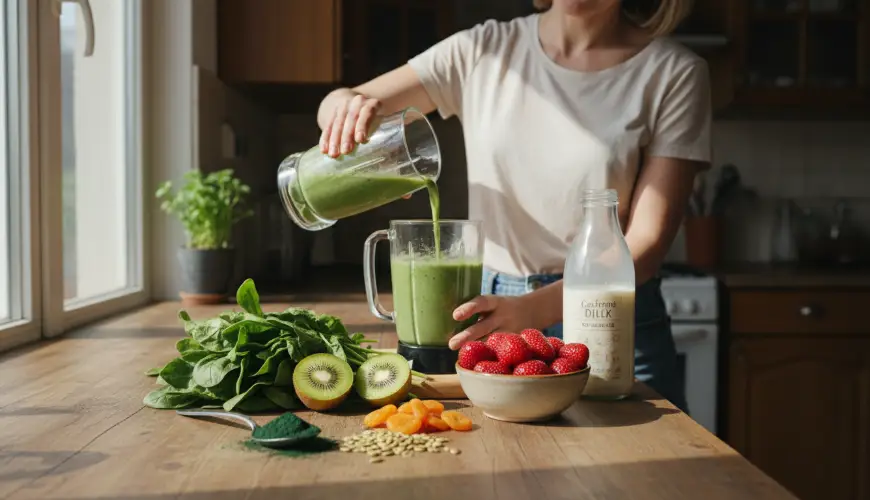
The foundation of a good iron-boosting smoothie consists of ingredients that naturally contain high amounts of this mineral, as well as those that facilitate its absorption. Among plant-based sources with the highest non-haem iron content are dark leafy greens – spinach, kale, or Swiss chard. Just 100 grams of fresh spinach contains approximately 2.7 mg of iron, while the recommended daily intake for women of reproductive age is around 18 mg. Spinach is ideal for smoothies – it has a mild flavour that is easily masked by fruit, and it does not affect the consistency of the drink.
Other excellent ingredients include hemp seeds and pumpkin seeds, which are literally packed with iron – 100 grams of pumpkin seeds contains over 8 mg of this mineral. They can easily be added as a topping or blended directly into the drink. Dried apricots or prunes are also great additions, as they are a concentrated source of iron while also providing natural sweetness to the smoothie. Blackstrap molasses, particularly the dark variety, is another surprising source – one tablespoon contains up to 3.5 mg of iron and also beautifully enriches the flavour of the drink.
Vitamin C-rich fruit then forms the second indispensable layer. Strawberries, kiwi, oranges, pineapple, or blackcurrants – all of these are ingredients that not only taste great but actively help the body utilise iron. Kiwi deserves special attention in this regard: one medium-sized kiwi covers more than 100% of the recommended daily intake of vitamin C while containing only around 60 calories.
It is important to know, however, what does not belong in a smoothie. Coffee, black tea, and dairy products contain substances that actively block iron absorption – tannins, phytic acid, and calcium. A smoothie aimed at replenishing iron should therefore not contain yoghurt or milk as a base. Instead, it is better to opt for plant-based alternatives – oat, almond, or rice drink – or simply use water or coconut water.
Another interesting and very practical ingredient is spirulina – a blue-green algae that contains approximately 28 mg of iron per 100 grams and is also rich in protein, B vitamins, and antioxidants. One teaspoon of spirulina added to a smoothie will significantly boost its nutritional value, though it is worth bearing in mind that it will slightly alter the taste of the drink. For those who are trying spirulina for the first time, it is advisable to start with a smaller amount.
What an iron smoothie looks like in practice
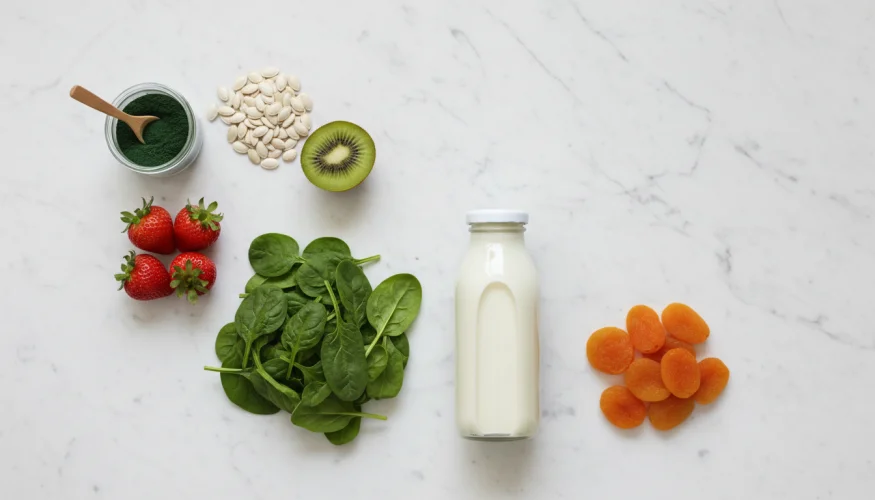
Imagine Klára – a thirty-four-year-old teacher and mother of two who complained of constant fatigue and hair loss. After visiting her doctor and having a blood test, it turned out that she had low ferritin levels – the storage form of iron. Her doctor recommended adjusting her diet and possibly considering dietary supplements. Klára decided to start gradually, and as a first step she began having a smoothie every morning made from a handful of fresh spinach, one kiwi, a handful of strawberries, a teaspoon of spirulina, a tablespoon of pumpkin seeds, and a glass of oat drink. After six weeks of drinking it regularly, a follow-up blood test showed improvement – and perhaps even more importantly, Klára herself felt she had more energy and that her hair was falling out less.
Such stories are not uncommon. Nutritional therapist Margit Slimáková, one of the leading Czech nutrition experts, has long emphasised that diet is the foundation of health and that many health problems can be resolved, or at least significantly alleviated, by adjusting what we eat and drink every day. As she herself says: "Food is information for our cells. Every bite or sip tells the body how to function."
Smoothies have one great advantage over conventional meals – speed and simplicity of preparation. In the morning, when time is precious, all it takes is throwing the ingredients into a blender, pressing a button, and in two minutes it is done. Yet one such drink can cover a significant portion of the daily requirement for iron and vitamin C. For women who do not have the time or inclination to deal with complex recipes, this is a very accessible solution.
When choosing ingredients, it makes sense to prioritise quality. Organic spinach, certified spirulina, or seeds from verified producers ensure that the drink contains no unnecessary added chemicals. Online shops focused on healthy living, such as Ferwer, offer a wide range of such ingredients under one roof – from superfoods and seeds to plant-based milk alternatives.
There is one more thing that tends to be overlooked when putting together an iron-rich diet: consistency. A one-off smoothie will not work miracles. Iron is stored in the body gradually, and the reserves are replenished just as gradually. The key is regularity – consistently incorporating iron-rich foods into the daily diet, ideally always in combination with vitamin C. A smoothie is an excellent ally in this regard precisely because it can easily become part of a morning routine.
It is also worth noting that a smoothie is not a medicine. If a woman experiences significant fatigue, dizziness, or other symptoms of possible anaemia, the first step should be a visit to the doctor and a blood test. Only based on the results can it be determined whether there is indeed an iron deficiency, how severe it is, and whether a dietary adjustment is sufficient or whether supplements are also needed. A smoothie can be an excellent complement to treatment and a preventive measure for the future, but it does not replace professional medical care.
The world of smoothies is, moreover, incredibly diverse. The combinations of spinach–mango–orange, spirulina–pineapple–ginger, red berries–dried apricots–coconut water – the possibilities are endless, and each one can be delicious in its own way. Experimenting with ingredients is actually an enjoyable part of the whole process. And when you discover that you enjoy a drink that is also doing you good, that is a win on every level. Fatigue does not have to be an inevitable part of a woman's life – sometimes all it takes is one sip of the right smoothie to start moving things in the right direction.