
# Why Do We Tolerate Things Elsewhere That Bother Us at Home?
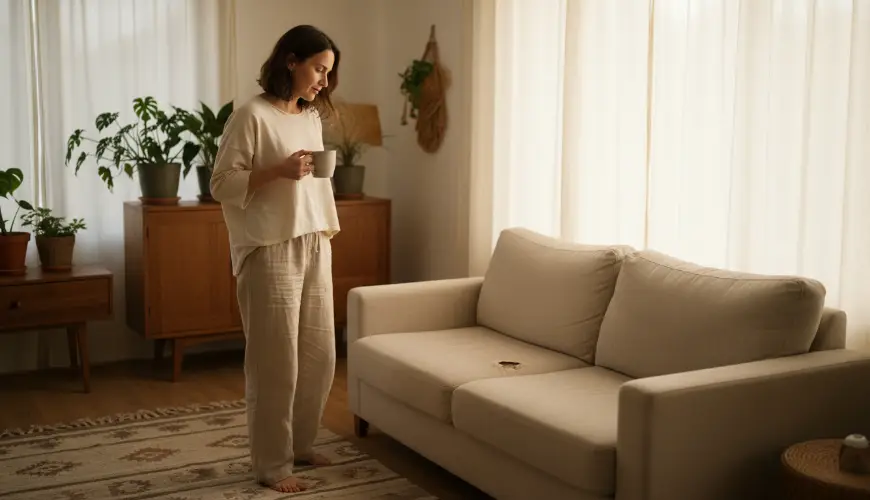
Everyone knows the feeling. You come home after a long day, drop your bag on the floor, and suddenly an uncomfortable feeling washes over you. That scuffed corner of the hallway furniture that's been there for a year. The stain on the carpet that catches your eye every time you walk past. The creaking stair that wakes you every morning. And yet at a friend's place or in a restaurant, you wouldn't notice any of these things – and if you did, they wouldn't bother you at all. What's actually going on? Why does our own home manage to irritate us in ways that would never even occur to us anywhere else?
The answer to this seemingly trivial question reaches deep into the psychology of perception, into how our brain functions in an environment we consider our own, and into what we actually expect from a home.
Try our natural products






A brain that adapts – and then stops adapting
Psychologists describe this phenomenon as habituation – a process by which the brain stops responding to stimuli that repeat without any consequence. This is precisely why you eventually stop noticing the ticking of the clock in the living room or the distant street noise outside the window. The brain learns that these stimuli are not important and simply filters them out.
However, habituation doesn't work uniformly for all types of stimuli. Visual imperfections in an environment we perceive as "ours" undergo different processing. Research in environmental psychology suggests that the more we identify with a space, the more sensitively we react to what doesn't "fit" within it. At home, we are in a state of heightened ownership awareness – and ownership brings responsibility, and therefore increased attention to shortcomings.
In other words, in a café, you are a guest. Nobody expects you to take care of the condition of the furniture. In your home, however, you are the "caretaker" – and your brain knows it. Every scuff or stain thus becomes an implicit reminder that there is still something you haven't done, fixed, or resolved. This is the source of the strange tension that so many people describe when they come home and, instead of relaxing, immediately feel overwhelmed.
British psychologist and environmental expert Dr. Sally Augustin repeatedly emphasises in her work that the home is a mirror of a person's inner world – and that is precisely why its imperfections feel so personal.
The incompleteness effect and the mental burden of the home
There is another key mechanism at play in this phenomenon – the so-called Zeigarnik effect. Russian psychologist Bluma Zeigarnik demonstrated in the first half of the 20th century that unfinished tasks remain active in our minds far longer than completed ones. The brain literally "remembers" them with greater intensity, as if it keeps them permanently open in a tab.
Let's translate this into the context of the home. Every thing that bothers us at home and hasn't been fixed is, from the brain's perspective, an unfinished task. A cracked tile in the bathroom, a rusty tap fitting at the sink, a pile of things on the bedroom chair – these are all open tabs that continuously consume mental energy in the background. And because we spend time at home in relative quiet, without external stimuli to draw our attention elsewhere, these "tabs" surface far more easily than anywhere else.
Take a concrete example: Jana works in an open-plan office with noise, constant movement of people, and all manner of visual activity. When she comes home to her otherwise cosy flat, she suddenly notices that one of the blinds isn't working properly. In the office, she wouldn't have noticed it for a month. At home, however, it immediately starts to irritate her – and the more she tries to relax, the more she notices the faulty blind. This isn't because Jana is overly critical or anxious. It is a natural response of the brain to an environment that is "home" to her – a place where everything should be in order.
This phenomenon is also described in a study published in the journal Personality and Social Psychology Bulletin, which found that people living in cluttered or unfinished home environments show higher levels of cortisol – the stress hormone – than those whose homes present a more cohesive impression.
Identity, ownership, and what we expect from home
Key to understanding this phenomenon is also what home actually means to us. It is not merely a physical space – it is a projection of ourselves. Psychologists speak of the concept of the extended self, first systematically described by Professor Russell Belk. People have a natural tendency to merge with the things they own – and the home is the most intense example of this. As architect and spatial theorist Juhani Pallasmaa once said: "Home is not merely a place, it is a state of mind."
This is precisely why, when something bothers us at home, we don't perceive it as a problem with an object, but as a problem with ourselves. A scuffed wall in the living room is not just a scuffed wall – it is a visual signal saying: "Here is something you've neglected." And this signal, in a space that is part of your identity, is unbearably loud.
This effect does not occur with strangers or in public places, because there we feel no sense of responsibility or identification. A scuffed wall in a restaurant is an aesthetic shortcoming of the restaurant, not yours. The brain processes it, registers it, and moves on. At home, such lightness is absent.
What to do about it? A practical perspective on home care
Once you understand why your own home causes this specific form of tension, interesting possibilities open up for working with it. It's not about having a perfect, magazine-worthy home – that is both unattainable and psychologically counterproductive, since perfectionism creates its own kind of stress.
It is more about consciously reducing the number of those "open tabs". Experts in spatial organisation and mindfulness consistently recommend approaching the home gradually and with kindness – not as a project that must be finished by Saturday, but as a living space that evolves. Small, concrete steps have a greater psychological effect than large, unfinished plans.
It also helps to consciously distinguish between what genuinely bothers you and what is merely a temporary state. Not every thing that irritates you in a given moment deserves immediate attention. Sometimes it is enough to consciously "close the tab" – to acknowledge that the thing exists, and to consciously decide to deal with it another time. This approach, close to the principles of cognitive-behavioural therapy, can significantly reduce the level of stress associated with the everyday sight of one's home.
The quality of the things that surround us also plays an interesting role. Research shows that people are less stressed by imperfections in an environment they perceive as intentional and valuable. In other words, the wear on an old wooden table that was deliberately chosen for its character feels different from a scuffed laminate surface that ended up there by chance. This is one of the reasons why interest in sustainable and high-quality household products has grown in recent years – it's not just about the ecological aspect, but about the conscious selection of things that have meaning and value.
If you are looking for inspiration on how to gradually transform your home into a space that brings calm rather than stress, it may be useful to start from the basics – from the everyday objects you actually use. It is precisely in details such as natural materials, functional design, or eco-friendly household products that a surprisingly large part of how we feel at home is hidden.
Why this matters more than it seems
It would be easy to dismiss this issue as oversensitivity or unnecessary worry about trifles. Yet the influence of the home environment on mental health is today well documented. Research from UCLA and other institutions repeatedly shows that the environment in which we spend the most time significantly affects our mood, sleep quality, ability to concentrate, and overall stress levels.
Home is the place where it should be possible to truly rest – physically and mentally. If it becomes a space full of unresolved stimuli and unfinished tasks, it loses its fundamental function. And this manifests beyond the home as well: people who don't feel good at home are less productive at work, less patient in relationships, and cope less well with stress in general.
Understanding why things bother us at home that we would overlook without a second thought elsewhere is therefore not merely an interesting psychological curiosity. It is a gateway to better caring for the space in which we live – and thereby for ourselves. A mindful approach to the home, the gradual elimination of sources of minor everyday stress, and the intentional selection of the things that surround us are steps that have a real impact on quality of life. And that is worth paying attention to.