
# Strengthen Your Core with Pilates Hundred in a Few Minutes The Pilates Hundred is one of the most
There is an exercise that Pilates instructors around the world describe as the absolute foundation of every class. It is called the "hundred" – and if you have ever stepped onto a Pilates mat, you have probably experienced it firsthand. This seemingly simple exercise, in which you lie on your back and rhythmically pump your arms, conceals a surprising depth. It is not just a warm-up. It is a concentrated lesson in what Joseph Pilates called the "powerhouse" – the body's centre of strength, from which all movement originates.
But why the hundred specifically? And why does this exercise appear in Pilates classes from Prague to New York, from beginners to elite athletes? The answer lies in what the exercise actually does to the core, to the breath, and to one's overall awareness of movement.
Try our natural products





What the Pilates exercise hundred is and how it works
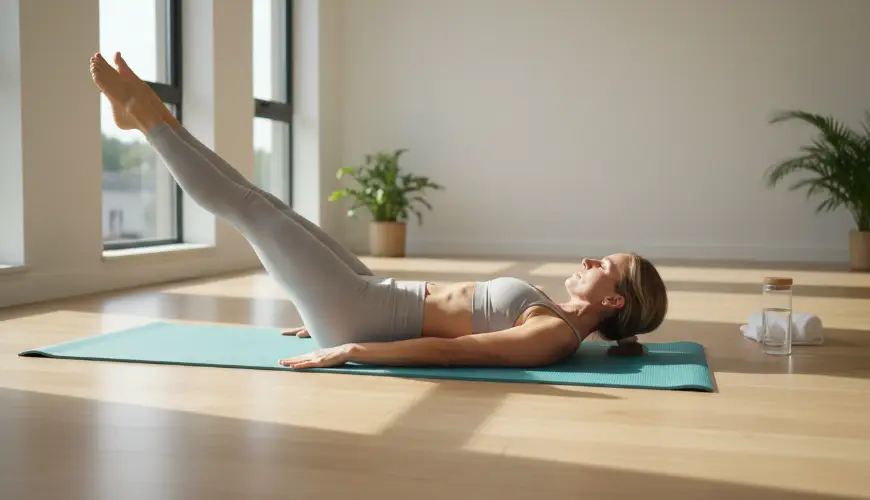
The hundred got its name in a very straightforward way: when performing it, one hundred rhythmic arm movements are made. Specifically, this consists of ten sets of ten small, controlled pumps – five inhales and five exhales per set. Throughout the exercise, the body assumes a precisely defined position: the back is pressed into the mat, the legs are lifted to an angle of approximately forty-five degrees or higher depending on the practitioner's level, the head and shoulders are slightly lifted off the mat, and the arms move energetically up and down at hip height.
It sounds simple, but the reality is different. Correct execution of the hundred requires the simultaneous coordination of breath, engagement of the deep abdominal muscles, spinal stabilisation, and conscious control of the entire body. No muscle works in isolation – quite the opposite. The hundred is, in a sense, an orchestra in which every player must know their role.
From an anatomical perspective, the primary muscles engaged in the hundred are those of the abdominal wall, particularly the transversus abdominis, which forms a natural corset around the spine. The rectus abdominis, oblique abdominal muscles, and deep spinal stabilisers also contribute. Secondarily, the hip flexors, hamstrings, and even the muscles of the arms and shoulders are engaged. It is therefore a complex exercise involving a large portion of the body simultaneously – with the breathing rhythm adding yet another dimension: conscious engagement of the diaphragm and intercostal muscles.
The science behind it is not complicated, but it is compelling. Research shows that deep core muscles play a key role in preventing back pain and improving the overall function of the musculoskeletal system. Studies published in the Journal of Orthopaedic & Sports Physical Therapy repeatedly confirm that targeted strengthening of the deep muscular corset leads to a significant reduction in chronic lower back pain. The hundred activates this corset naturally, within the context of holistic movement – not as isolated strength training.
How the hundred is performed correctly
Technique is everything. A poorly executed hundred will not engage the correct muscles and may instead overload the neck or lower back. It is therefore worth paying close attention to the fundamentals, particularly for beginners.
Starting position: lie on your back, bend your knees, and place your feet flat on the mat. Slowly draw your abdomen towards your spine – not merely contracting the superficial muscles, but truly "engaging" the deep muscular corset. Then lift your head and shoulders off the mat so that your chin moves slightly towards your chest, while keeping your neck relaxed. Your arms are extended alongside your body, palms facing down.
Beginners may keep their knees bent or rest their legs in the so-called "table top" position. More advanced practitioners extend their legs and lower them closer to the mat, thereby increasing the demands placed on core stabilisation. The lower the legs, the more intensively the abdominal muscles must work to prevent the lower back from arching. The golden rule is: the legs may only go as low as the lower back can remain in contact with the mat.
Then comes the rhythm. Five short inhales through the nose, five short exhales through the mouth – accompanied by energetic yet controlled arm pumps. The arm movement is not large; it is more of a vibration than a wave. The pace is moderate, the rhythm steady. After ten such cycles – that is, one hundred pumps – the exercise is complete.
Experienced instructors frequently point out several most common mistakes. The first is pulling on the neck – if the practitioner feels tension in the neck, they should reduce the height of the head lift or support their head with their hands behind it. The second mistake is losing contact between the lower back and the mat when lowering the legs – in this case, the legs should be raised higher. The third mistake is shallow or held breath, which disrupts the entire rhythm of the exercise and strips it of much of its effectiveness.
Why the hundred is more than just abdominal strengthening
This is where we arrive at what makes the hundred exceptional compared to conventional strengthening exercises. It is not simply about making the abdomen look better – though that does come as a pleasant side effect. In Pilates philosophy, the hundred is regarded as an exercise for both mind and body simultaneously.
Joseph Pilates, the German exercise pioneer who developed his method in the first half of the twentieth century, believed that body and mind are inseparable. "Pilates is the coordination of mind, body, and spirit," he would say. The hundred embodies this philosophy literally: without concentration, the correct position cannot be maintained; without conscious breath, the rhythm cannot be sustained; without body awareness, the muscles cannot be properly engaged. It is an exercise in presence.
The breathing component of the hundred also has a direct effect on the nervous system. The short, rhythmic inhales and exhales activate both the sympathetic and parasympathetic branches of the autonomic nervous system – the exercise therefore functions as a gentle energiser that awakens the body without overloading it. This is why the hundred is traditionally placed at the beginning of a Pilates class: it prepares the body for movement, warms the deep muscles, and synchronises breath with motion.
Consider, for example, a middle-aged woman – let us call her Jana – who sits at a computer all day and suffers from chronic lower back pain. She begins attending Pilates classes, and the instructors guide her through the hundred as the first exercise every session. At first, it seems trivial to her, almost tedious. After six weeks, however, Jana notices that her back pain has diminished, that she sits more upright without conscious effort, and that she feels generally more stable. This is not coincidence – it is the result of regularly strengthening the deep muscular corset, which has begun to function as natural support for the spine even outside of exercise sessions.
There are thousands of stories like this. And while Pilates is not a miracle cure, research does confirm its effects. A review study published in the Journal of Bodywork and Movement Therapies found that regular Pilates practice leads to demonstrable improvements in core muscle strength, flexibility, and balance – across all age groups.
The hundred is not the exclusive domain of the physically fit. It can be adapted for almost anyone. Older practitioners or those recovering from injury can perform the exercise with their feet firmly on the mat and minimal lift of the upper body. Pregnant women in their second and third trimesters should consult a specialist and opt for a modified version where appropriate. Advanced athletes, on the other hand, can add reverse breathing or combine the hundred with other Pilates elements.
Interestingly, the hundred finds application beyond the Pilates studio as well. Physiotherapists recommend it to patients with lumbar spinal instability, coaches incorporate it into conditioning programmes for professional athletes, and yoga instructors sometimes combine it with breathing techniques as part of a broader movement practice. Its versatility lies precisely in the fact that it works with the body as a whole, rather than with isolated muscle groups.
For those who wish to incorporate the hundred into their home training, all that is needed is a mat and a few minutes of focus. No equipment, no gym required. Simply lie down, engage the core, and begin counting. Ten sets, one hundred movements, five inhales, five exhales. Consistency is the key – the Pilates core is built gradually, day by day, session by session.
The hundred is proof that the most effective exercises need not be the most spectacular. It requires no weights, no complex machinery, no acrobatic skill. It requires only awareness, breath, and a willingness to listen to one's own body. And it is precisely this that makes it one of the most enduring Pilates exercises, having survived more than a hundred years – and still holding its place at the very beginning of every class.