
# Visual clutter at home causes stress and fatigue, even when we're not aware of it at all
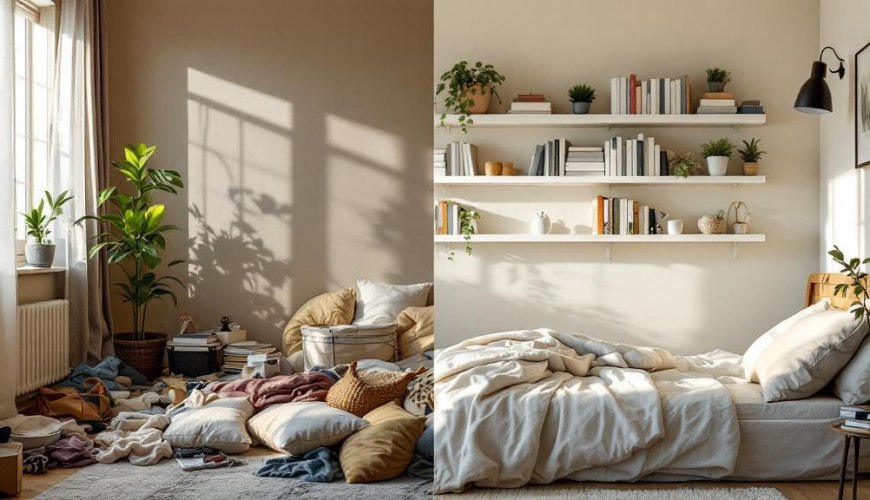
Every day we come home expecting peace and rest. But what if instead we're greeted by a cluttered hallway, a pile of unopened mail on the kitchen counter, and shelves full of objects we don't even look at anymore? Most people associate the word "smog" with polluted air over a big city, but there's another kind of overload that affects us more than we'd expect – visual smog. And we don't have to look for it only outside on streets full of advertisements. Very often we cultivate it right in our own living room.
Try our natural products





What is visual smog and why does it actually bother us
The term visual smog was originally used primarily in urban planning and architecture. It referred to an excess of advertising billboards, mismatched facades, flashing signs, and chaotic urban environments that tire the eyes and burden the mind. Over time, however, it became clear that the same principle works on a much smaller scale as well – inside our homes. Visual smog at home is essentially everything that creates unnecessary visual noise: cluttered surfaces, mismatched colors, piles of small items without a clear place, cables tangled behind the TV, magnets covering the entire fridge, or decades-old decorations that no longer bring anyone joy.
But why should this bother us? After all, it's not just about aesthetics. Research in neuroscience and psychology has repeatedly confirmed that clutter and visual overload increase cortisol levels, the stress hormone. A study conducted at Princeton University found that physical clutter in our field of vision competes for our attention and reduces our ability to focus on important tasks. In other words, the brain constantly processes all those visual stimuli around us, even when we're not consciously aware of it. Every object in our peripheral vision takes a bit of mental energy. And when there are hundreds of such objects, the result is fatigue, irritability, and the feeling that "I can't focus on anything," without knowing exactly why.
Interestingly, this effect is amplified in environments where we should be resting. In the workplace, we're to some extent prepared for visual stimulation – colleagues, screens, documents. But at home, we expect relief. When we don't get it, the body and mind remain in alert mode. As architect and designer William Morris aptly noted: "Have nothing in your houses that you do not know to be useful or believe to be beautiful." This more than one-hundred-year-old piece of advice is more relevant today than ever before.
Moreover, visual smog in the home tends to grow unnoticed. Most people don't bring home two hundred unnecessary things at once. But one souvenir from a vacation, one promotional deal at the drugstore, one gift that doesn't suit but "it would be rude to throw it away" – and after a few years, it becomes a layer of visual noise that we no longer even perceive because we've gotten used to it. This is precisely where the insidiousness of visual smog lies: we adapt to it, but its impact on our well-being doesn't disappear.
Many people describe that after a thorough cleaning and organizing of their space, they experienced a feeling similar to being relieved of a chronic headache they didn't even know they had. This isn't an exaggerated comparison. Our visual environment shapes our mood, productivity, and sleep quality. A bedroom full of piled-up laundry, books, cosmetics, and random objects on the nightstand sends the brain a signal that "there's still work to do here," which certainly doesn't help with falling asleep at night.
How to reduce visual smog at home – practical tips that actually work
The good news is that calming down the home environment doesn't require a complete renovation or an interior designer's budget. Often, simply changing our approach to what and how we store things at home is enough, and results come surprisingly quickly. It's not about creating a sterile, empty space without soul – it's about consciously choosing what stays in our field of vision and what doesn't.
The first and most important step is taking an honest look at the surfaces we see most often. The kitchen counter, dining table, coffee table, hallway – these are the places where our gaze falls dozens of times a day. That's where tidying up has the greatest effect. There's no need to start with the entire apartment at once. Just pick one surface and decide that only what functionally belongs there or what truly brings us joy will remain. Everything else gets its place in a cabinet, in a drawer, or leaves the household entirely.
Related to this is a principle that minimalism advocates know as "one in, one out" – for every new item that enters the household, one leaves. You don't have to be a minimalist in the strictest sense of the word to benefit from this rule. It's enough to treat it as a guideline that naturally curbs endless accumulation. In practice, this means that when you buy a new mug, you give away or recycle an old one. When a new book arrives on the shelf, another one goes to a book-sharing box. It's a simple mechanism, but incredibly effective in the long run.
Another powerful tool against visual smog is unifying colors and materials. This doesn't mean the entire apartment has to be white or gray. But it does mean that when a pink vase, green candleholder, orange figurine, blue frame, and yellow box all stand on the same shelf, the brain perceives it as chaos, even if each individual item is attractive. Simply reducing the color palette to two or three harmonizing tones significantly increases the sense of calm. The same applies to storage boxes, baskets, and organizers – if they're made of the same material and color, the space immediately feels more orderly.
A very underestimated source of visual smog is cables and electronics. Tangles of cables behind the TV, under the desk, or at the charging station in the hallway create visual clutter that we register subconsciously. Yet the solution is relatively easy – cable organizers, cable clips, or simple cable channels can work wonders. The same goes for small electronic devices that we leave in visible places even though we use them once a week.
Walls and doors are also worth mentioning. A fridge covered in magnets, a bulletin board overflowing with old tickets and notes, a wall with dozens of mismatched frames – all of this contributes to visual overload. One beautiful painting has a much greater impact than a gallery of twenty mismatched pictures. And an empty wall isn't "boring" – it's a place where the eyes can rest.
A concrete example might be helpful. Imagine a family with two children in a typical apartment. The hallway is full of shoes, jackets hang one over another, keys, flyers, toys, and sunglasses pile up on the dresser. The kitchen counter holds a toaster, blender, spice rack, knife block, fruit bowl, three decorative tins, and a stack of school papers. The living room is full of toys, cushions, and magazines. Nothing is dirty anywhere, but everywhere it's visually full. All it took was for this family to introduce a few simple rules: shoes go into a closed cabinet, only items used daily stay on the counter, toys have their own basket where they get put away in the evening, and flyers go straight into the bin. The result? The apartment looks twice as big, and all family members describe feeling more relaxed at home. No big investment, no dramatic transformation – just a conscious decision to reduce visual noise.
When buying new things for the home, it pays to ask a question that is simple but surprisingly effective: "Where exactly will I put this?" If the answer is "I'll put it somewhere" or "we'll see," there's a high probability the item will end up as another addition to the visual smog. On the other hand, if an item has a clearly defined place and a clear purpose, it fits naturally into the space.
We also shouldn't forget about digital visual smog, which is closely related to the physical kind. A computer desktop full of icons, dozens of open browser tabs, unread notifications on the phone – all of this works on the same principle as a cluttered kitchen counter. The brain registers it as unfinished tasks and keeps us in a state of mild stress. Regular digital decluttering – deleting unnecessary files, organizing the desktop, unsubscribing from newsletters we don't read – is a natural complement to physically simplifying the household.
Minimalism as a life philosophy offers a valuable framework in this context, even though it doesn't need to be adopted as dogma. The essence of minimalism isn't about having as few things as possible, but about having only the right things. It's about a conscious relationship with the objects that surround us and an understanding that fewer visual stimuli means more mental space. Popular books like "The Life-Changing Magic of Tidying Up" by Marie Kondo or "Essentialism" by Greg McKeown address this topic from different angles but share a common core: quality over quantity, intentionality over inertia.
For those who want to go deeper into the topic of the influence of environment on the psyche, an overview of research on the American Psychological Association website exploring the relationship between environment and mental health may be of interest. It shows that an organized, visually calm environment has a measurable positive impact on reducing anxiety and improving cognitive functions.
The path to a visually calm home is more of a marathon than a sprint. It's not about throwing out half your belongings one weekend and then living in an empty apartment that doesn't feel cozy. It's about a gradual, conscious transformation of your relationship with your own space. Every tidied drawer, every cleared shelf, every cable hidden in a channel is a small victory. And those small victories add up to something we feel very concretely – calm, focus, and the feeling that home truly is home. Perhaps it's time to look around with fresh eyes and ask: of everything I'm looking at right now, what truly brings me joy?