

What one tree can teach us about the rhythm of nature and life
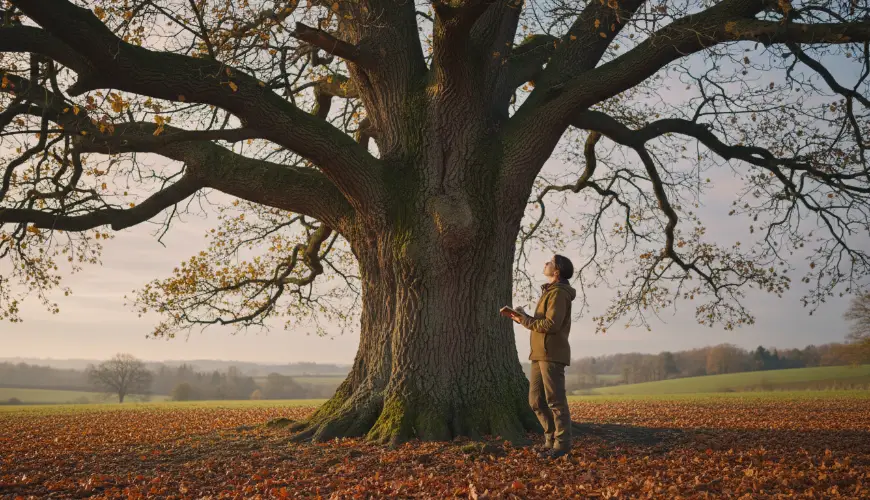
There is a special magic in stopping at one particular tree and returning to it again and again. It doesn't have to be any monument or a centuries-old linden tree in the town square – a garden apple tree, a birch outside the window, or an oak at the edge of the forest that you pass every day on the way to work will do. Yet precisely this simple faithfulness to one place can bring surprisingly profound insights – about nature, about time, about oneself.
This approach, which might be called "observing one tree throughout the year", is nothing new. Naturalists, poets, and philosophers have practiced it since time immemorial. The Japanese concept of satoyama – caring for the landscape in the immediate vicinity of humans – is based on a similar principle: deep knowledge comes through repeated, attentive contact with a specific place, not through rapid movement from one experience to another. And yet, in the age of smartphones, instant content, and constant shifting of attention, such a practice is almost revolutionary.
Try our natural products




How a tree transforms time into a story
Observing one tree throughout the year is essentially an exercise in patience. January brings bare branches that appear dead, but that is precisely when their shape, branching, and crown architecture are most visible. Only without leaves does it become clear how carefully the tree distributes its weight, how symmetrically or asymmetrically it has responded to light and wind over the decades. Experienced dendrologists can read an entire history of a tree from the shape of its crown – where a forest once stood, where a wall once stood, where people pruned it.
With the arrival of February and March, something begins to change. At first you won't notice the buds, but if you visit the tree regularly, one day you'll realise that the branches have stopped being grey and are beginning to take on a faint greenish or reddish tinge. This is a moment that cannot be planned – it can only be experienced. And precisely because it cannot be googled or watched on video, it has such a powerful emotional impact.
The natural transition from spring to summer then brings an explosion of activity. Leaves unfurl, the first insect visitors arrive, birds seek places to nest. The tree becomes an ecosystem. British naturalist and writer Robert Macfarlane notes in his book The Wild Places that true wilderness is not necessarily far away – it can be present even in a single old tree in the middle of a city. This thought is liberating: we don't need to travel to Iceland or the Amazon rainforest to experience contact with living nature in all its complexity.
Summer brings an apparent calm – the tree looks full and stable. But that is precisely when the most work takes place. Photosynthesis runs at full capacity, roots draw water from deep layers of soil, fruit ripens. If you sit under a tree on a summer afternoon and close your eyes, you hear buzzing, rustling, movement – an entire small world that exists independently of human concerns. Psychologists refer to this kind of presence in nature as a restorative experience – a renewing experience that reduces stress and restores cognitive capacity.
Lessons no textbook can provide
Autumn is probably the most dramatic period of the entire year. Leaves change colour not randomly, but as the result of a complex biochemical process: the tree stops producing chlorophyll and pigments that were present all along are revealed, previously hidden beneath the green. It is a fascinating metaphor – what appears to be an ending is in fact a revelation. Autumn colouring is not death; it is truth.
Observing this process in one specific tree throughout the year brings knowledge that cannot be gained in any way other than direct experience. You begin to notice that your tree turns red earlier or later than neighbouring trees of the same species. You start to ask why – is it because of the soil? The orientation towards light? The microclimate? These questions are not academic; they are alive and personal, because they concern a specific tree to which the observer has a relationship.
And this is where one of the deepest lessons lies: nature shows us that every organism is unique, even when it belongs to the same species. Two linden trees standing side by side will respond to the same conditions in slightly different ways. Just like two people growing up in the same family. This analogy is not merely poetic – it is biologically accurate. Epigenetics, the science examining how the environment influences gene expression, shows that individual experience shapes living organisms in ways that shared genetic makeup cannot predict.
Take a specific example: Jana, a teacher from Brno, began photographing an old walnut tree in her parents' garden in January 2022. Every week she took a photograph from the same spot, at the same time of day. At the end of the year she had 52 photographs, which she compiled into a video. She says that only then, when she saw the entire year compressed into two minutes, did she understand how dramatically the tree changes – and at the same time how stable it remains in its essence. "It was like watching your own parent grow old and simultaneously realising how much you love them," she described her experience.
Such a practice also has very concrete effects on a person's relationship to the natural world. Research repeatedly shows that people who have a personal relationship with natural places or organisms are significantly more motivated to protect them. A study published in the journal Environment and Behavior demonstrated that so-called "place attachment" – an emotional bond to a place – is one of the strongest predictors of ecological behaviour. In other words: it is not enough to know that forests are important. You need to have a specific tree that you care about.

How to begin and why it is worth it
Winter arrives and the tree returns to its winter rest. But this time the observer sees it differently. They know what is happening beneath the bark, they know the rhythm that will follow. The bare branches are not sad – they are full of potential. A whole year of observation has transformed the view of an apparently static object into a dynamic, living story.
The practice of observing one tree throughout the year requires no special equipment or expert knowledge. All that is needed is regularity and a willingness to pay attention. Some people keep a journal, others take photographs, others simply sit and observe. Every approach is valid. If you want to deepen your botanical knowledge, you can use apps such as iNaturalist, which enables species identification and sharing of observations with the scientific community – while also contributing to a worldwide biodiversity database.
The key is to choose a tree that is easy and regularly accessible. Ideally one that you naturally pass by – on the way to work, during a morning walk with the dog, in the garden. Distance and accessibility are crucial: if the tree is far away, regularity is difficult to maintain, and it is precisely regularity that makes the whole practice meaningful.
A natural question arises: what does all of this mean for everyday life? The answer may be surprising. People who practise this kind of attentive presence in nature report reduced anxiety, a better ability to concentrate, and a deeper sense of meaning. This is no coincidence – evolutionary psychology suggests that the human brain is "tuned" to perceive natural cycles, because for most of human history survival depended on the ability to read nature's signals. Modern life has cut us off from these signals, but the need for them is still present within us.
The tree we observe throughout the year teaches us rhythm. It teaches us that every season has its purpose – that winter is not merely a waiting for spring, but a necessary part of the whole. It teaches us patience, because no moment can be hurried or skipped. It teaches us humility, because the tree existed long before us and – if we protect it – will exist long after us. And perhaps above all it teaches us attention: the ability to see what is always present, but which we cease to perceive the moment we stop looking.
One tree. An entire year. And suddenly the world is a little larger and a little deeper than it was before. That is not a bad result for simply stopping regularly in the same place and looking up.