
# Why Bedtime Fairy Tales Are Better Than Audiobooks
Every parent knows it. Evening approaches, the child doesn't want to go to sleep, and you're looking for the easiest way to get them into bed and make them close their eyes. Modern technology offers a tempting solution – just turn on an audiobook, set a timer, and leave the room. But is this really the best thing you can do for your child at that moment? The answer from experts and experienced parents alike is surprisingly clear-cut.
Fairy tales told in a living voice by a parent or grandparent have a value for the child that no recording can fully replace. This isn't about nostalgia or romanticising the past. It's about science, psychology, and something very concrete – the relationship between the child and the person reading them that story.
Try our natural products



What happens in a child's brain during bedtime reading
Research in the fields of child neurology and psychology has long confirmed that the bedtime reading ritual has a direct impact on sleep quality, language development, and a child's emotional stability. The American Academy of Pediatrics (American Academy of Pediatrics) recommends reading aloud to children from birth and emphasises that interactive reading with a parent develops language skills in a way that passive listening cannot provide.
The key word here is "interactive." When a parent reads a story, they naturally respond to the child – slowing down at a tense moment, changing their voice for different characters, pausing when the child asks a question, or spontaneously commenting on a picture in the book. This lively, unpredictable interaction activates the child's brain in a different way than playing a recording, where everything is fixed and no response to the specific child is forthcoming.
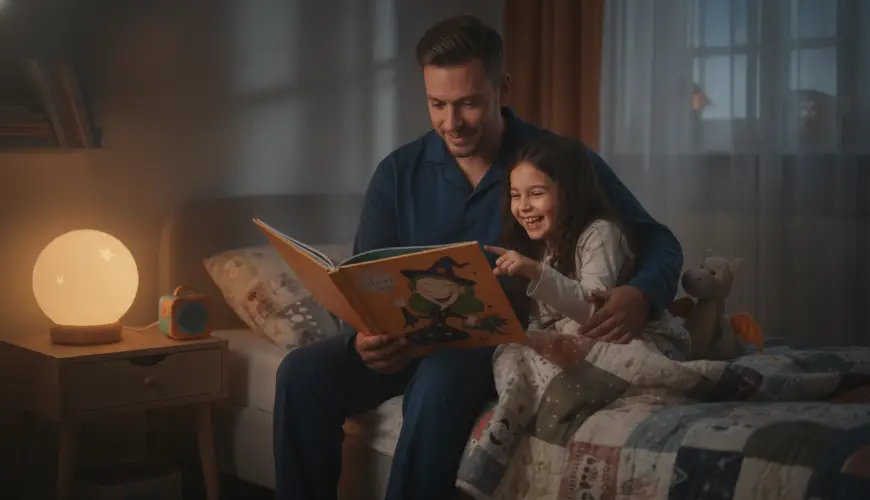
Imagine six-year-old Eliška, who listens to an audiobook of fairy tales every evening. The recording is professionally produced, the actor's voice pleasant, and the stories engaging. Eliška falls asleep quickly and her parents are satisfied. But one evening, her father sits on the edge of her bed and reads her the same fairy tale from a book. Eliška asks why the witch has green hair, her father laughs and says it probably didn't work out at the hairdresser's. Eliška giggles, then snuggles up and falls asleep with a smile. No audiobook can do that.
This seemingly trivial moment has a deep psychological foundation. Shared laughter, physical closeness, and a sense of security are precisely the ingredients that help a child transition from a wakeful state to peaceful sleep. Cortisol, the stress hormone, drops more quickly in the presence of a loved one than when listening to even the finest recording.
Audiobooks have their place – but not at bedtime
It would be unfair to condemn audiobooks entirely. They are an excellent aid on long car journeys, during illness when a parent cannot be present, or as a supplement to daytime reading. Through audiobooks, children expand their vocabulary, learn correct pronunciation, and can discover stories they might otherwise not have time for. These are undeniable advantages.
The problem arises when an audiobook replaces the bedtime reading ritual with a parent as a regular practice. And this is precisely what is happening in more and more families. The reasons are understandable – parents are tired, have little time, the working day has been exhausting. Yet this very tiredness is paradoxically an argument for live reading, not against it. Those fifteen to twenty minutes spent over a fairy tale are not just for the child. They are for the parent too.
Psychologists speak of the so-called "transitional ritual" – a moment that helps both parties separate the hectic day from the peaceful night. A parent who reads a fairy tale naturally slows down, puts down their phone, stops thinking about work emails, and focuses on the present moment. It is a form of gentle meditation that benefits the whole family.
As child psychologist and parenting author Margot Sunderland says: "Time spent with a child at bedtime is not a waste of time – it is an investment in their mental health that pays dividends for life."
Another reason why fairy tales told live at bedtime work better is the ability to tailor the story to the child's current state of mind. If the child has had a difficult day, experienced a conflict with a friend at nursery, or is afraid of the dark, an experienced parent can gently steer the story so that the child recognises themselves in the character and processes their emotions through the fairy-tale narrative. This sensitive improvisation is not possible with any pre-recorded audio.
Fairy tales have served this therapeutic function since time immemorial. It is no coincidence that we repeatedly find within them themes of fear, abandonment, overcoming obstacles, or finding one's way home. These are archetypal themes that resonate with a child's inner world. And when they are told by someone close who knows the child, this resonance can be consciously supported.
What the ideal bedtime fairy tale looks like
You may be wondering whether it matters which fairy tale you read to children, or whether the ritual itself is more important. The answer is a little of both. The content of the fairy tale should be calm, without excessive tension and dramatic twists just before sleep. Stories with a clear ending, where good triumphs and the characters find peace, help the child naturally settle into sleep.
Suitable examples include the following types of stories:
- Nature fairy tales – about animals, seasons, and natural cycles, which evoke a sense of calm and order
- Classic folk fairy tales with a simple plot and a clear moral thread
- Stories about everyday life close to the child's own experience, where the hero deals with situations similar to those the child encounters
- Fairy tales with recurring elements – rhythm and predictability are soothing and settling
By contrast, stories full of action, fear, or unresolved conflict activate the child's brain rather than calming it. Research in sleep medicine, including studies published in the journal Sleep Medicine Reviews, confirms that the content of thoughts and emotions immediately before falling asleep significantly affects the quality and depth of sleep.
The physical book also plays a not insignificant role in the whole ritual. Tactile contact with a book – turning pages, looking at illustrations, pointing at pictures – develops the child's relationship with reading itself. Children who are regularly read to from physical books read more frequently and with greater pleasure in later life than children whose contact with stories took place exclusively through screens or speakers. This data is repeatedly confirmed by studies from the organisation Book Trust, a British foundation focused on children's literacy.
Another aspect that is often overlooked is the development of imagination. When a child listens to an audiobook, they receive a ready-made audio picture – a professional actor delivers precisely the right emotion, precisely the right tone, precisely the right atmosphere. The child is a passive recipient. But when a parent reads from a book without sound effects and musical accompaniment, the child must construct the world of the story for themselves in their own head. This mental activity is enormously valuable for the development of creative thinking and spatial imagination.
Of course, there are situations where live reading simply isn't possible. A parent's illness, a business trip, or perhaps an older child who wants to listen to a story in the middle of the night without wanting to wake their parents. In such cases, an audiobook is an excellent alternative and certainly better than television or a tablet with visual content that overly stimulates the brain before sleep. It is therefore a matter of pragmatic distinction – an audiobook as a rescue in an emergency, yes; an audiobook as a regular substitute for bedtime reading with a parent, no.
Parents sometimes object that their child loves audiobooks and falls asleep wonderfully with them. That may be true and there is no reason to make it a problem. Quality sleep is important. But falling asleep quickly and falling asleep contentedly, in the safety of a parent's closeness, are two different things. A child who falls asleep quickly with a recording may simply have resigned themselves to the parent's absence and learned to fall asleep alone. That is practical, but from the perspective of emotional bonding and long-term mental health, it is not the same as a conscious, shared ritual.
It is also interesting to observe how bedtime reading changes as the child grows. Toddlers respond primarily to the rhythm of the voice and physical closeness; pre-school children love the repetition of the same stories endlessly – and that is fine, repetition is their way of learning and making sense of the world. School-age children begin to have their own preferences, ask more complex questions, and reading becomes a conversation. And even older children who could read a book themselves sometimes secretly wish someone would read aloud to them. Because it's not about the content. It's about closeness.
In an age when children and adults alike are surrounded by screens, notifications, and constant digital noise, reading a bedtime story is one of the few truly analogue moments of the day. A moment when the phone is switched off, the light is dimmed, and the only thing that exists is the parent's voice and the world of the story. This moment is worth protecting – not only for the children's sake, but for our own.