

# What to do when a child has a different pace than peers ## First, accept the difference Every ch
Every parent knows it – they arrive at the playground, a garden party, or a parent-teacher meeting and inevitably start making comparisons. The neighbor's daughter is already reading complete sentences, a friend's son rides his bike without training wheels, and your child can't yet. Or the opposite – your child taught themselves to read at four, but still can't tie their shoelaces and doesn't want to play with other children. A child's developmental pace is a topic that can trigger enormous anxiety in parents, yet the answer to the question of why this is the case is surprisingly simple: every child is different, and their individual pace is completely natural.
The problem arises, however, when parents hear this sentence repeatedly as empty reassurance, without receiving any concrete tools for how to genuinely come to terms with their child's different pace – and how to maintain their own calm and balance in the process.
Try our natural products



Why children develop at different rates
Developmental psychology has long confirmed that child development does not proceed linearly or uniformly. The World Health Organization (WHO) and the American Academy of Pediatrics (AAP) repeatedly emphasize that so-called "developmental windows" are broad – a child may begin walking anytime between ten and eighteen months and still be within the normal range. Yet society creates implicit expectations that are far narrower and more rigid than the scientific ones.
A whole range of factors underlies differences in developmental pace. Genetic makeup plays a role – if one parent was a late talker, it is more likely that the child will follow a similar pattern. Birth order also matters: firstborn children often have different conditions for language development than younger siblings, who are surrounded by older children and naturally adopt their patterns. A child's temperament, their sensory processing of the world, the level of stimulation in their environment, and health factors such as allergies, recurrent middle ear infections, or sleep disorders – which can slow certain areas of development without anything being pathological – all have a significant influence as well.
In other words – a child who lags behind peers in one area may be perfectly fine and even excel in another. A boy who isn't speaking in full sentences at three may have exceptionally developed motor skills and spatial thinking. A girl who refuses to draw and cut because it frustrates her may be emotionally more mature than most of her peers.
It is precisely this complex understanding of development that is the key to us, as parents, stopping the practice of evaluating our child against a single measure and beginning to see them as a whole.
Comparison as a trap that almost all of us fall into
It is important to say out loud: comparing children is a natural human reflex, not a parental failure. The brain is evolutionarily wired for comparison – it helps us assess risks and navigate the world. So when we see other children doing things our child cannot yet manage, a mild anxiety automatically kicks in. The problem arises when we uncritically accept this anxiety as a signal that something is wrong with our child.
Research in the field of parenting psychology, such as studies published in the journal Child Development, shows that excessive comparison and the resulting parental anxiety transfers to children and can paradoxically slow their development. A child who senses that a parent is anxious or disappointed in their performance responds with stress – and stress is one of the greatest enemies of healthy neurological development.
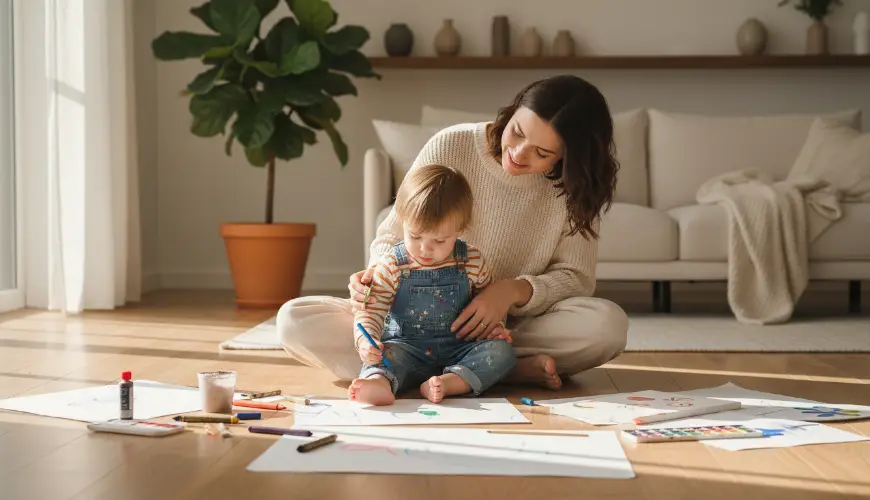
Consider a real-life example: Markéta, the mother of four-year-old Tomáš, noticed that her son wasn't yet drawing figures the way his nursery school peers were. She began pushing him to draw every day, bought worksheets, and compared his creations to children's drawings she found online. Tomáš began to hate drawing and resisted. It was only when Markéta stopped pushing and started drawing with him without any goal – just for fun – that Tomáš began to improve on his own within a few weeks. Pressure and comparison did not help; a safe space for natural development did.
This story is not an exception. It repeats itself in various forms in thousands of families and points to a fundamental truth: what a child needs most for their development is a sense of safety, not performance pressure.
How to stay calm when other children "can do more"
Maintaining inner balance in moments when you feel under pressure from those around you is not easy. But there are specific approaches that can genuinely help.
The first step is consciously distinguishing between what is a real problem and what is merely social comparison. There is a difference between a situation where a child shows no progress over a long period of time and you have specific concerns, and a situation where they simply lag behind one particular child in one particular skill. In the first case, a consultation with a pediatrician or child development specialist is appropriate. In the second case, the best remedy is perspective.
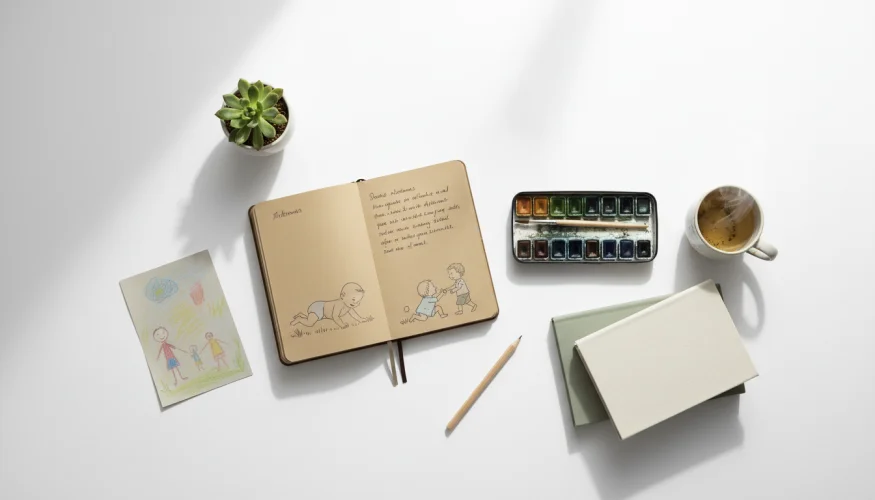
It can be very helpful to keep informal records of your child's progress – not to evaluate them, but to see their own developmental story. Photographs, brief diary entries, or simple notes on your phone will show you, over time, how far your child has come – and that is a comparison that makes sense: a child compared to themselves, not to others.
Another powerful tool is working through your own anxiety separately from your child. If the topic of your child's development causes you significant stress, this is a signal that you need care – not necessarily your child. A conversation with a partner, friend, psychologist, or in a parenting group can help you process your concerns without passing them on. As child psychologist Becky Kennedy, founder of the "Good Inside" approach, says: "The most important thing you can do as a parent is to regulate yourself before you start regulating your child."
In practical terms, this means: before you react to a situation where your child is "falling behind," take a moment for yourself. A few deep breaths, a short walk, a moment of quiet. Your calm nervous system is the most valuable environment you can provide for your child.
It also helps to limit your exposure to comparison-inducing stimuli. Social media is full of parents sharing their children's achievements – and algorithms deliberately show the most impressive content. Nobody publishes a post saying "my son again refused to eat vegetables today and threw away his crayons." Consciously limiting time on social media or selectively following accounts that share a realistic view of parenting can significantly reduce unnecessary anxiety.
When it's time to seek professional help
Even though a variable developmental pace is natural, there are situations where consulting a professional is genuinely warranted. There is no need to wait until a problem becomes obvious – on the contrary, the sooner you turn to a professional, the better. A pediatrician, child neurologist, speech therapist, occupational therapist, or child psychologist – each of them has tools to assess whether the pace is natural or whether the situation calls for targeted support.
Indicative signs worth paying attention to include:
- loss of already acquired skills – if a child stops doing something they previously could do
- significant isolation from peers and a lack of interest in any social contact
- absence of speech or a marked delay in combination with other behavioral differences
- intense tantrums or anxiety that significantly disrupts everyday functioning
- your own feeling that something is not right – parental intuition is legitimate and deserves to be heard
Seeking professional help is not an admission of failure. It is an act of care – for your child and for yourself. A specific developmental need identified early is far easier to address than one that has been overlooked for years.
The modern approach to child development is increasingly embracing what is known as the neurodiversity perspective, which recognizes that different ways of processing the world – whether ADHD, autism, dyslexia, or other differences – are not defects, but variations of the human brain. Children with these characteristics do not need to be "fixed," but need an environment and support that matches their specific needs. More on this approach is offered by organizations such as CHADD, which supports families of children with ADHD and provides accessible resources for parents in various languages.
Parents who take care of their own mental health and work on their own well-being are naturally calmer guides for their children. And a calm guide is the most valuable resource for a child with a different developmental pace. It is not about perfection – it is about presence, about the willingness to be with the child where they are right now, not where we wish they were.
Every child carries their own timeline. And when parents trust it – instead of comparing it to the timelines of others – that timeline becomes the best possible starting point for the child's entire future life.