

# Night Terrors in Children and How to Respond to Them Correctly
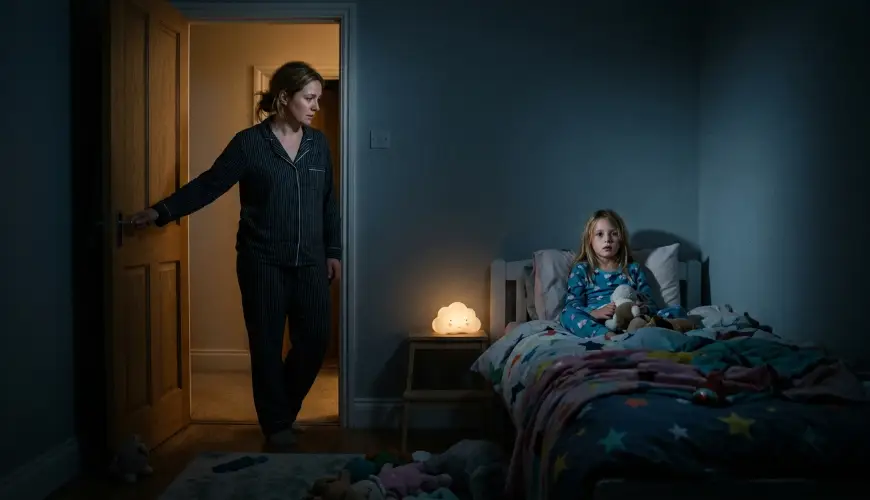
Imagine this scene: it's half past one in the morning, the house is sunk in silence, and suddenly a piercing scream comes from the children's room. Parents leap out of bed, hearts pounding, and when they reach their child, they see them sitting with eyes open, trembling or kicking, screaming with all their might — and seemingly completely unaware of their presence. They call the child by name, but there is no response. They try to hug them, but the child resists. After a few minutes that feel like an eternity, the child calms down and falls back asleep — and in the morning, they remember absolutely nothing from the entire night.
These are night terrors, and for parents experiencing them for the first time, they can be truly terrifying. The natural reaction is to try to stop them, prevent them, or "cure" them. Yet experts agree on something surprising: the best thing parents can do is learn how to respond correctly — not eliminate them at all costs.
Try our natural products

What night terrors are and why they differ from nightmares
Night terrors are a phenomenon that many people confuse with nightmares, but they are two fundamentally different things. Nightmares are dreams — the child wakes up, is frightened, remembers what they dreamed, and needs to be calmed and reassured. Night terrors, on the other hand, are a sleep disorder belonging to a group known as parasomnias. They occur during the deepest phase of sleep — so-called NREM sleep, specifically the slow-wave phase — and during them the child is technically neither awake nor fully asleep. They exist in a kind of in-between state where the brain is neither fully awake nor fully asleep.
This is precisely why the child does not respond to being called, does not recognise their parents, and remembers nothing from the episode in the morning. The brain has simply "got stuck" during the transition between sleep phases and is going through a kind of storm of nerve impulses, which manifests outwardly as screaming, crying, a confused gaze, or wild movements. The entire episode typically lasts between five and twenty minutes, sometimes longer.
According to data from various studies, night terrors affect approximately 1 to 6.5 percent of children, most commonly appearing between the ages of three and eight. Some sources, such as the American Academy of Sleep Medicine, indicate that the incidence may be even higher in preschool-aged children, because their sleep architecture differs significantly from that of adults — they have longer and deeper slow-wave sleep phases, making the transition to lighter phases more demanding.
Interestingly, night terrors have a strong genetic component. If one of the parents suffered from them, the likelihood that their child will experience them is significantly higher. They are therefore not a failure of parenting, an unsuitable environment, or a sign of psychological problems in the child — they are simply the way in which the developing brain works.
What triggers night terrors and how to understand them
Even though the cause of night terrors lies in biology, there are factors that demonstrably intensify their occurrence or make them more frequent. Fatigue and lack of sleep are paradoxically among the biggest triggers — a tired brain tends to fall into deeper NREM sleep faster and more intensely, which increases the likelihood that the transition between phases will not be smooth. Fever, illness, changes in environment or travel, stress, and major life changes such as starting nursery school or the arrival of a sibling also play a role.
One specific example: a seven-year-old boy began having night terrors regularly every week shortly after his family moved to a new flat. His parents initially searched for complex explanations — trauma, anxiety, problems at school. It turned out, however, that the key was much simpler: the boy was going to bed an hour and a half later than before, because the new flat was noisier and falling asleep was taking him longer. Once the parents established a more consistent evening routine and moved bedtime back to its earlier time, the episodes calmed down significantly.
This example illustrates well why it is so important to view night terrors in the broader context of a child's everyday life, rather than treating them as an isolated problem that needs to be "fixed."
As paediatric sleep specialist Richard Ferber wrote: "Night terrors are the result of a normal but immature nervous system — they are not a symptom of illness or psychological damage." This perspective can bring enormous relief to parents, because it helps them stop looking for a fault where none exists.
How to respond correctly when a night terror occurs
And here we come to the heart of the matter. The instinct of most parents is to intervene immediately — to take the child in their arms, shake them, call their name, try to wake them up. Yet this is precisely what can make the situation worse and prolong the episode. Because the child is technically neither awake nor asleep, sudden external stimuli — bright light, loud calling, physical contact — can confuse the brain further and delay the return to calm sleep.
What should you do instead? Experts recommend approaching night terrors with calm and patience, even though this is enormously difficult in the moment. The most important thing is to ensure the child's safety — to make sure they do not bang into furniture, fall out of bed, or sustain any injury. Then simply stay nearby, speak in a quiet, calm voice, and wait for the episode to pass on its own.
There is no need to wake the child. There is no need to convince them that they are safe — they cannot hear you at that moment anyway. It is enough to be present, to keep watch, and to let nature take its course. Most episodes resolve on their own and the child returns to peaceful sleep without any conscious experience of what happened.
In the morning, it is best to remain calm and not to ask the child about the night terror — or only very gently. Because they have no memory of it, detailed questioning could unnecessarily unsettle them, or conversely, plant fears about the night that they would not otherwise have. If you do ask and they reply that they remember nothing, believe them — this is completely normal.
There are also situations where it is appropriate to seek professional help. If episodes are very frequent (for example, every night or multiple times per night), if they are extremely intense or prolonged, if the child leaves their bed during them and could injure themselves, or if night terrors persist beyond the age of ten — in such cases, consultation with a paediatrician or sleep specialist is warranted. The Czech Society of Paediatric Neurology offers useful information and contacts for specialists in this regard.
In cases of very frequent and intense night terrors, some doctors recommend a technique known as scheduled awakening — where the parent gently wakes the child approximately twenty to thirty minutes before the usual time when terrors occur, thereby disrupting the deep sleep cycle and allowing the transition to proceed more smoothly. This method has scientific support and can be effective, but it should definitely be discussed with a specialist rather than attempted without guidance.
Equally important as the response during the night is what happens during the day. A regular sleep schedule is one of the most effective tools for reducing the frequency of night terrors. The child should go to bed at approximately the same time every day, the evening routine should be predictable and calm — without screens, loud games, or stimulating activities immediately before bedtime. The bedroom environment should be dark, quiet, and pleasantly cool.
If parents notice that terrors recur at the same time each night, it is useful to record this — and to determine whether the child is more tired than usual at that time, or whether stressful events or changes in routine preceded the episodes. Such a sleep diary can be a valuable tool both for parents themselves and for a doctor, should they decide to seek consultation.
It is also worth emphasising that night terrors are not dangerous for the child — they are unpleasant and exhausting for parents, but the child themselves carries no trauma away from them. The child's brain is simply developing, and night terrors are one manifestation of this development. Just as first teeth hurt but grow in, just as a child falls before learning to walk — this too is part of the journey.
Parents going through this period deserve support and reassurance that they are doing enough. There is no need to have a perfect plan after every episode or to search for a miraculous solution. Sometimes it is enough simply to be there, to endure, and to know that it will eventually pass — because in the vast majority of children, it truly does pass on its own as their nervous system matures and sleep cycles stabilise. And that is a message worth remembering.