

What really helps improve a toddler's sleep
Every parent knows that moment. It's nine in the evening, the child should have been asleep long ago, but instead they're standing in their cot, calling "mummy" or "daddy", and what began as a peaceful evening turns into an exhausting marathon. A toddler's sleep is one of the greatest daily challenges of family life – and at the same time one of the topics surrounded by the most contradictory advice, myths and wishful thinking. The truth lies somewhere in the middle, and above all: it is deeply rooted in biology, developmental psychology and the reality of everyday family life.
A toddler – that is, a child roughly between one and three years of age – is going through a turbulent period. The brain is developing at a dizzying pace, the child is discovering their autonomy, testing boundaries, and yet is still very dependent on the presence of their parents. All of these factors accumulate in the evening, resulting in a situation that many parents describe as a "sleep battle". But sleep should not be a battle. It should be a natural conclusion to the day – and with a little understanding and patience, it truly can be.
Try our natural products






Why toddlers don't want to sleep: the biology behind the nightly drama
Before we get into specific steps, it is worth understanding why toddlers resist sleep so persistently. Melatonin, the hormone that regulates the sleep cycle, is released differently in young children than in adults. According to research published in the journal Sleep Medicine Reviews, toddlers' sleep patterns are still stabilising and are highly sensitive to external stimuli – light, noise, changes in temperature or deviations from an established routine.
Added to this is the developmental phase that psychologists call separation anxiety. The child knows that their parent exists even in their absence, but cannot yet fully imagine that they will return in the morning. Crying at bedtime is therefore very often not defiance or manipulation – it is genuine fear of separation. Understanding this distinction is absolutely crucial for establishing a functional routine. A parent who knows that their child is not crying out of malice reacts differently from a parent who perceives the situation as a power struggle.
So-called overstimulation also plays a role. A toddler who spent the afternoon at the playground, watched a cartoon on a tablet in the evening and then had an energising snack arrives at their cot with a brain running at full capacity. A young child's nervous system cannot switch from active to calm mode as quickly as an adult's. It needs time and the right conditions – and this is precisely where the bedtime routine makes the greatest difference.
Consider a specific example. A family with two-year-old Eliška faced the same situation every evening: their daughter refused to go to sleep, cried, called for her parents and didn't fall asleep until around eleven o'clock. After speaking with their paediatrician, they discovered that Eliška was going to bed at different times each night, had no consistent ritual and was watching television for an hour before bed. All it took was introducing regularity and limiting screen time – and within three weeks, Eliška was falling asleep around nine o'clock without any tears. No magic, just a consistent approach.
How to build a routine that actually works
The word "routine" sounds dull, but for a toddler, routine means security. The predictability of an evening sequence of activities gives the child a sense of control at a time when they are otherwise very dependent on adults' decisions. A child who knows what comes after the bath and what comes after the bedtime story is better able to prepare for sleep, because their brain receives the signal: sleep is coming now.
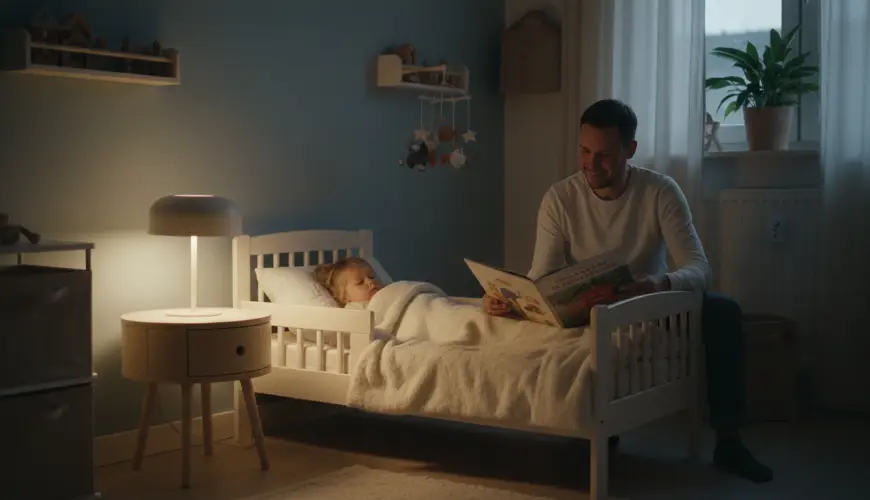
A functional routine does not need to be complicated. The key is consistency, a duration of approximately 20 to 40 minutes, and a clear beginning and end. A routine that is too short will not have time to calm the child down; one that is too long will overstimulate them or become a tool for stalling. A typical sequence recommended by, for example, the American Academy of Pediatrics includes a bath or wash, getting dressed in pyjamas, brushing teeth, reading or telling a story, and a final goodnight.
The bedtime itself also matters. Research consistently shows that the optimal time for toddlers to fall asleep is between seven and eight o'clock in the evening. A later bedtime paradoxically does not mean a more tired child – on the contrary, an overstimulated brain produces cortisol, a stress hormone that makes falling asleep even harder. As children's sleep specialist Jodi Mindell put it: "Children who go to bed earlier sleep longer and better – and their parents are happier."
Light plays a greater role in the whole process than it might seem. Blue light from screens – televisions, tablets, mobile phones – suppresses melatonin production and keeps the brain in an alert state. Expert recommendations are clear: at least one hour before bedtime, the child should not be exposed to any screen. Instead, a pleasant, dimmed bedside lamp, soft music or background sounds of nature work well. These signals tell the nervous system that the day is ending.
Room temperature is another factor that parents often underestimate. The ideal sleeping temperature for a toddler is between 18 and 20 degrees Celsius. An overheated room disrupts sleep cycles and causes the child to wake. A lighter blanket, an aired-out room and cooler air are simple measures with a significant effect.
The reality of everyday life: what to do when the routine breaks down
Theory is a wonderful thing, but family life does not conform to theory particularly well. Illness, travel, festive evenings at the grandparents', a new sibling or simply a bad day – all of these will disrupt the routine, and that is entirely natural. The question is not whether it will happen, but how to respond.
The most important principle is not to panic and to return to the established routine as soon as possible. A single disruption will not change a child's sleep habits. The problem arises when the exception becomes the rule – when a child falls asleep on the sofa in front of the television once and then begins to expect it every evening. Consistency does not mean rigidity, but it does mean that the parent maintains the overall framework even when they are tired or under pressure.
Crying at bedtime is a topic surrounded by an enormous range of approaches – from the "cry it out" method, through various forms of gradual withdrawal, to presence-based methods where the parent stays in the room until the child falls asleep. None of these methods is universally right or wrong. It depends on the child's temperament, the family's values and what is sustainably manageable for the particular parents in the long term. What works for a calm, adaptable child may be entirely unsuitable for a sensitive or anxious toddler.
What experts consistently recommend, however, is responding to crying consistently. If a parent comes at every call one night and ignores everything the next, the child cannot make sense of the situation. Uncertainty makes things worse. A predictable response, whatever it may be, helps the child understand what to expect.
So-called transitional objects can be a great help. A stuffed bear, a favourite blanket or a small pillow serve as a symbolic substitute for the parent's presence. Research shows that children who have a transitional object fall asleep more easily and wake less frequently during the night. If a child does not have such an object, it is worth gently introducing one – for example by having the parent hold the soft toy during the bedtime story, so that their scent transfers to it.
Night waking is a chapter in itself. Toddlers naturally wake between sleep cycles – just as adults do. The difference is that an adult falls back asleep on their own, whereas a child who has learned to fall asleep only with the help of a parent will require that help again at two in the morning. This is why it is important for the child to fall asleep independently if possible – or at least under the same conditions in which they will sleep throughout the night.
A toddler's sleep is not merely a matter of parental convenience – although that aspect is legitimate and important. Quality sleep is absolutely essential for a child's development. During sleep, memories are consolidated, emotions are processed and the brain literally grows. Children who sleep enough are calmer during the day, concentrate better and are less prone to tantrums. Investing in healthy sleep is an investment in the child's overall health and wellbeing.
If, despite every effort, the routine is not working, problems persist for months, or the child shows unusual symptoms – such as very heavy snoring, irregular breathing during sleep or extreme daytime fatigue – it is always advisable to consult a paediatrician. Sometimes there is a medical cause behind sleep difficulties, such as sleep apnoea or an allergy, which complicates the situation regardless of how good the routine is.
Establishing a functional sleep routine for a toddler is not a sprint, but a marathon. It requires patience, a willingness to experiment and, above all, realistic expectations. No child will suddenly start sleeping like an angel overnight simply because a parent has read one article or bought the right night light. But every step in the right direction – a little more consistency, a little less screen time, a little more predictability – will make a difference. And one day, the parent will find that after the bedtime story, the child calmly says goodnight and closes their eyes on their own. That moment makes all the effort worthwhile.