

# Why Children Lie and What to Do as a Parent
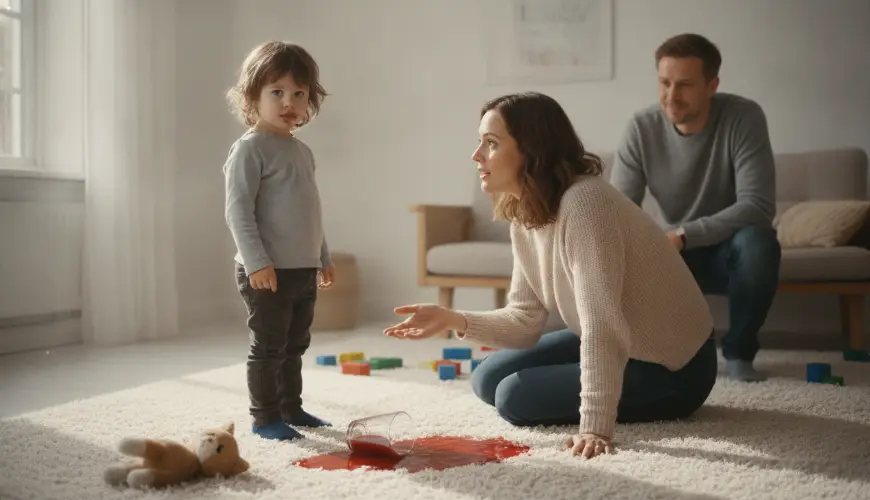
Every parent has experienced it. You walk into a room, see spilled juice on the carpet, and your child declares with complete seriousness that it was the cat. Or a sibling. Or nobody. Children's lying is one of the most frustrating parenting challenges, because it immediately triggers an alarm in us – are we failing? Are we raising a little deceiver? The answer is almost always no, and understanding why children lie and how to respond can change the entire dynamic of the parent-child relationship.
It's important to state one thing right at the outset: lying is, from a developmental perspective, a completely normal part of childhood. It is not a parenting failure, nor a sign of poor character. It is a skill – quite literally. For a child to be able to lie, they must be capable of understanding that you don't know what they know, and that they can make you believe something that isn't true. This requires fairly sophisticated thinking, known as theory of mind – the ability to understand that other people have different thoughts, knowledge and beliefs than we do ourselves.
Try our natural products



Why children lie – and age matters
Research shows that children begin lying surprisingly early. Canadian researcher Kang Lee, who has studied children's lying for decades, found that approximately 30% of two-year-olds lie, while among four-year-olds the figure is already around 80%. This doesn't mean we're raising a generation of deceivers – it means their brains are developing healthily. Nevertheless, it's important to distinguish at what age and for what reason a child lies, because a parent's response should be different each time.
In young children around the ages of two to four, the boundary between lying and fantasy is very thin. A three-year-old who insists they have a dragon at home is not lying in the sense of deliberate deception – they are rather experimenting with language, reality and their own imagination. At this age, lying is more of a game than manipulation. Parents should respond calmly, without making a big drama of it, and rather than punishing, should gently set the record straight. "That's a lovely story, but we both know how it really was, don't we?" is far more effective than an interrogation or punishment.
Around the age of five and six, the situation changes. Children at this age begin to understand the social context of lying – they know that the truth can have consequences, and they start lying deliberately to avoid punishment or an unpleasant situation. A classic example: a six-year-old denies having taken a biscuit from the tin, despite having chocolate around their mouth. At this point, lying is conscious, but still fairly straightforward. Parents should not ask questions they already know the answer to, because in doing so they are essentially inviting the child to lie. Instead of "Did you take that biscuit?" it is better to say "I can see you took a biscuit. Let's talk about it."
Primary school age, roughly seven to twelve years, brings more sophisticated forms of lying. Children begin to understand social norms and lie not only out of fear of punishment, but also to fit in with their peers, protect a friend, or maintain their privacy. This is when lies that don't directly involve parents first appear – a child may lie to a teacher, friends, or other adults. It is precisely at this age that it is crucial to build an environment where the truth is safe – where the child knows that admitting a mistake is unpleasant, but far better than being caught in a lie.
Puberty and adolescence bring an entirely new dimension. A teenager who lies about where they were on Friday evening is not necessarily lying because they want to deceive their parents – they lie because they are building their own identity separate from the family, testing boundaries and seeking autonomy. As American psychologist Lisa Damour notes in her book on adolescence, "secrets and privacy are a teenager's way of creating their own world." Lying at this age is therefore largely a developmental need, rather than a moral failing.
What to do when a child lies – practical tips for different situations
The most common mistake parents make is overreacting. Shouting, lengthy lectures or harsh punishments may stop the situation in the short term, but in the long run they teach children to lie better, not less. Research published in journals such as Developmental Psychology repeatedly shows that children who fear punishment lie more – not less.
The first step is to stay calm and curious. Instead of accusation, try to understand why the child lied. Were they afraid of punishment? Did they want to protect a friend? Were they ashamed? Each of these motivations calls for a different response. A child who lies out of fear needs to know that the truth is safe. A child who lies out of shame needs reassurance that mistakes are human. A child who lies to protect someone else perhaps deserves praise for their loyalty – along with a conversation about where the limits lie.
A very effective technique is naming the situation without accusation. Research shows that children who hear phrases such as "I know you made a mistake, and I trust you to tell me the truth" lie less than those who are confronted with direct accusation. This technique works because it gives the child the opportunity to preserve their dignity while at the same time motivating them towards the truth.
Let's take a concrete real-life example: an eight-year-old comes home from school and says they got a failing grade because the teacher didn't even mark the test. The parent knows this isn't true, because they saw the test in the school bag. How should they respond? Confrontation – "You're lying, I saw that test!" – does expose the lie, but it also shames the child and closes off the space for a genuine conversation. A better approach is: "I can see you don't want to talk about that test. I understand that, failing grades are unpleasant. But let's look at what happened and how I can help you." This signals to the child that the truth is safe and that a mistake is not a catastrophe.
Another important tool is modelling honesty. Children learn primarily from what they see. If a parent tells someone on the phone in front of their child that they are ill to avoid a boring work meeting, or tells a neighbour they don't have time when they simply don't want to visit, the child will remember this strategy. It's not about being absolutely perfect – it's about talking openly with the child even about situations where the truth is complicated. "I told the neighbour I didn't have time because I was tired and needed some peace and quiet. It would have been better to be more honest, but sometimes that's hard" – a sentence like this teaches a child far more than any punishment.
A special category involves situations where a child lies repeatedly or about serious matters – theft, bullying, dangerous behaviour. In these cases, it is important not to treat the lying as an isolated problem, but to look at what lies behind it. Repeated lying can be a symptom of anxiety, low self-esteem, problems at school or in social relationships. If a parent feels that the situation goes beyond ordinary parenting tools, there is no shame in seeking help from a child psychologist or family therapist.
Websites such as Česká asociace dětí a mládeže or the international organisation Zero to Three offer parents a range of practical materials on child developmental psychology, which can help them better understand their own child's behaviour.
It is also important to note that there is a difference between lying and so-called white lies, which are part of normal social functioning. Teaching a child to say "Thank you, it was really good" even when they didn't enjoy the food is not raising them to be a liar – it is raising them to be empathetic and considerate. Children around the age of seven to eight are capable of understanding this distinction, and parents should explain it to them.
The entire approach to children's lying rests on one fundamental principle: the relationship matters more than the rule. A child who has a safe and trusting relationship with their parent lies less – not because they fear punishment, but because they don't want to damage that relationship. Building such a relationship requires time, patience and a willingness to see the child as a whole person with their own emotions, concerns and needs. When a parent responds to lying with calm and curiosity rather than anger and punishment, they send the child a message: "You matter to me, even when you make mistakes. And that is precisely why I want to know the truth."
Children's lying will never disappear entirely – even in the adult world, things are never black and white. But a child who grows up in an environment where the truth is safe and where mistakes lead to conversation rather than punishment carries something very valuable into life: the courage to be honest, even when it's hard.