

You can master the fifth taste umami in your home kitchen too

Sweet, sour, salty, bitter – this is the list of basic tastes that every chef and every schoolchild has learned for generations. But this list is incomplete. There is a fifth taste that has no precise equivalent in English, yet it is known to anyone who has ever savoured a properly made soup, aged parmesan, or a bowl of ramen. It is called umami, and in home cooking we still underestimate it more than we should.
The word umami comes from Japanese and could be loosely translated as "delicious taste" or "pleasant savouriness". It was first used by Japanese chemist Kikunae Ikeda in 1908, when he was investigating why broth made from kombu seaweed tasted so distinctive and satisfying – yet could not be described as either salty or sweet. Ikeda isolated glutamic acid, or rather its salt, monosodium glutamate, and identified it as the carrier of this mysterious taste. The scientific world largely ignored him at the time, but a hundred years later, umami is a fully recognised scientific concept confirmed by research around the world. According to a study published in the journal Chemical Senses, the human tongue has specific receptors sensitive to glutamates, which places umami among the basic taste categories alongside the others.
So why did this taste elude us for so long? The answer is simple: umami does not act immediately and dramatically like sweetness or sourness. It is subtle, deep, almost physical. It creates a sense of fullness and roundedness in food, making a dish feel finished and complete. When umami is missing from a meal, we feel that "something is lacking", but we cannot say exactly what. That is precisely why we so easily overlook it.
Try our natural products




Where umami hides and why it matters
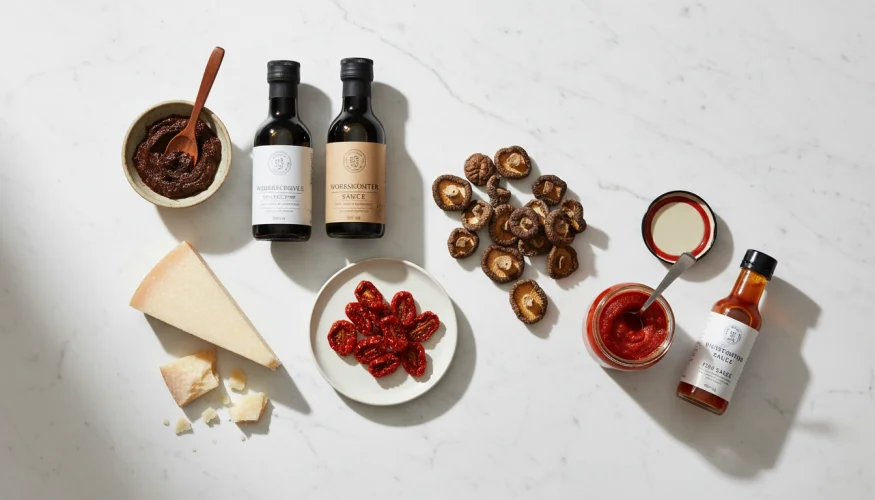
The good news is that umami is not some exotic ingredient that needs to be sought out in specialist shops. It hides in a whole range of commonly available foods that most households either have directly in their pantry or at least buy occasionally. Tomatoes, especially sun-dried ones or in the form of paste, are among the richest plant-based sources of glutamates. Parmesan is similarly rich – its long ageing leads to the natural formation of free amino acids, precisely the substances that create umami. Fermented products such as soy sauce, miso paste, or Worcestershire sauce are literally concentrates of the fifth taste. And then there are mushrooms – particularly shiitake or dried porcini – which contain another umami carrier, the nucleotide guanylate.
Interestingly, umami has a synergistic effect. When different sources of glutamates and nucleotides are combined, the resulting intensity of flavour is significantly greater than the simple sum of the parts would suggest. Japanese cuisine has known this for centuries: the classic dashi broth combines kombu seaweed, rich in glutamates, with katsuobushi fish flakes, full of inosinates. The result is far more flavourful than either ingredient on its own. The same principle works when a pinch of parmesan is added to a tomato sauce – the tomatoes and cheese mutually amplify each other, without the dish tasting "cheesy" or "tomatoey". Simply better.
Why does this matter in everyday cooking? Because understanding umami can fundamentally change the way we cook – and we don't need to buy expensive ingredients or spend hours at the stove. We just need to know where to reach. A spoonful of miso paste added to a salad dressing creates depth that would otherwise take hours of cooking to build. A parmesan rind thrown into a pot of soup or a simmering legume soup transforms an average meal into something guests will still be talking about at home. Fermented foods in general are one of the easiest ways to bring umami into home cooking, and they also offer a range of other health benefits thanks to their probiotic and enzyme content.
Take a concrete real-life example: Markéta, a thirty-four-year-old teacher from Brno, complained that her homemade bolognese never tasted as good as the one at an Italian restaurant, even though she used the same recipe. The key difference was that the restaurant added a teaspoon of soy sauce, a pinch of dried mushrooms, and let the sauce bubble slowly for hours so that glutamates could naturally accumulate. Markéta started adding a teaspoon of Worcestershire sauce and a little extra tomato paste – and the result was surprisingly closer to what she knew from the restaurant. She didn't change the recipe; she simply added sources of umami.
How to consciously work with umami at home
Using umami consciously in home cooking does not mean adding monosodium glutamate from a packet to every dish – although even that would be scientifically defensible, since the European Food Safety Authority (EFSA) has repeatedly confirmed in its assessments that monosodium glutamate is safe at normal intake levels. It is more about learning to recognise natural sources of the fifth taste and working with them deliberately.
One of the most important principles is cooking at low temperatures for longer periods. Slow cooking breaks down proteins into free amino acids – precisely the substances that create umami. This is why a long, slow-simmered broth tastes so different from a quickly made stock cube soup. This is why slowly braised meat has a different depth than meat prepared in a hurry. This chemical transformation happens naturally – it just needs time.
Fermentation is another powerful tool. Kimchi, miso, tempeh, quality vinegar, or traditional Czech fermented vegetables – these are all products of fermentation, in which microorganisms break down complex molecules into simpler, flavour-active substances. It is no coincidence that fermented foods form the backbone of many world cuisines renowned for their depth and complexity. As the celebrated chef Ferran Adrià wrote: "Taste is memory." And the memory of good food is very often the memory of umami.
In practical terms, there are several ingredients worth always having on hand:
- Miso paste – added at the end of cooking to preserve the live cultures; excellent in soups, dressings, and marinades
- Soy sauce – a versatile source of umami that works even in dishes where no one would expect an Asian influence
- Dried mushrooms – porcini or shiitake, ideally soaked and added along with the soaking water
- Tomato paste – a concentrate of glutamates; a spoonful at the start of sautéing is enough
- Parmesan or pecorino – the rind goes into soup, grated at the end as a flavour base, not merely decoration
- Worcestershire sauce – fermented, full of umami, excellent in meat sauces and vegetarian dishes alike
- Fish sauce – intense, but in small quantities completely undetectable; it adds depth, not a fishy taste
It is also important to know when not to add umami, or not to overdo it. Dishes with a delicate, subtle flavour – light fish dishes, fruit desserts, or fresh salads – can be overwhelmed by too strong an umami presence. The fifth taste is an excellent servant but a poor master. The goal is harmony, not dominance.
An interesting perspective is offered by the relationship between umami and salt. Research shows that the presence of glutamates makes it possible to significantly reduce the amount of added salt without the food tasting bland. The food simply tastes "fuller" even with less salt. This is important information for anyone trying to reduce their sodium intake for health reasons – instead of salt, simply add a little miso paste or soy sauce, and the result will be flavouristically comparable or even better. Studies published in the journal Nutrients confirm that umami can indeed serve as a partial salt substitute without any loss of taste enjoyment.
Umami also has an interesting impact on the sense of satiety and overall satisfaction with a meal. A dish rich in the fifth taste tends to be subjectively perceived as more nourishing and satisfying, even when it is calorically entirely comparable to a dish without umami. This effect, referred to as kokumi (a sense of fullness and roundedness of flavour), also plays a role in why after some meals we feel truly satiated, while after others we are hungry again within an hour.
Czech cuisine, meanwhile, has its own tradition of umami, without ever having named it as such. Rich beef broth, long-simmered svíčková sauces, fermented cabbage, utopenec, or smoked meat – these are all dishes rich in naturally occurring glutamates and nucleotides. Our grandparents knew nothing about the chemistry of taste, but they instinctively knew that good food needs time, fermentation, and quality ingredients. Modern science has proven them right.
Understanding umami, then, does not mean making cooking more complicated. On the contrary – it is one of the simplest ways to significantly improve results in the kitchen without major investment in expensive ingredients or complex techniques. All it takes is to stop overlooking umami and start consciously seeking it out. In every pot, every sauce, every plate, it is waiting to be finally discovered.