

# Cook Masala Chai from Scratch with Fresh Spices
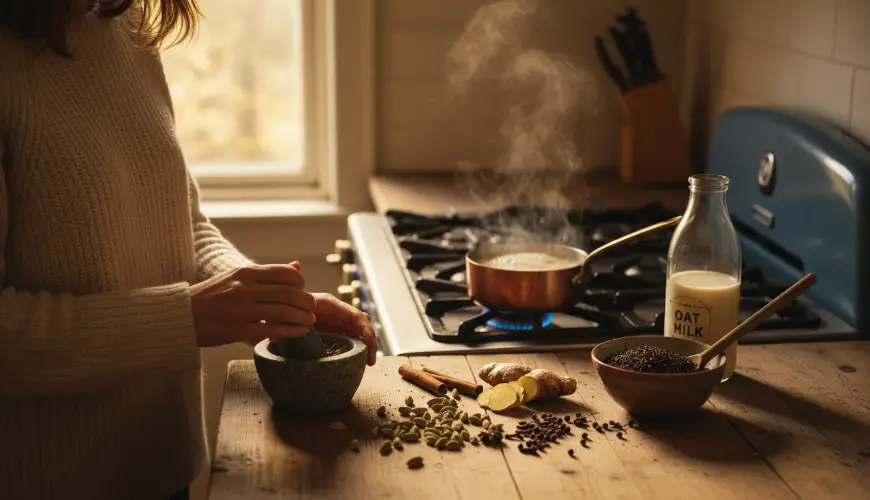
There are drinks that can transform an entire day. Masala chai is one of them. This fragrant blend of tea, milk and spices has its roots deep in Indian culture and for centuries has served not only as a morning ritual, but also as a means of wellbeing and balance. Today, masala chai has won the hearts of people around the world – and it's no wonder. You only need to smell the aroma of fresh ginger, cardamom and cinnamon drifting through the kitchen once to understand that this drink is something exceptional.
Yet most people settle for teabag versions or instant blends, which are quick but fall short of the real experience. Brewing masala chai from scratch with fresh spices is not complicated – it simply requires a little patience and a willingness to reach for quality ingredients. And that difference is well worth it.
Try our natural products





What masala chai really is and where it comes from
The word chai in Hindi simply means tea. The combination masala chai refers to spiced tea – and every Indian family has their own recipe, passed down from generation to generation. It is not, therefore, one specific drink, but rather a philosophy of preparation: slow brewing, balanced spices, full body. The origins of this drink stretch back thousands of years and are connected to Ayurvedic medicine, which attributed healing properties to individual spices. Ginger warms, cardamom aids digestion, cinnamon stabilises blood sugar levels and black pepper improves nutrient absorption.
The modern form of masala chai – with black tea and milk – spread primarily in the 19th and 20th centuries, when British colonial administrations began cultivating tea on a massive scale in India. It was then that a local Ayurvedic drink became an everyday staple for millions of people. Today, masala chai is the most popular drink in India and its popularity worldwide continues to grow – as confirmed, for example, by a report from the Tea Board of India, which tracks trends in tea consumption.
As an Indian proverb says: "Tea is a way of inviting the world inside." And masala chai takes this literally – every cup carries within it an entire world of aromas, flavours and traditions.
Why fresh spices matter
Here is a question that naturally arises: why bother brewing masala chai from scratch when ready-made blends exist? The answer is simple yet fundamental. Fresh spices contain essential oils and active compounds that are quickly lost during grinding and storage. Ready-made powders are often months, sometimes even years old. The result is a drink that smells like chai but lacks depth and genuine flavour intensity.
Take a specific everyday example. Jana, who works as a yoga instructor in Prague, began brewing masala chai from fresh ginger and whole cardamom pods after a local teacher showed her how during a course in India. "It was a shock," she says. "I always thought powdered chai was normal. But the difference was like freshly ground coffee versus instant." Today she prepares her morning chai as a meditative ritual – pounding the spices in a mortar, brewing slowly over a low flame – and says the entire process is just as important to her as the finished drink.
And that is where the magic of home preparation lies. Making masala chai from scratch with fresh spices is not just about flavour – it is about the process, about mindful cooking and about connecting with tradition. A study published in the Journal of Ethnopharmacology confirms that freshly processed spices do indeed contain significantly higher concentrations of bioactive compounds than their industrially processed alternatives. This means not only better flavour, but also greater health benefits.
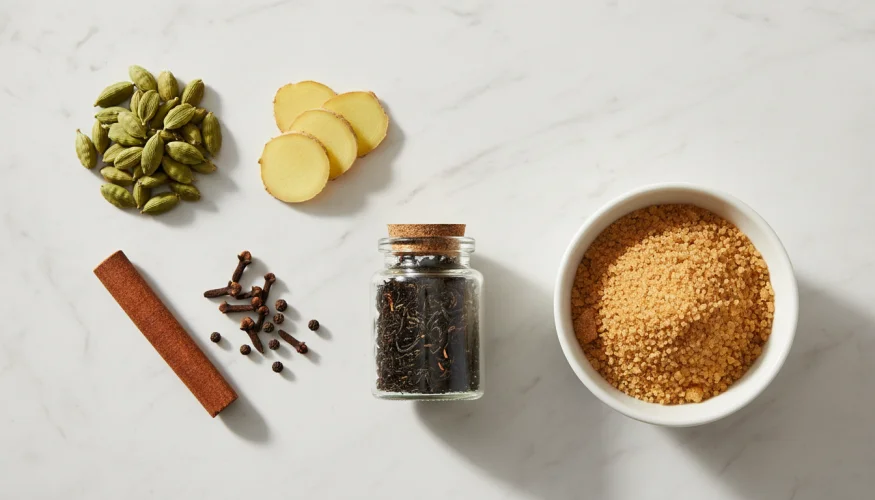
The essential spices that belong in masala chai include ginger – ideally fresh, grated or sliced – cardamom in whole pods, cinnamon in stick form, cloves, black pepper and sometimes also nutmeg or fennel. Each of these ingredients brings its own dimension: cardamom contributes a delicate floral sweetness, ginger a sharp heat, cinnamon a warming earthiness and cloves an intense resinous aroma. Together they form a harmonious whole that is greater than the sum of its parts.
The choice of tea is just as important as the spices. Traditionally, a strong, full-bodied Assam black tea is used, one that can hold its own against the layer of milk and spices. Darjeeling tends to be too delicate, while cheap teabag teas can be unnecessarily astringent. Good options include loose-leaf Assam tea or tea from Sri Lanka, or speciality tea blends intended specifically for making chai.
How to prepare masala chai step by step
Preparing masala chai from scratch is not a complicated process, but it does require attention. The basic method is straightforward: the spices are first lightly crushed or pounded – this helps release the essential oils. They are then placed in a pot with water and brought to the boil. The tea is added after a short while, giving the spices time to release their flavour. Finally, milk is poured in and the whole mixture is left to bubble gently for a little longer.
Specifically: place approximately 200 ml of water in a small saucepan, add three to four whole cardamom pods crushed in a mortar, two to three slices of fresh ginger, one cinnamon stick, two cloves and three to four whole black peppercorns. Bring to the boil and allow the spices to simmer over a low heat for approximately three minutes. Then add one to two teaspoons of loose-leaf Assam tea and brew for a further two minutes. Finally, pour in 150 ml of whole milk – or any plant-based alternative, with oat milk working particularly well – and allow the mixture to bubble gently for another one to two minutes. Strain through a fine sieve into a cup and sweeten to taste, ideally with coconut sugar or jaggery, an unrefined cane sugar commonly used in India.
The key to a perfect chai is slowness. Rushing is this drink's greatest enemy. The spices need time to give up everything they hold within them. Equally, the milk must not boil too vigorously, otherwise it will scald and the drink will lose its silky texture. Many Indian cooks recommend pouring the drink back and forth between the pot and a cup twice towards the end of preparation – a technique known as "pulling" – which aerates the drink and refines its flavour.
An interesting variation is the so-called kadak chai, or strong chai, in which the quantity of tea and spices is doubled. This style is particularly popular in Mumbai and Delhi and is served in small clay or glass cups on the street. Conversely, for those who prefer a gentler version, the amount of black tea can be reduced and more cardamom or ginger added.
Plant-based milk alternatives open up another dimension for experimentation. Coconut milk lends chai a tropical sweetness and creaminess, almond milk brings a nutty undertone, and oat milk, with its natural sweetness, is best suited to everyday preparation. For those interested in sustainability and a healthy lifestyle, plant-based alternatives are also a more ecological choice – their production has a significantly lower carbon footprint than cow's milk, as data from Oxford University's food sustainability research shows.
Spices for masala chai are now available in many health food shops or Asian grocery stores. When buying, it is worth paying attention to quality and origin – organic spices free from pesticides and additives will guarantee not only better flavour but also greater health benefits. Fresh ginger should be firm and aromatic, cardamom pods green and plump, cinnamon sticks intact and fragrant. If a spice smells intensely when broken or crushed, it is fresh and of good quality. If it has no aroma, it is time to reach for a new supply.
Masala chai also lends itself beautifully as a base for further experimentation. Some people add fresh turmeric for its anti-inflammatory effect, others reach for dried rose petals or lavender for a softer, more floral profile. Adding a pinch of cayenne pepper in place of black pepper creates a more pronounced, spicier version that is ideal for a cold winter morning. The possibilities are practically endless – and that is one of the greatest advantages of home preparation.
Drinking masala chai with fresh spices regularly can bring a whole range of positive effects. Ginger is one of the most thoroughly researched natural substances, with well-documented anti-inflammatory and digestive properties. Cardamom supports heart and respiratory function. Cinnamon helps regulate blood sugar levels. And black tea itself is a rich source of antioxidants that protect cells from oxidative stress. All of these effects are naturally strongest when the ingredients are fresh and of good quality – not industrially processed and stored for months.
Brewing masala chai from scratch with fresh spices is, in a sense, a small act of resistance against the culture of instant gratification. It is a decision to devote a few minutes of attention to the process, not merely the result. And therein lies its true value – not only as a drink, but as a daily ritual that connects a person with tradition, with nature and with the present moment.