
An insect hotel in the garden will benefit all of nature
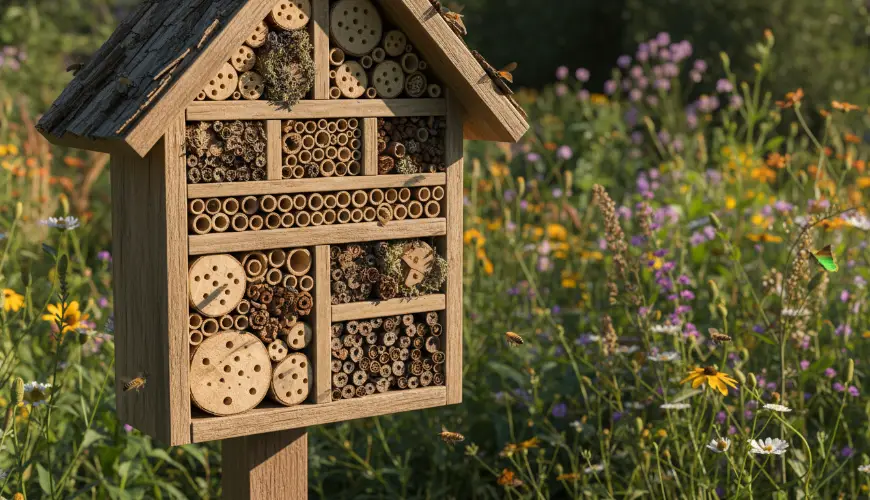
A garden without insects would be silent, but also dead. Pollinators, decomposers of organic matter, and natural enemies of pests form the foundation of every healthy ecosystem – and yet they increasingly lack a place to live in the modern landscape. That is precisely why the insect hotel has become a popular tool in recent years, not only among environmentally conscious gardeners, but also schools, community gardens, and companies that want to contribute to the restoration of biodiversity. However, building a truly functional insect hotel is not as simple as it might seem. It is not enough to gather a few sticks, stuff them into a wooden box, and wait for the first residents to move in.
The idea of an insect hotel stems from a very simple observation: most insects that we need in the garden nest in cavities, crevices, dry stems, or in the soil. However, as the British Royal Horticultural Society RHS points out, a large proportion of commercially sold insect hotels are in reality more of a decorative object than a functional shelter. Holes that are too large, unsuitable materials, or poor placement mean that insects simply ignore such structures. The result is a beautiful garden decoration and zero residents.
Try our natural products


What insects actually need
For an insect hotel to be truly inhabited, it is necessary to understand who we are actually building it for. Different insect species have very different requirements. Solitary bees, such as the ground bumblebee, digger wasp, or mason bee, look for narrow tubes or tunnels with a diameter of roughly 2 to 10 millimetres. Lacewings and seven-spot ladybirds prefer bundles of dry stems or cavities filled with pine cones. Ground beetles and many other beetles hide under bark or in moss. If we mix together unsuitable materials without regard for specific species, the hotel will most likely remain empty.
The key principle is specialisation. Instead of one large, showy structure filled with a variety of materials, experts are increasingly recommending smaller, thematically focused hotels – one for solitary bees, another for ground beetles, another for overwintering insects. Such an approach is not only more effective, but also more easily achievable using available natural materials.
Let us consider a specific example: Mrs Nováková has a small garden at her family home in Prague-Řepy. Three years ago, she bought a large wooden insect hotel at a garden centre for a few hundred crowns, hung it on the fence, and waited. Nothing happened. This year she decided to tackle the situation differently – she built three small, simple structures from materials she had at home: a bundle of bamboo canes of various diameters, a box filled with dry nettle stems, and a small log with drilled holes. By the end of summer, mason bees had nested in the bamboo canes and lacewings were overwintering in the box. The difference was fundamental – and it lay primarily in the details.
Materials for an insect hotel must meet several conditions. First and foremost, they must be dry and natural – mould is lethal to insects and synthetic materials repel them. Bamboo or reed cut to a length of 15 to 20 centimetres with smooth, uncracked edges is ideal for solitary bees. It is important that one end of the tube is closed by a node, while the other remains open – the insect then has a safe space for laying eggs. The holes must not have any burrs or splinters, as these could damage the wings or body of the insect. Stems of elder, nettle, or fennel are an excellent alternative to bamboo and can easily be collected directly in the garden or in the surrounding landscape.
For beetles and other larger insects, pieces of bark, pine cones, dry moss, or even small pieces of wood with natural cavities are suitable. Clay or loam mixed with sand can attract species that nest in the ground. What does not belong in an insect hotel, on the other hand, includes colourfully painted wooden parts, plastic tubes, overly densely packed sections, or materials with sharp edges. Surprisingly unsuitable are also large pieces of wood with excessively deep holes – insects will enter them, but without natural ventilation, moisture accumulates inside and eggs perish.
How and where to place an insect hotel so that it works
Correct placement is just as important as correct construction. Perhaps even more so. As German entomologist and science communicator Josef Reichholf says: "Insects do not look for beautiful homes, they look for the right conditions." And these are determined primarily by orientation towards the sun, height above the ground, and proximity to food sources.
Solitary bees need warmth – their hotel should be oriented to the south or south-west and exposed to direct sunlight for at least part of the morning. The temperature inside the nest accelerates larval development and increases survival rates. The ideal placement height is between 1 and 1.5 metres above the ground, approximately at eye level. The hotel must be firmly secured so that it does not sway in the wind – movement discourages insects from nesting.
For beetles and overwintering insects, slightly different rules apply. These species prefer shaded, more humid spots closer to the ground – ideally near a hedge, compost heap, or under trees. A shelter for ground beetles can be placed directly on the ground or at a low height, where these natural predators of slugs and other pests have easy access.
An essential condition for a functional insect hotel is also proximity to food. Solitary bees fly for nectar and pollen typically within a radius of up to 300 metres from their nest. If the hotel is placed in the middle of a concrete area without a single flowering plant, no bee will colonise it. The ideal solution is to combine the hotel with the planting of nectar-rich plants – lavender, mint, sage, borage, or buckwheat are excellent choices that will attract insects even in the small space of a balcony or terrace.
Another overlooked factor is protection from predators. Cats, birds, and rodents can damage the insect hotel or frighten its inhabitants. Fine metal mesh with sufficiently large openings (so that insects can enter freely), placed approximately 5 centimetres in front of the holes, will provide protection without restricting access. This detail is addressed inadequately or not at all by a large proportion of commercial models.
The question of regular maintenance is another topic that is rarely addressed in popular articles about insect hotels. Hotels should be inspected annually – ideally in autumn or early spring – and damaged or clogged sections should be replaced with fresh materials. If tubes are occupied and sealed with clay or leaves, this is a good sign: it means that eggs or pupae are inside. These sections must not be cleaned or replaced until the adult insects have hatched. Conversely, sections that remain empty after two to three years are worth reconsidering – a different orientation, different material, or different height can change everything.
When it comes to the size of the hotel, the rule is that smaller and high-quality is better than large and mediocre. Research conducted by Wageningen University in the field of pollinator conservation shows that the density and diversity of insect shelters in the landscape has a fundamental impact on solitary bee populations – but only when these shelters are truly functional and located near food sources. One well-built and correctly placed hotel measuring 30 × 30 centimetres can attract more species than three large but low-quality structures distributed around the garden.
For those who want to go even further, there is an interesting option: to get involved in citizen science projects, such as the Czech platform Naši opylovači (Our Pollinators), where insect sightings can be reported, thereby contributing to biodiversity mapping. Data from such projects then help scientists and nature conservationists better understand where insects genuinely need help.
An insect hotel is not merely a fashionable garden accessory or an ecological alibi for an otherwise unsustainable lifestyle. It is a concrete, practical step towards making a garden or balcony serve not only us, but also the creatures upon which the pollination of plants, soil quality, and the overall balance of the ecosystem depend. All it takes is a little attention, the right materials, and an understanding of what insects are truly looking for. And then simply wait patiently – because nature will always find its way when we give it a chance.