

# How to Find Time Just for Yourself Even with Small Children

Every parent of young children knows the feeling. You wake up earlier than planned because you're roused by crying or calling from the children's room. The whole day flies by in a cycle of feeding, changing nappies, playing, putting children to sleep, and feeding again. In the evening, when you finally get the children to bed, you're so exhausted that the only thing you long for is to lie on the sofa and do absolutely nothing. And yet, somewhere in the back of your mind, there's a nagging feeling that you've forgotten about yourself. That you've stopped being a person with your own needs and have become just "mum" or "dad".
This isn't weakness or selfishness. It's a natural consequence of how intense parenting young children actually is. And that's precisely why time just for yourself – whether we call it "me time", a moment for yourself, or simply rest – is not just a luxury, but a genuine necessity.
Try our natural products




Why time for yourself is so important
Psychologists and mental health professionals agree on this point: parents who regularly allow themselves moments just for themselves are more patient, more balanced, and ultimately better parents. This isn't a paradox – it's simple human physiology. Chronic stress and exhaustion lead to greater irritability, poorer decision-making, and an overall reduced ability to respond to others' needs, as research published by organisations such as the American Psychological Association demonstrates. In other words, an empty vessel cannot nourish others.
Yet many parents, especially mothers, struggle with feelings of guilt whenever they allow themselves a moment "just for themselves". Society expects complete devotion to the family from them, and any step aside can feel like a betrayal. But this logic is flawed. A child doesn't need a parent who sacrifices themselves to the last breath – they need a parent who is present, calm, and happy.
The renowned paediatrician and psychoanalyst D. W. Winnicott once said that children don't need perfect parents, but "good enough" ones – and a good enough parent is one who takes care of themselves in the same way they take care of their child.
Consider an example from everyday life: Jana is a mother of two children aged two and four. After going on maternity leave with her second child, she completely stopped painting – a former hobby that brought her joy. For a year and a half, she told herself there "simply wasn't time for it". Then she tried one thing: every Wednesday evening, once the children had fallen asleep, she sat down to paint for an hour. Just one hour. "It was as if I'd returned to myself," she describes. "The next day I was much more patient with the children, because I wasn't just an exhausted shell."
How to find time that seemingly doesn't exist
The biggest myth about time for yourself is that you need to "have" it. That you need to wait for the ideal moment when the children are in the grandparents' care, your partner is home, and you have an entire afternoon ahead of you. But such a moment never comes. And even if it did, most parents would spend it dealing with household tasks or catching up on lost sleep.
Time for yourself doesn't occur naturally – it must be consciously created. Even in small doses.
Start by honestly answering this question: where in your day do you lose time without gaining any real benefit or joy from it? According to research by DataReportal, the average person spends over two hours a day on social media. Much of this scrolling isn't conscious rest – it's more of an automatic escape that ultimately leaves us even more tired. What if at least thirty minutes of this time were devoted to something that genuinely recharges you?
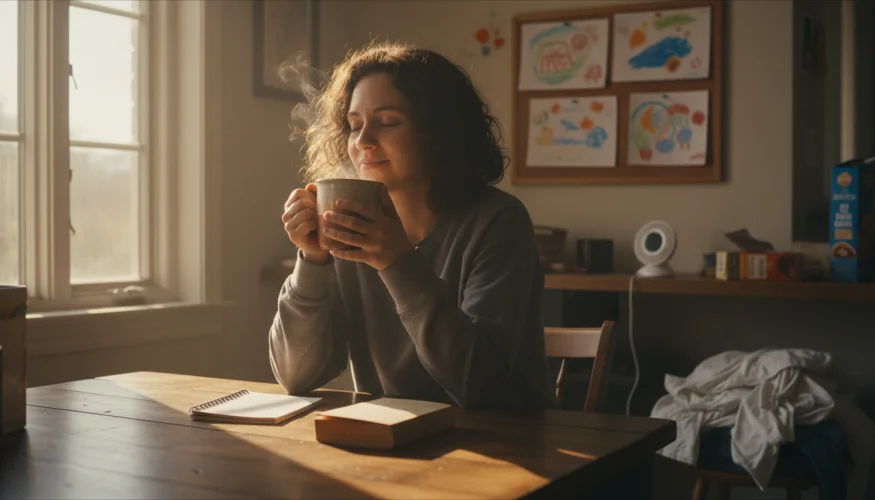
Small, regular moments have greater value than we realise. Ten minutes of morning coffee in silence before the children wake up. A short walk without the pram and without your phone. An evening bath with a favourite book. These moments may seem trivial, but their regularity creates a sense that you have space for yourself in your life – and that is psychologically very important.
In practical terms, there are several tried-and-tested approaches for beginning to systematically build time for yourself:
- Make use of the early morning hours. Many parents swear by getting up thirty to forty-five minutes before the children wake. This quiet window can be used for meditation, reading, light exercise, or simply a peaceful breakfast.
- Arrange to take turns with your partner. If you're raising children as a couple, try introducing a system where one parent "watches the children" while the other has two hours entirely to themselves – and then you swap. No guilt, no commentary.
- Don't be afraid to ask for help. Grandparents, friends, neighbours – the people around you are often more willing to help than you think. Many parents are afraid to ask because they see it as admitting weakness. It isn't weakness. It's wisdom.
- Schedule your time for yourself like an appointment. Write it in your calendar. Give it a name. Treat it just as seriously as a paediatric check-up or a work meeting.
- Accept that your child can wait a little while. A healthy child who is safe can manage twenty minutes alone – in their cot, on a play mat, or with toys. You don't need to be present every single second.
The key isn't to find more hours in the day, but to change the way you think about time. Time for yourself isn't what's left over after everything else – it's an investment that enables you to handle everything else better.
What to do with the time you find
Here comes a question that surprises many parents: what do you actually want to do? After months or years in which all your thoughts were focused on your child's needs, you may find that you don't know what you enjoy, what recharges you, what you're missing. And that is completely normal.
Try returning to what you loved before having children. What sport did you play? What music did you listen to? What did you read? What did you enjoy doing when you had time? This recollection can be a good starting point.
It's also important to distinguish between passive rest and active recovery. Both types are necessary, but they have different effects. Passive rest – sleep, lying down, watching a series – helps the body recuperate. Active recovery – exercise, creativity, social contact with friends, nature – restores psychological energy and a sense of one's own identity. Ideally, your time for yourself would combine both.
Exercise deserves special mention. Regular physical activity is one of the most effective tools for reducing parental stress, and not only because of endorphins. Exercise, walks, or yoga send the body a signal that there is space beyond the everyday chaos. It doesn't have to mean an hour at the gym – twenty minutes of brisk walking a day has a demonstrable effect on mood and stress levels, as studies cited by Harvard Health Publishing confirm.
Equally important is contact with friends. Isolation is one of the greatest risk factors for parental burnout, yet many parents of young children stop maintaining friendships because there "isn't time" or "it's too complicated to organise". One coffee with a friend every two weeks can do more than an hour of meditation – because it reminds us that we are more than just parents.
And then there's an area that doesn't get much discussion: self-care through everyday rituals. Quality body care products, a mindful morning routine, a pleasant home environment – these are all small ways of reminding yourself that you matter. This isn't about superficiality. It's about the fact that the way we care for ourselves reflects how we relate to ourselves. Parents who allow themselves quality self-care – whether it's natural cosmetics, comfortable clothing, or healthy food – are setting the best possible example for their children that self-respect is an important value.
Parenting young children is a sprint and a marathon at the same time. It is intense, exhausting, and at the same time incredibly fulfilling. But in order to be a present, loving, and patient parent over the long term, it is essential to take care of yourself. Time for yourself isn't a reward for good parenting – it is its fundamental prerequisite. And the sooner parents allow themselves to accept this, the better – for them and for their children.