

# What cloth to choose when you want to clean without microplastics
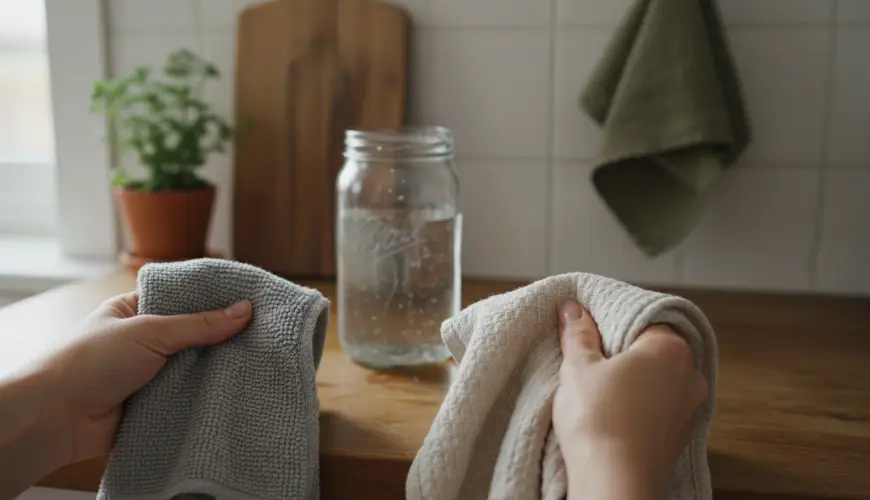
Every week it repeats itself – pull out the cloth, wipe away the dust, pour out the water and carry on. An apparently innocent routine that has its own hidden story. Few people realize that the choice between a microfibre and a cotton cloth can have a surprising impact not only on household cleanliness, but also on the quality of water we share with the rest of the planet. The question of microplastics from cleaning is no longer just a matter for environmental activists – it is becoming the subject of scientific studies, legislative debates and everyday consumer decisions.
Microfibre cloths have experienced a genuine boom over the past two decades. They are lightweight, absorbent, require almost no cleaning products and at first glance seem like the perfect eco-friendly solution – less chemicals, less water, less waste. But beneath this appealing image lies a complication that manufacturers rarely talk about.
Try our natural products
What happens when you wash a microfibre cloth
Microfibre is a synthetic material most commonly made from polyester or polyamide – in other words, from plastic. And this is where the problem begins. With every wash, tiny fibres are released from the fabric – fibres so small that they pass through most filters in domestic washing machines. These particles then travel into wastewater, through treatment plants (which only partially capture them) and on into rivers, lakes and ultimately the sea.
According to research published in the journal Environmental Science & Technology, a single wash of synthetic textile can release up to 700,000 microfibres. Other studies report even higher figures depending on the age of the fabric, the water temperature and the detergent used. Researchers at Plymouth University found that fleece jackets and other synthetic materials are one of the main sources of microplastics in the marine environment – and microfibre cloths operate on exactly the same principle.
What is particularly alarming is the size of these fibres. Microplastics are defined as plastic particles smaller than five millimetres, while fibres from microfibre cloth are often many times smaller than that. This makes them easy for aquatic organisms to ingest, allows them to enter the food chain and – as an increasing number of studies show – they are now being found in human blood, placentas and lung tissue. The World Health Organization WHO has identified microplastics as one of the priority research issues in public health.
This does not mean that microfibre cloths are simply "bad" and cotton cloths "good." The reality is, as is so often the case, considerably more complex.
Cotton: natural, but not without compromises
Cotton cloths have one key argument in their favour – they are biodegradable. The fibres released from cotton fabric during washing do not pose nearly the same threat to aquatic ecosystems as synthetic microplastics. Bacteria and other microorganisms are able to gradually break down cotton fibres, whereas plastic fibres persist in the environment for hundreds of years.
Yet cotton carries its own ecological debt, and this must be stated openly. Cotton cultivation is one of the most resource-intensive agricultural processes in the world in terms of water consumption and pesticide use. According to data from WWF, producing one kilogram of cotton requires up to 10,000 litres of water. Conventional cotton farming also uses approximately 16% of all insecticides used worldwide, even though cotton occupies only 2.5% of arable land.
This sounds discouraging, but here too meaningful alternatives exist. Organic cotton grown without synthetic pesticides and with attention to water consumption is a significantly more sustainable option. An even more interesting choice is cloths made from recycled cotton – that is, from textile waste that would otherwise end up in landfill. Such a cloth carries a considerably lower environmental footprint than a new cotton product and does not contribute to the problem of microplastics from cleaning.
Consider a family living in a block of flats in Brno. Every week they mop the floors, dust the surfaces and clean the bathroom. They use a set of microfibre cloths that someone recommended to them as an eco-friendly solution. They wash them at sixty degrees because they want to be sure they are hygienically clean. What they do not realise is that each such wash sends tens of thousands of plastic fibres down the drain – and the higher temperature accelerates this process further, as heat releases fibres more readily. This is not a reproach directed at any particular family, but an illustration of how easily even well-intentioned decisions can miss the mark.
How to make sense of it all and what actually helps
A comparison of microfibre and cotton cloths cannot therefore be concluded with a clear-cut verdict. Each material brings a different type of burden – microfibre burdens aquatic ecosystems with microplastics, while cotton demands enormous resources during production. The key to more responsible cleaning is therefore not the blind rejection of one or the other, but an informed approach to what we buy, how we use it and how we care for it.
If you already have microfibre cloths at home, it makes sense to keep using them – throwing away functional textiles prematurely will not improve the situation. There are, however, ways to reduce the number of microplastics released. Special bags or washing machine filters, such as the Guppyfriend, capture a significant proportion of released fibres directly in the drum. Washing at lower temperatures and on shorter cycles also helps. And if you are thinking about a new purchase, it is worth considering cloths made from organic cotton, recycled textiles or natural materials such as hemp or linen, which have proven their worth as cleaning tools for centuries.
As British marine biologist Richard Thompson – one of the first to draw attention to the problem of microplastics in the oceans – aptly put it: "Plastic pollution is a problem we created ourselves – and therefore one we can solve ourselves."
It is also important to add that cleaning is just one of many sources of microplastics in the home. Clothing made from synthetic materials, carpets, plastic kitchenware and car tyres – all of these contribute to overall pollution. Nevertheless, cloths and cleaning textiles represent an area where every household can make a relatively easy and meaningful change. It requires no great sacrifice or costly investment, but rather a conscious decision that is repeated with every clean and whose effects accumulate over time.
Sustainable cleaning is not about perfection, but about direction. There is no need to immediately throw out everything synthetic and switch exclusively to natural materials. It is enough, at the next purchase, to pause and ask: what is this cloth made from, how long will it last, what will happen to it when it wears out, and what does it release into the water with every wash? These simple questions are the starting point for a more mindful approach that requires no complex guides or eco-certifications.
The market for sustainable cleaning textiles has grown considerably in recent years. Alongside classic cotton cloths, products made from bamboo, hemp or recycled materials are gaining ground, combining a favourable environmental footprint with practicality. Some brands also offer take-back schemes, whereby worn-out cloths can be returned for recycling rather than ending up in general waste. This approach closes the loop and moves closer to the idea of a circular economy – much discussed, but advancing in practice more slowly than would be desirable.
Legislation is slowly beginning to respond to the problem of microplastics. The European Union is working on measures to limit the release of microplastics from synthetic textiles – one option under discussion is mandatory filters in washing machines for new appliances. France already introduced a requirement in 2025 for filters to be installed in all new washing machines sold on its territory. This is a step in the right direction, though it naturally does not address the problem of the millions of washing machines already in use.
The choice between a microfibre and a cotton cloth is thus ceasing to be merely a practical question and is becoming part of a broader debate about how our consumption works and what traces it leaves behind – in water, in soil, in the bodies of animals and in our own. And that is a debate worth having – even in the context of something as seemingly mundane as cleaning the house.