
# How to Properly Care for Wooden Spoons Wooden spoons are a staple in every kitchen, but they requ
Few kitchen tools have as long a history as the wooden spoon. It has accompanied humanity since ancient times, survived the arrival of plastic, stainless steel and silicone, and still holds a firm place in kitchen drawers around the world. It's not just nostalgia or sentimental attachment to tradition – wood has an undeniable place in the kitchen. Yet wooden spoons are among those kitchen tools whose hygiene rarely gets discussed. That's a shame, because proper care for them can have a direct impact on the health of the whole family.
Imagine a situation that is perfectly common in Czech households: grandmother's old wooden spoon, blackened from years of stirring beef stew and potato soup, standing in a pot on the stove like a family heirloom. Nobody throws it away because it "still does the job." Yet this apparent durability can be misleading. Wood is a natural material that ages, absorbs and changes – and these properties have a direct impact on what happens in the pot being stirred with it.
Try our natural products



What's really happening inside the wood
To understand why the hygiene of wooden spoons matters so much, it's worth looking at how wood functions as a material. Unlike the smooth surface of stainless steel or glass, wood has a porous structure. This means microscopic channels and cavities absorb water, oils, sauces and, not least, bacteria. Every use of a spoon while cooking leaves traces in the wood fibres – and no superficial rinsing under running water will remove them completely.
Food safety researchers have long been interested in whether wood in the kitchen is safe or not. A study published at UC Davis found that bacteria such as Salmonella or E. coli do indeed get absorbed into wood, but under the right conditions they don't survive. The key phrase is "under the right conditions" – meaning proper drying and regular maintenance. If a spoon remains damp, bacteria have an ideal environment in which to multiply.
This doesn't mean wooden spoons are inherently dangerous. On the contrary – natural wood contains certain antimicrobial substances, particularly tannins and resins, which prevent the overgrowth of bacteria. These properties are depleted over time, however, and as wood ages and degrades, it loses its natural protection. That's why it's important not only to clean spoons properly, but also to know when it's time to reach for new ones.
The type of wood also matters, of course. Hardwoods such as beech, maple or olive have a denser structure with smaller pores, meaning lower moisture absorption and a more resilient surface. Softer woods, by contrast, absorb more and deteriorate more quickly. Most quality kitchen spoons are therefore made from hardwoods – and this is worth finding out before making a purchase.
How to care for wooden spoons properly
Proper care of wooden spoons isn't complicated, but it does require a degree of regularity and a mindful approach. The biggest mistake households make is washing them in the dishwasher. High temperatures and aggressive cleaning agents dry out the wood, cause cracking and accelerate its deterioration. The surface becomes rough, porous and far more prone to trapping dirt. Wooden spoons should always be washed by hand – warm water, a mild washing-up liquid and a thorough rinse.
After washing, it is absolutely essential to dry the spoon thoroughly. The worst thing that can happen is leaving it lying in a pool of water or setting it aside in a damp pot with other utensils. The ideal approach is to wipe it with a cloth and then let it air-dry in a vertical position or in a dry place. Moisture is wood's greatest enemy in the kitchen – and at the same time bacteria's best friend.
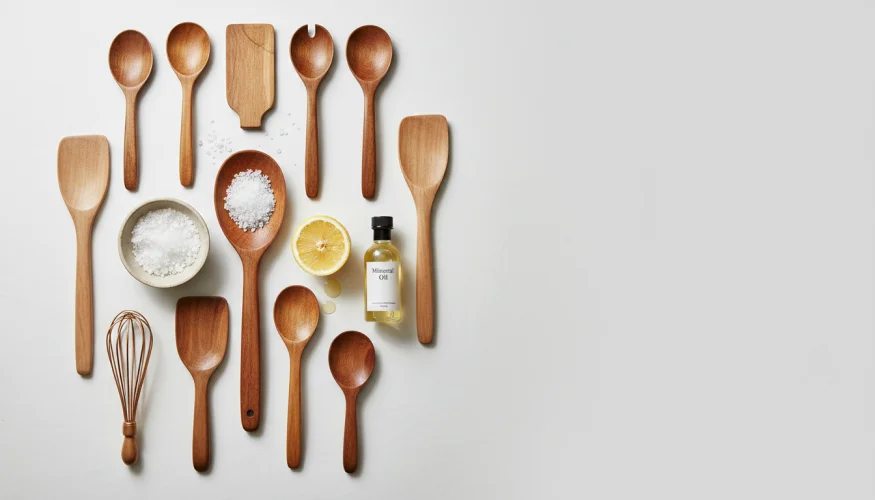
Every now and then, ideally every two to three months, it's worth treating wooden spoons with a natural oil. An unscented mineral oil or a special oil designed for wooden kitchen utensils works best. Linseed oil is popular but not recommended in the kitchen, as it can turn rancid. Olive oil has the same problem. Treating with oil seals the pores, prevents excessive drying and extends the spoon's lifespan. Simply apply the oil to the surface, leave it to absorb overnight and wipe off any excess in the morning.
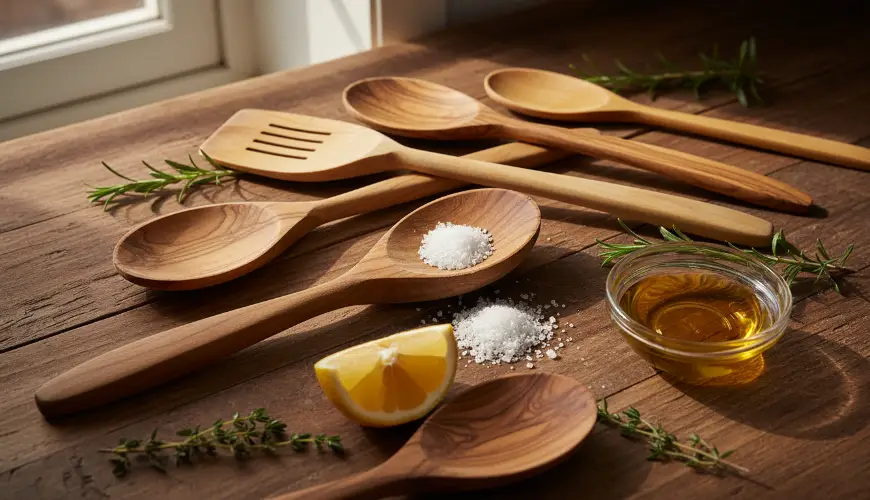
There is also an old household trick for deep-cleaning a spoon without chemicals: coarse salt and lemon juice. The surface is sprinkled with coarse salt, lemon juice is added and the whole spoon is gently scrubbed. The salt acts as an abrasive that mechanically removes dirt from the surface, while citric acid has natural antibacterial properties. After this kind of cleaning, simply rinse the spoon and dry it thoroughly.
When it's really time to replace them
And now to the question that is perhaps the most important and yet the most frequently overlooked: when should you throw a wooden spoon away? The answer isn't just about aesthetics or how old the spoon is. It's primarily about what condition it's in.
The first clear signal is cracks and splits on the surface. Even minor cracks are a problem, because food residues and bacteria get into them and cannot be removed by any ordinary cleaning method. If a spoon is cracking or splintering, it's time to replace it regardless of how long it has been in service.
Another warning sign is a significant change in colour or the presence of dark spots that won't wash off. These spots may be caused by mould or deeply absorbed food residues. Mould on a wooden surface is a serious hygiene problem – and unlike hard surfaces, it cannot be reliably removed from wood. If a spoon smells even after thorough washing, that's a clear indicator that the wood is contaminated at a depth beyond the reach of any cleaning.
As food safety consultant and chef Harold McGee puts it: "Kitchen tools are not eternal. Replacing them at the right time is part of good cooking." And while this may sound obvious, it is frequently forgotten in practice. People invest in quality ingredients but keep old, damaged tools in circulation indefinitely.
The general recommendation from food safety experts is to replace wooden spoons approximately every one to two years with regular use. If spoons are maintained properly, they may last longer – but even then it's worth giving them a thorough inspection once a year to assess their condition. Spoons that are used less frequently but stored poorly or exposed to heat and moisture may wear out far sooner.
It's also worth noting that different spoons should have different uses. A spoon used for raw meat should never be used for vegetables or cooked dishes without thorough washing in between. Cross-contamination is a real risk in the kitchen, and wooden utensils are particularly susceptible to it precisely because of their porous structure. A practical solution is to keep at least two sets in the kitchen – one for meat and one for everything else.
An interesting perspective on the whole issue is offered by the World Health Organization in its food safety guidelines, which emphasise that proper hygiene of kitchen utensils is one of the key factors in preventing foodborne illness. Nearly 600 million people worldwide fall ill each year due to contaminated food – and while the vast majority of cases have other causes, kitchen utensils do play their part.
Wooden spoons still have an irreplaceable place in the modern kitchen. They are gentle on non-stick surfaces, don't heat up like metal, are pleasant to handle and, with proper care, also environmentally sustainable – especially when they come from certified sources or are made from reclaimed wood. Their advantages are undeniable, but like any other kitchen tool they require attention and care. There's no need to fetishise them or discard them unnecessarily – it's enough to keep an eye on them, treat them regularly and know when the time for a change has come. Because a good kitchen rests not only on quality ingredients and recipes, but also on tools that are clean, functional and safe.