

Dukkah is a crunchy Egyptian blend for dipping bread in oil
There are flavors that instantly transport you somewhere else. One bite is all it takes, and suddenly you feel warm air, hear the noise of a marketplace, and sense that you are thousands of kilometers away from your kitchen table. This is precisely the experience offered by dukkah – an Egyptian nut blend that has been winning the hearts of food lovers around the world in recent years. And yet its story reaches deep into the past of North African cuisine, where this simple dish was an everyday part of life.
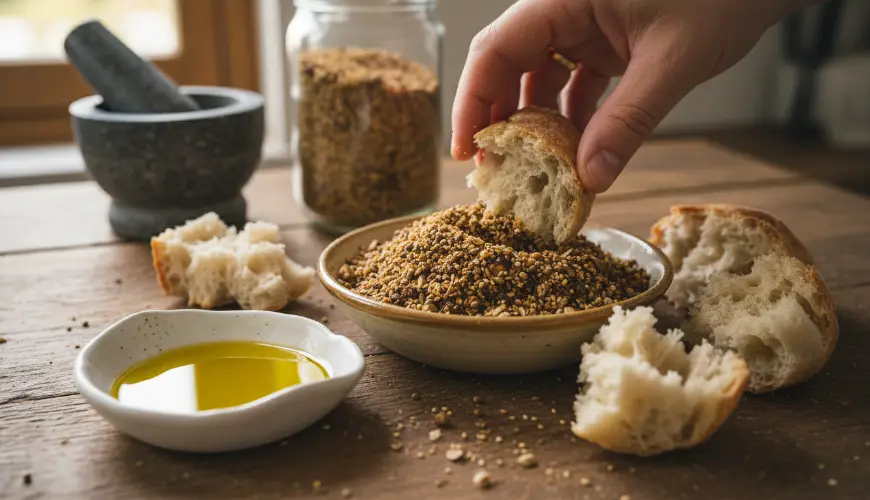
The word dukkah comes from the Arabic verb meaning "to pound" or "to crush," which perfectly captures the method of preparation. Nuts, seeds, and spices are ground or crushed by hand in a mortar – never to a fine powder, always preserving a coarser texture. That texture is what makes dukkah distinctive and irreplaceable. It is not a paste, it is not a powder. It is a dry, crumbly mixture full of aromas and flavors, traditionally served as a simple snack or appetizer: you dip a piece of bread in olive oil and then coat it in dukkah. Nothing more, nothing less – and yet it is one of the most satisfying ways to enjoy food.
Try our natural products
Where dukkah comes from and why it has endured for centuries
Egyptian cuisine is one of the oldest in the world, and dukkah has been part of it for at least several centuries. Historically, it was a dish of ordinary people – cheap, nutritious, and easy to carry. Farmers and laborers would take it to the fields as a quick snack. Bread, olive oil, and a handful of nut mixture – that was a lunch that kept you going all afternoon. In Egypt, dukkah is still sold on the streets, wrapped in newspaper, and locals eat it in exactly this traditional way.
What is fascinating about this dish is its resilience across time. While many traditional recipes have disappeared or been transformed beyond recognition, dukkah has preserved its essence. The reason is simple: it is perfect just as it is. The combination of nuts, toasted seeds, and aromatic spices creates a flavor profile that needs no improvement. Every Egyptian family has its own recipe – some add more coriander, others prefer cumin, some use pistachios, others hazelnuts – but the underlying logic remains the same.
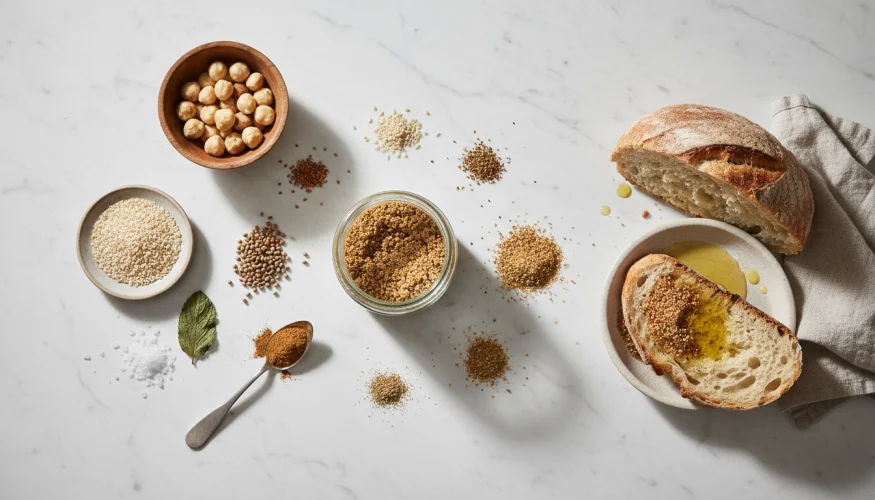
The composition of traditional Egyptian dukkah revolves around a few key ingredients. The base is typically lightly toasted hazelnuts or pistachios, to which sesame seeds, coriander seeds, and cumin are added. Sometimes mint, pepper, or even dried rose petals appear, lending the whole mixture an unexpected floral note. Everything is dry-toasted in a pan, then roughly crushed and left to cool. The result is a mixture that smells like an Egyptian bazaar – earthy, spiced, and with a gentle nutty sweetness.
Culinary writer and traveler Claudia Roden, who devoted much of her life to documenting Middle Eastern cuisine, wrote of Egyptian food: "Egyptian cuisine is a cuisine of simplicity and depth at once – rarely elsewhere in the world can so few ingredients create such complex flavor." Dukkah is precisely such an example.
What dukkah tastes like and why you will love it
Describing the taste of dukkah is a bit like describing music – words are not enough, you have to experience it. But let us try. On the first bite you notice a gentle crunch, followed by a wave of flavors: first the nutty richness, then the earthy depth of coriander, then the slightly anise-like warmth of cumin, and finally a pleasant lingering sesame finish. If the recipe includes pepper, it adds mild sharpness. If mint, it refreshes. Salt holds it all together, linking and enhancing every flavor.
The key to why dukkah works so well with bread and olive oil lies in the contrast of textures and flavor temperatures. Olive oil – ideally a quality, cold-pressed one – brings its fruity bitterness and richness, bread provides a neutral base and softness, and dukkah layers on top its dry, aromatic complexity. It is a trio that needs each other. Have you ever tried eating just bread with oil? Good, but flat. With dukkah, the entire experience is transformed.
Imagine a Sunday morning. Guests arrive for breakfast, you do not want to spend an hour in the kitchen, but you still want to impress. All you need is a good loaf of bread, a bowl of olive oil, and a small bowl of dukkah placed beside it. Guests will figure out for themselves how it works – they dip, coat, taste. And then they ask what it is and where they can get it. That is exactly the kind of reaction dukkah tends to provoke: surprise, curiosity, and an immediate desire for more.
Australians have embraced this combination so thoroughly that dukkah with bread and olive oil is now a standard feature of Australian restaurant culture. It is interesting how immigrant cuisine can enrich an entire gastronomic scene – the Egyptian community in Australia brought dukkah to Sydney and Melbourne, from where it spread across the world. Today you can find it in premium food shops from London to New York to Tokyo.
How to use dukkah in the kitchen
It would be a shame to limit dukkah to the role of a starter. This versatile nut blend can transform a whole range of dishes in ways you might not expect. Sprinkle it on hummus instead of the classic paprika – you get a different texture and depth of flavor. Add it to a roasted vegetable salad as an alternative to croutons. Coat a white fish fillet in it before baking and you get a crispy, aromatic crust. Or simply stir it into yogurt and serve as a dip with fresh vegetables.
It also works beautifully as a topping for eggs – whether scrambled, fried, or baked in a jar. A spoonful of dukkah is all it takes to give breakfast a completely different dimension. Vegetarians and vegans will appreciate that it is a naturally plant-based product, rich in protein from nuts and seeds. According to the USDA nutritional database, hazelnuts, for example, are an excellent source of vitamin E, magnesium, and healthy unsaturated fats – and those are precisely the ingredients that make up dukkah.
Making your own dukkah at home is surprisingly simple and within reach of anyone who has a pan and a mortar or food processor. The basic method looks like this:
- Hazelnuts or pistachios (100 g) – toast dry in a pan until golden, then leave to cool and remove the skins
- Sesame seeds (50 g) – toast separately, as they burn quickly
- Coriander seeds (2 tablespoons) and cumin (1 tablespoon) – toast lightly and grind in a mortar
- Combine everything, add salt and optionally freshly ground pepper or dried mint
- Crush roughly – the mixture should remain dry and crumbly, not paste-like
Store the finished dukkah in a sealed jar at room temperature. It will keep for several weeks, although it will likely disappear much sooner.
Dukkah as part of sustainable and healthy eating
In the context of today's interest in healthy living and sustainable food, dukkah occupies an exceptional place. It is a naturally unprocessed product with no added preservatives, colorings, or emulsifiers. The ingredients are plant-based, locally available, and their production does not burden the environment the way industrially processed foods do. If you opt for organic nuts and seeds, you have a product that is good for your body and for the planet.
The Mediterranean and Middle Eastern diet, of which dukkah is a natural part, is considered one of the healthiest dietary patterns in the world according to research published in the New England Journal of Medicine. Olive oil, nuts, seeds, and spices – these are the pillars that scientists repeatedly associate with a lower risk of cardiovascular disease and inflammation. Dukkah elegantly combines these ingredients into a single delicious and practical form.
It is also interesting to observe how traditional dishes like dukkah are becoming part of the modern mindful eating movement. People are increasingly interested in the origin of their food, in the stories behind recipes, and in the connection to the cultures from which food comes. Dukkah is not just delicious – it is a piece of history, a piece of Egypt, a piece of thousands of years of wisdom about how to create something extraordinary from simple ingredients.
Whether you buy it ready-made or prepare it at home, dukkah deserves a place in your pantry. Next time you are looking for a quick yet impressive way to entertain friends or brighten up an ordinary breakfast, think of the Egyptian marketplace, the newspaper cone full of nut mixture, and a piece of bread dipped in olive oil. Sometimes the best things really are the simplest ones.