

# How to Organize Your Pantry and Stop Wasting Food

Do you know that feeling when you open the pantry door and an avalanche of forgotten cans, expired spices, and bags of pasta you bought with the best intentions but never used comes tumbling out? It's not just a matter of aesthetics or tidiness – a poorly organised pantry is one of the biggest sources of food waste in the household. Both financially and ecologically. According to data from the United Nations Food and Agriculture Organization (FAO), approximately one third of all food produced worldwide ends up as waste, with households making up a significant portion of this figure.
The good news is that changing this situation doesn't require expensive renovations or a professional organiser. All it takes is a few smart habits, the right containers, and a bit of system. And the result? A pantry where you actually know what you have, where it is, and by when you need to use it.
Try our natural products





First declutter, then organise
Before you start any organising, it's essential to begin from scratch. Many people make the mistake of trying to introduce order into existing chaos – moving things from place to place without getting rid of what doesn't belong there. Take everything out of the pantry, lay it on the kitchen table or counter, and go through each item individually. Check the use-by dates, assess the condition of the packaging, and be honest with yourself – if you didn't buy that rice flour intentionally and don't know what to use it for, it will probably sit there for another five years.
This "big clear-out" is also an ideal opportunity to become aware of your shopping patterns. Do you have seven open packages of different cereals at home? Three types of mustard? Tea supplies that would last a year ahead? These insights will help you shop more wisely in the future. As organiser and bestselling decluttering author Marie Kondo said: "Order is not an end in itself, but a means to a life that truly suits you."
Once the pantry is empty and you've had a good look at everything, only then is it time for the actual organisation. And this is precisely where the system makes all the difference.
The key principle: what came in first, goes out first
In the food industry, this principle is called FIFO – First In, First Out. It's a rule that every well-organised home pantry should follow. The principle is simple: always store new supplies at the back and move older items to the front. It seems obvious, but in practice the vast majority of households don't do this – new shopping is simply added to the pile and older items fall to the back, where they quietly expire.
Think of Lenka, who buys tinned tomatoes for cooking every week. She never thought about the order in which she used them, and one day during a big clear-out she discovered that behind the old tins were ones three years past their best-before date. And yet it would have taken so little – always putting the new ones at the back and reaching for the oldest one. This simple habit would have saved her not only a guilty conscience, but also unnecessary money.
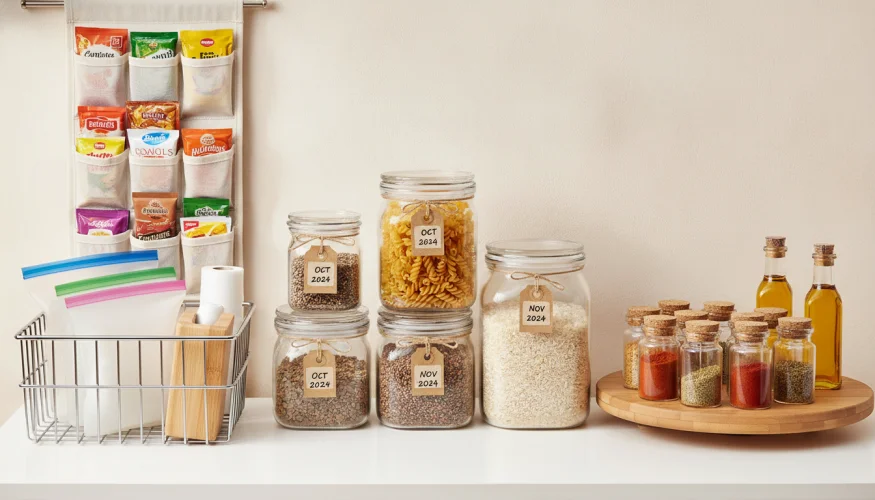
For the FIFO principle to work, labels or dates need to be clearly visible. If you transfer food into unlabelled containers, write the purchase or use-by date on them – with a permanent marker or adhesive tape, for example. This step takes ten seconds but saves hours of confused rummaging.
Arranging things by category also plays a crucial role. Pasta with pasta, pulses with pulses, tins with tins. When you know where to find things, you naturally see what's running low and what you have in excess. This way you only buy what you actually need.
The right containers change everything
One of the most effective tools for pantry organisation is hermetically sealed containers or jars. It's not just about aesthetics – transferring dry foods from open bags into sealed containers significantly extends their shelf life, protects them from moisture, pests, and odours, and gives you an immediate overview of how much of each item remains. Glass containers are the ideal choice from both an ecological and health perspective – they contain no plastics, are easy to clean, and last for decades.
When choosing containers, it's also worth thinking about shape. Square or rectangular options use shelf space more efficiently than round containers, which leave dead corners between them. It also makes sense to invest in containers in several standardised sizes that stack neatly together.
In addition to containers, rotating trays – known as lazy Susans – are also helpful, allowing easy access to items stored at the back of a shelf without having to move everything around. They are particularly practical for spices, oils, vinegars, or small bottles that tend to get lost behind larger items. Wire baskets or pull-out drawers work in a similar way, maximising the use of shelf height and preventing the creation of "dead zones" where things disappear from sight.
Hanging organisers on the inside of the pantry door are also a great help. This space is chronically underused, yet a surprising number of small items can fit there – spice packets, instant soup sachets, foil, zip-lock bags, or small kitchen tools.
Zoning: everything in its place
Professional organisers work with the concept of "zoning" – dividing a space into logical areas based on how and how often you use things. In a pantry, this means that the most frequently used items should be at eye or hand level, easily accessible without bending or stretching. Upper shelves are suitable for things you only use occasionally – back-up supplies, empty containers, or seasonal ingredients. Lower shelves, on the other hand, are well suited to heavier or bulkier items, such as large packs of drinks, bags of potatoes, or onions.
A special zone should exist for items with an imminent use-by date. Some organisers recommend setting aside a small section of a shelf or a basket exclusively for foods that need to be used first – either because they've been opened or because their date is approaching. This "urgent use zone" will remind you what needs to be included in the next meal and significantly reduces situations where things quietly expire on the back shelf.
The same logic applies to seasonality. If you know that you grill a lot in summer and need quick access to marinades and spices, store them in a more prominent and accessible spot. In winter, you can swap them out for things that are useful for soups or baking. The pantry is not a static thing – it can and should change along with your needs.
A natural part of zoning is also separating food from other goods. Paper towels, foil, baking bags, or cleaning supplies should not be mixed in with food – not only for hygiene reasons, but also because such mixing significantly reduces clarity.
The shopping list as part of the system
Pantry organisation doesn't end with physical arrangement – it's a continuous process that also includes the way you shop. One of the most effective tools is a running shopping list. Instead of going through the pantry before each shop and trying to remember what's missing, get into the habit of noting items down as you use them or when you see that a supply is running low.
There are now a number of smart apps for this – such as OurGroceries or Bring!, which allow you to share a list with the whole household in real time. No one will then buy a third jar of mustard because they didn't know you already had some. Such a digital list is also more eco-friendly than a paper one, and you always have it with you on your phone.
A regular, if brief, pantry inventory – perhaps once a week before shopping – will help you stay on top of things and plan meals so that what you have gets used up. If you add basic meal planning to this, you'll significantly reduce both food waste and unnecessary expenditure. The WRAP organisation, which has long been dedicated to reducing food waste in the United Kingdom, states that households that plan meals in advance throw away on average a third less food than those that don't shop to a plan.
Keeping order in the pantry is not a one-off action, but more of a habit – much like washing the dishes or taking out the rubbish. The more naturally these small rituals become part of your routine, the less energy they will require. And in return, they will save you not only money and food, but also stress during everyday cooking. A well-organised pantry is not a luxury – it is the foundation of a functional, sustainable, and mindful household.