

# What's Behind Why Tight Clothing Starts to Bother Us
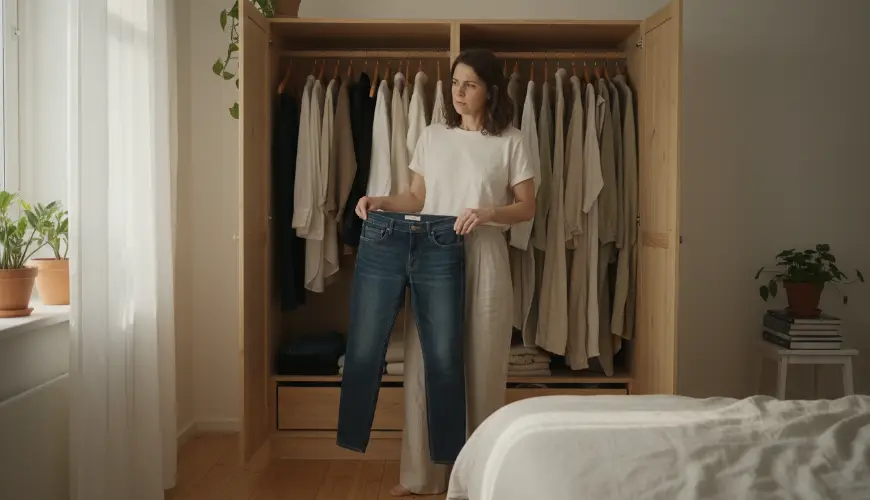
Maybe you've experienced it too - you pull a pair of jeans out of the wardrobe that you last wore two years ago, and suddenly you find they fasten with difficulty, or they do fasten, but you spend the whole day feeling like you're in a vice. Yet the number on the scales hasn't changed much. So what actually happened? Why does tight clothing bother us more than it used to - and is it really just about the kilograms?
The answer is surprisingly complex and goes far beyond a mere number on a label. It's a combination of physical changes in the body, shifts in lifestyle, the psychology of comfort perception, and also how our expectations of how we feel in clothing have radically shifted over the past decade.
Try our natural products


The body changes continuously throughout life - and that's completely normal
The human body is not a static sculpture. It changes with age, hormonal fluctuations, stress, sleep, and the amount of physical activity a person gets each day. Doctors and researchers repeatedly confirm that even with a stable body weight, fat tissue is redistributed and muscle mass changes over the years. Fat shifts with increasing age - typically from the limbs to the abdominal and hip area, regardless of whether a person has gained a single kilogram. This phenomenon is well documented, for example, in academic literature published by the National Institutes of Health, where scientists tracked body composition in adults over decades.
Hormones also play a role. In women, the transition into perimenopause brings significant changes in body fat distribution; in men, a gradual decline in testosterone levels affects the ratio of muscle to fat. Younger people are no exception either - stress triggers cortisol production, which promotes fat storage specifically in the abdominal area. The result is that clothing that fitted perfectly three years ago can feel uncomfortably tight around the waist today, even though the rest of the body has barely changed at all.
There is yet another, less discussed factor: changes in posture. Years spent at a computer, behind the wheel, or hunched over a phone shape the way we stand and sit. Rounded shoulders, a forward head position, and weakened abdominal muscles change the volume of the torso and cause a jacket or shirt that once fitted like a glove to suddenly pull across the shoulders or bunch up at the back.
It is no wonder, then, that more and more people describe a similar experience: clothing from the wardrobe stops fitting, without them being able to rationally explain why. And it is precisely this uncertainty that tends to be frustrating - because our culture still strongly links clothing size with a person's worth.
The pandemic and working from home changed our bodies and our expectations
One of the most significant turning points in how we perceive clothing comfort was, paradoxically, brought about by the Covid-19 pandemic. Millions of people spent months in tracksuit bottoms, loose hoodies, and comfortable loungewear. The body grew accustomed to this comfort - and the brain remembered it as the new standard. When people then began returning to offices and reached for formal clothing, many described the feeling of dressing up in a costume from another life. A tight suit or a fitted skirt suddenly felt physically unbearable, even though they objectively fitted the same as they had years before.
This phenomenon is not mere laziness or self-indulgence - it has a real physiological basis. The nervous system adapts to stimuli. If the skin does not feel the pressure of a tight waistband or a stiff collar for a long period of time, it becomes more sensitive. Dermatologists and neurologists speak of so-called tactile sensitisation - increased skin sensitivity to mechanical stimuli following a period when those stimuli were reduced. In other words, if we haven't worn jeans for a year, our body has simply become unaccustomed to them.
But the pandemic brought yet another, this time purely physical effect: physical activity declined for a large portion of the population, while caloric intake remained the same or even increased. A study published in BMJ Open showed that the average European gained approximately 1.5 to 2 kilograms during the first lockdown. Seemingly little - but even this gain is enough for clothing to stop fitting comfortably, especially around the waist.
And then there is the psychological dimension. Many psychologists point out that during the pandemic, many people began to perceive and accept their bodies more consciously. Loose clothing supported this acceptance. Returning to tight clothing was then not only physically uncomfortable for many - it was also psychologically demanding, as it confronted them with norms they had meanwhile ceased to wish to meet.
As fashion critic and writer Cathy Horyn once observed: "Fashion has always reflected what we expect of the body - and those expectations are radically changing right now."
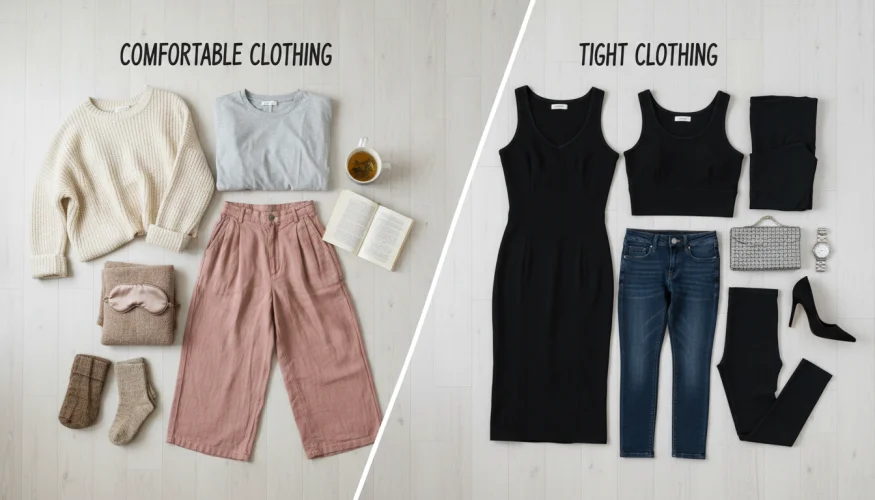
How our expectations of clothing have changed
Alongside the physical changes in the body and the influence of the pandemic, there is a third, longer-term reason why tight clothing bothers us more than it used to: a fundamental transformation in what we expect from clothing. And this transformation has been underway for approximately the past fifteen years, even if we may not have been fully aware of it.
The rise of athleisure and leisurewear - clothing on the boundary between sport and everyday wear - has significantly raised the bar for what we consider acceptable comfort. High-waisted leggings, technical T-shirts made from stretch fabrics, shoes with soft soles - all of this has become part of the everyday wardrobe. And once a person has experienced what it is like to move through an entire day without any restriction, it is difficult to return to stiff jeans or narrow suit jacket sleeves.
This trend is also confirmed by figures from the fashion industry. According to data from the analytics firm McKinsey & Company, the comfortable and sportswear segment has seen significantly faster growth over the past decade than traditional formal fashion. Consumers are simply voting with their wallets - and they are voting for comfort.
At the same time, awareness is growing of how clothing affects health. Tight clothing around the abdomen can contribute to digestive problems, as gastroenterologists point out. Overly tight trousers or a tight waistband can increase intra-abdominal pressure and worsen symptoms of reflux or irritable bowel syndrome. A tight bra or T-shirt can restrict deep breathing. These are all things that were not widely discussed in the past - but today they are part of the public conversation about a healthy lifestyle.
Take, for example, Petra, a thirty-year-old accountant from Brno, who after returning to the office following two years of working from home found that she was unable to concentrate on her work whenever she was wearing formal clothing. It wasn't just about physical discomfort - the tight jacket stressed her psychologically, reminding her of norms she had stopped subscribing to. She gradually began transitioning to looser cuts in natural materials and describes feeling calmer and more productive at work. Her story is not an isolated one - similar experiences are shared by a growing number of people across professions and age groups.
A natural consequence of all these changes is growing interest in sustainable and comfortable fashion made from natural materials - cotton, linen, modal, or bamboo. These materials are breathable, adapt to the body's movements, and do not cause skin irritation. Unlike synthetic fabrics, which hold their shape at all costs, natural fibres "breathe" along with the body and allow it to function naturally.
Cut also plays an important role. Looser, oversized, or unisex cuts, which the fashion industry long regarded as a fringe trend, are becoming mainstream. This is not about giving up style - it is about understanding that style and comfort need not be at odds. A well-designed loose garment can be just as elegant as a fitted piece, only it does not subordinate the body to an aesthetic norm, but instead creates that norm around the body.
Interestingly, this shift in clothing expectations corresponds with a broader cultural move towards authenticity and body acceptance. The body positivity and body neutrality movements are often criticised as superficial or commercialised, but their core message - the idea that the body deserves comfort regardless of its shape and size - is finding an increasingly strong resonance. And clothing is one of the most visible places where this idea manifests itself in everyday life.
Manufacturers and designers who have understood this shift are offering an ever-growing number of collections designed with the real body and its movement in mind - not an imaginary ideal. Size ranges are expanding, cuts are being adapted to different proportions, and materials are being chosen with long-term comfort in mind, not just the visual impression from a first try-on in the fitting room.
So if you find that tight clothing bothers you more than it used to, it is not necessarily a signal that something is wrong with your body. It may be quite the opposite - a signal that your body and mind have arrived at a clearer understanding of what they truly need. And that is knowledge worth listening to.