

# Why Talking to Yourself Out Loud Helps Us

Everyone knows it. You're standing in the kitchen, looking for your keys, and suddenly you hear yourself saying out loud: "Now, I put the keys on the table… or in my pocket?" Or you're sitting at a complex task at work and quietly, yet audibly, mumbling what you're doing. Maybe you feel a little embarrassed about it, especially when someone catches you. And yet talking out loud to yourself is one of the most natural and beneficial things a person can do – and science confirms it.
For centuries, talking to yourself was considered eccentric at best. People who loudly commented on their own activities or voiced their inner monologue were met with mocking glances. Today, however, psychologists and neuroscientists are making it increasingly clear that this is completely normal behavior – indeed, highly advantageous behavior. The question, then, is not whether it's strange – the question is why it actually helps us and how to use it consciously to our advantage.
Try our natural products






The voice as a tool for thinking
Talking out loud to yourself is not the same as having hallucinations or being "out of it." It is a form of what is known as private speech, a term introduced into psychology by Russian psychologist Lev Vygotsky. He found that children naturally commentate on their own play and activities – and argued that this is a key tool for learning and self-regulation. Over time, this spoken speech transitions into silent, inner speech, but never disappears entirely. In moments of stress, concentration, or complex decision-making, it resurfaces – and that is precisely the moment when it does its most important work.
Research from the past two decades shows that speaking out loud to yourself activates different parts of the brain than simply thinking in silence. When we say a thought out loud, we engage not only the parts of the brain responsible for language, but also the auditory cortex – the brain processes it as information coming from outside. This means we hear our own words somewhat differently than we merely "think" them – and this distance helps us see the situation more clearly.
A study published in the Quarterly Journal of Experimental Psychology demonstrated that people who said the name of an object out loud while searching for it found it significantly faster than those who searched in silence. The brain simply functions more efficiently when given a verbal anchor. It's not magic – it's about how the human brain is constructed.
Professional athletes, for example, use this principle. Tennis players quietly but audibly give themselves instructions before serving, golfers commentate on their swing, swimmers repeat their stroke technique to themselves. This is no accident or tic – it is a deliberate strategy that improves performance. And the same strategy works in everyday life – from cooking by a recipe to preparing for a demanding job interview.
An interesting real-life example comes from the experience of teachers. Many educators admit that before a challenging lesson or a conversation with the parents of a difficult student, they "run through" the situation out loud – what they will say, how they will respond to possible objections, how they will end the conversation. This is not a theatrical rehearsal, but mental preparation that significantly reduces stress and increases confidence. And this is exactly how talking to yourself functions as a tool – it helps us organize thoughts that would otherwise remain fragmented and chaotic.
When and why we actually talk to ourselves
There are several situations in which people spontaneously shift to speaking their monologue out loud. Most commonly these are moments of heightened stress or concentration, when solving problems, during physical work requiring precision, or conversely during tedious, repetitive tasks where the brain needs to maintain attention. Each of these situations has its own logic.
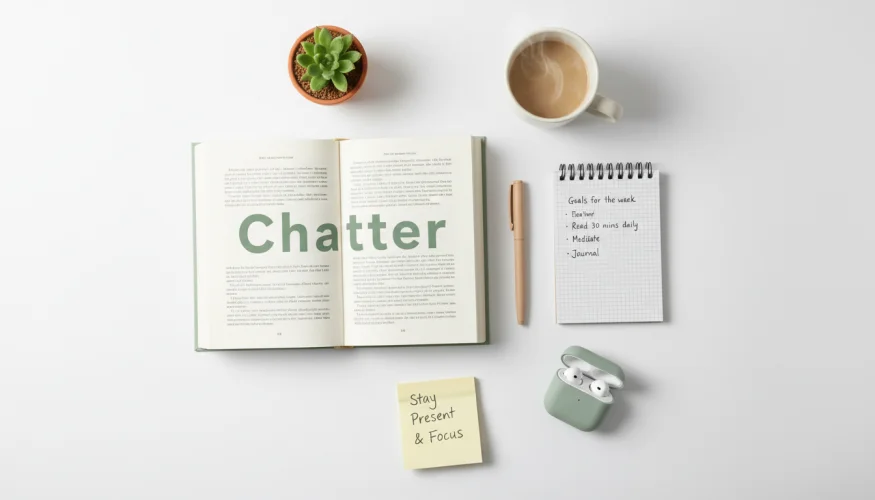
Psychologist Ethan Kross of the University of Michigan has spent decades researching inner dialogue and its influence on emotions and decision-making. In his book Chatter: The Voice in Our Head, Why It Matters, and How to Harness It (2021), he describes how the way we talk to ourselves fundamentally affects our mental health. Kross distinguishes between the destructive inner voice – the one that constantly criticizes us and replays past mistakes – and constructive self-talk, which guides, motivates, and calms us.
A key finding of his research is that talking to yourself in the third person – that is, saying "Jana, you can handle this" instead of "I can handle this" – significantly reduces anxiety and improves decision-making. He calls this phenomenon "distanced self-talk." By speaking about ourselves as if we were another person, we create psychological distance that allows us to approach the situation more rationally and less emotionally. As Kross himself says: "The way we talk to ourselves is one of the most powerful tools we have available for regulating our own emotions."
Why does this matter? Because most people are not even aware of how negative their inner voice actually is. Research shows that the average person speaks approximately 300 to 1,000 words per minute in their inner monologue – and a large portion of these are critical, pessimistic, or anxious. Converting this stream of consciousness into spoken, deliberate speech helps interrupt this pattern and replace it with a more functional way of thinking.
Talking out loud to yourself also has a very practical dimension in the context of memory and learning. Students who repeat material out loud while studying or explain it to an imaginary listener remember it significantly better than those who merely read or underline. This technique, known as the "production effect," is well documented in educational psychology. The brain simply encodes information it actively produces more effectively than information it passively receives. The APA – American Psychological Association, whose extensive and accessible database of research on this topic covers this phenomenon in detail, explores this further.
There is yet another aspect that is discussed less frequently, but is no less important: emotional processing. When we experience strong emotions – anger, sadness, fear – and try to name them out loud, an interesting neurological phenomenon occurs. Research from UCLA showed that verbalizing emotions reduces activity in the amygdala, the part of the brain responsible for emotional responses, and increases activity in the prefrontal cortex, which governs rational thinking. Simply put: saying out loud "I'm really angry right now" helps tame the anger more quickly than merely experiencing it in silence.
This principle is, incidentally, used by various therapeutic approaches. Cognitive-behavioral therapy works with techniques in which clients verbally formulate their thoughts, challenge them, and seek alternative ways of interpreting a situation. Narrative therapy works similarly, where the goal is to "tell yourself your story" differently – and out loud. The therapist serves as a mirror here, but part of the healing power lies precisely in the person hearing their own words with their own ears.
How to consciously harness the power of talking out loud to yourself
Knowing that talking to yourself helps is one thing. Being able to use it consciously is another. And yet it is a skill that requires no special equipment or professional training – just a little courage to overcome social inhibitions and a little practice.
One of the most effective approaches is so-called "think aloud" – thinking out loud when solving problems. If you're facing a complex decision, try literally describing the situation out loud: what options you have, what bothers you, what makes sense to you. Many people find that the very act of verbalization "breaks down" the problem into manageable parts and reveals a solution that would otherwise remain hidden in a fog of vague feelings.
Another approach is the deliberate use of encouraging self-talk before challenging situations. This is not about naive affirmations in the style of "I'm the best and I can handle everything" – research shows these don't work particularly well, because the brain evaluates them as untrue. It's more about realistic but supportive statements: "This is hard, but I've prepared well" or "I made a mistake, but I know what I'll do differently next time." Such inner commentary, spoken out loud, has a demonstrably positive effect on performance and mood.
The technique of talking out loud to yourself during physical activities is also very useful. People who exercise or work manually naturally commentate on their progress – and rightly so. Counting repetitions out loud, describing movement technique, or simple encouragement ("three more… two… one") helps maintain focus and overcome fatigue. Sports psychologists actively recommend this technique and train it with athletes at all levels.
It is worth noting that talking out loud to yourself is not the preserve of people in distress or under pressure. Creative people – writers, musicians, visual artists – very often describe how they "test" ideas out loud while working, say sentences to themselves to hear their rhythm, or commentate on their own decisions. It is part of the creative process, not a byproduct of it. The brain needs to hear what it is creating in order to evaluate it from a different perspective.
The world around us is constantly accelerating, information is multiplying, and demands on our attention are growing. In this context, the ability to stop, talk to yourself, and consciously process your own thoughts is more valuable than ever. There is no need to be embarrassed about it – next time someone catches you thinking out loud, you can say with a clear conscience that you are currently optimizing your cognitive performance. And you will be right.