
Cooking Will Be Easier with Kitchen Zones According to Professional Chefs
Anyone who has ever watched a professional chef at work couldn't help but notice one thing – their kitchen is in perfect order, and every movement is precise, deliberate, and efficient. No unnecessary trips from the stove to the sink across the room, no searching for a knife in the middle of cooking, no chaos. Behind this apparent effortlessness lies a system that professional chefs have been using for decades, known as dividing the kitchen into work zones. And the good news is that this system isn't reserved exclusively for restaurant operations – with a little thought and planning, it can be brilliantly applied in any ordinary home.
The idea behind dividing a kitchen into zones stems from a simple principle: every activity that takes place in the kitchen has its natural place. Preparing ingredients, cooking, washing dishes, storing food – these are all separate activities that deserve their own space. When these spaces are well-designed and logically arranged, the entire cooking process becomes smoother, faster, and paradoxically more enjoyable. It's no wonder that this approach is increasingly making its way into modern domestic kitchen design.
Try our natural products






How a professional chef thinks when planning a space
In professional gastronomy, a concept is used that in English is called mise en place – literally "everything in its place". It is a philosophy that says before you begin cooking, everything must be prepared, sorted, and accessible exactly where you will need it. The famous French chef Auguste Escoffier, who popularised this principle in the 19th century, would probably not believe how alive his legacy remains today – and how well it works even in a small apartment kitchen.
Professional chefs typically divide kitchen space into several basic zones. There is a preparation zone, where ingredients are cleaned, chopped, and made ready for cooking. Then there is the cooking zone, centred around the stove and oven. The third key area is the washing and cleaning zone at the sink. Added to this is the storage zone, which includes both the refrigerator and the pantry or cupboards with dry goods. And finally, in a domestic setting, the serving zone is also very important – where finished dishes are transferred onto plates and prepared for serving.
Interestingly, the arrangement of these zones is governed by the so-called work triangle, which kitchen architects know well. This is an imaginary triangle connecting the sink, the stove, and the refrigerator – the three most frequently used points in any kitchen. The more compact this triangle is, and the fewer obstacles it contains, the more efficiently the kitchen functions. Research in the field of ergonomics confirms that the optimal length of each side of this triangle should be between 120 and 270 centimetres – at greater distances, the cook unnecessarily moves back and forth, wasting time and energy.
The preparation zone as the heart of the home kitchen
If a single zone were to be singled out as having the greatest influence on cooking comfort in a home kitchen, it would undoubtedly be the preparation zone. This is where the cook spends the most time – chopping vegetables, marinating meat, preparing dough, or measuring out ingredients. And yet, paradoxically, it is the zone most often overlooked when fitting out a kitchen.
Take Petra, a thirty-five-year-old mother of two from Brno, who had her kitchen renovated two years ago. Originally, her worktop was almost entirely covered with appliances – a toaster, a coffee machine, a blender, and a dish rack. She had barely forty centimetres of free surface left for actual food preparation. After consulting an interior designer who worked with the principles of professional kitchens, she moved the appliances into cupboards and freed up a generous preparation space directly beside the sink. The result? She began to enjoy cooking more than ever before, and the time she spent in the kitchen was significantly reduced.
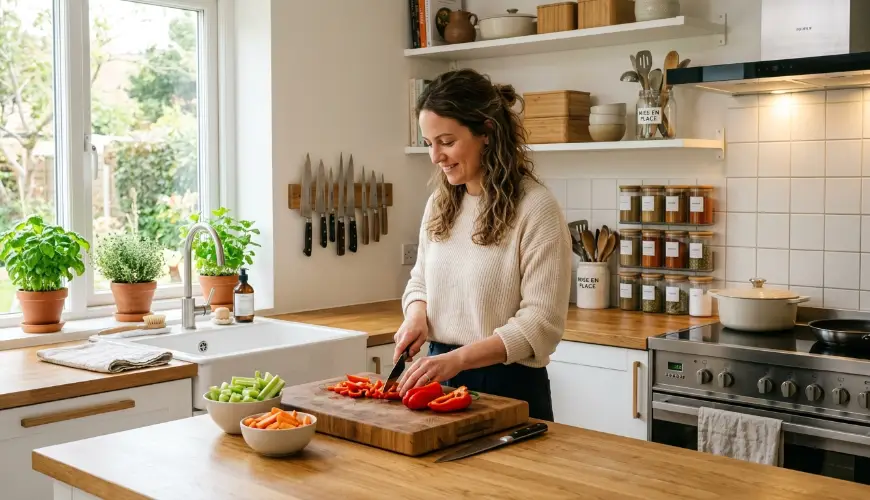
Several basic rules apply to the preparation zone. It should be positioned close to the sink, since ingredients are usually washed before preparation. At the same time, it should be as close as possible to the stove, so that the transfer of prepared ingredients is as short as possible. Ideally, the cook should have basic tools within reach – knives, chopping boards, graters, and bowls – without having to open any cupboard. Wall-mounted knife holders or magnetic strips directly above the worktop are therefore an excellent solution that professional chefs use as a matter of course.
The choice of worktop material in the preparation zone is a chapter in itself. While marble or granite may look luxurious, they can be problematic for everyday food preparation – they are susceptible to staining from acids or citrus juices. Professional chefs therefore increasingly appreciate stainless steel surfaces or high-quality composite materials, which are hygienic, durable, and easy to maintain. In keeping with a sustainable approach to the home, bamboo or recycled surfaces are also worth considering – they are environmentally friendly while remaining highly practical.
Storage and serving: zones that are often underestimated
While the preparation zone and the area around the stove tend to be addressed reasonably well in home kitchens, the storage zone and the serving zone are two areas where most households have the greatest room for improvement. And this is precisely where inspiration from professional kitchens can bring about the greatest change.
Professional chefs work with the principle of accessibility according to frequency of use. This means that things used every day – oil, salt, basic spices, the most frequently used cookware – are stored within arm's reach, without the need to bend down or stretch up on tiptoe. Things used less often are kept on lower or higher shelves. This seemingly obvious principle is, in practice, surprisingly rarely followed. How many households keep their most-used spices tucked away at the back of a high cupboard, while the front shelves are filled with things that are reached for once a year?
Good solutions for organising storage are offered by, for example, drawer organisers and modular cupboard systems, which are available today in a wide range of materials and sizes. Bamboo, cork, and recycled plastics are materials that combine practicality with an ecological approach – and precisely this type of product can be found in the Ferwer range, which focuses on sustainable solutions for the home.
The serving zone in a domestic setting is specific in that its placement depends on the layout of the flat or house. Ideally, it should be as close as possible to the table or the place where the family eats. Professional chefs know that transferring finished food onto plates and transporting it to the table are the moments when accidents most easily occur – sauce spilling, food going cold, or a carefully prepared dish falling apart. It is therefore important to have sufficient space in this zone and to have everything needed close to hand – ladles, serving spoons, plates warmed in the oven or on a special warming mat.
The modern approach to serving in homes increasingly also encompasses an aesthetic dimension. Food served on attractive tableware, with an awareness of where the ingredients come from and how they were processed, provides an experience that far exceeds mere sustenance. It is no coincidence that interest in high-quality, ecologically produced tableware and serving accessories has grown significantly in recent years – people want their kitchen and dining table to reflect their values.
Returning to the principle of kitchen zones itself, it is important to emphasise that this is not a dogma, but a tool. Every household is different, every cook has different habits, and every kitchen has different dimensions and layout. A small kitchen in a panel-block flat cannot have the same arrangement as a spacious kitchen in a family home. But even within six square metres, the work triangle can be optimised, the preparation zone clearly defined, and storage organised according to the logic of frequency of use.
A practical first step for anyone who wants to make their kitchen more efficient is to spend one day observing their own movements while cooking. Where do you stop most often? What do you most often find yourself searching for? What do you most frequently carry from one place to another? The answers to these questions are a more precise guide than any general instructions, because they reflect the actual habits of a specific household. Studies on the ergonomics of kitchen space indeed confirm that personalising a work environment has a direct impact on both efficiency and user satisfaction.
Professional chefs have one thing in common regardless of whether they cook in a Michelin-starred restaurant or a small family inn – they know their space by heart. They know exactly where everything is and have no need to search. This sense of certainty and overview in the kitchen is not the exclusive privilege of professionals. It simply takes a moment to reflect on how one's own kitchen is arranged, and to gradually adapt it so that it serves as well as possible. The result is not only more efficient cooking, but also a calmer, more pleasant, and more joyful time spent at the stove – and that is surely a goal worth pursuing.