

# What ginger "shots" can really do

On pharmacy shelves, in health food store aisles, and across Instagram – small bottles of ginger shots are now almost ubiquitous. Their fans drink them in the morning on an empty stomach, athletes take them as part of their recovery ritual, and influencers promote them as an elixir of health. But what really lies behind this trend? Is a ginger shot truly as effective as claimed, or is it just another fashion wave that will fade in a few years like so many before it?
Ginger itself is no newcomer to the world of natural medicine. Its root has been used in traditional Chinese and Ayurvedic medicine for thousands of years – as a remedy for nausea, inflammation, poor digestion, or colds. What has changed is the way we consume it. Traditional ginger tea has been replaced by concentrated, small doses in bottles that promise maximum effect with minimal effort. And it is precisely this form that has gained enormous popularity, especially after 2020, when interest in boosting immunity skyrocketed.
Try our natural products

What science says about ginger and its effects
To assess whether ginger shots are truly effective, we need to look at what we know about ginger from a scientific perspective. The main active component of ginger is gingerol – the substance responsible for its characteristic spicy taste as well as most of its health benefits. Research repeatedly confirms that gingerol has anti-inflammatory and antioxidant properties, with these effects demonstrated both in vitro and in clinical studies on humans.
One of the best-documented areas is ginger's effect on digestion and nausea. A meta-analysis published in the journal Nutrition Journal showed that ginger is effective at alleviating pregnancy-related nausea and nausea caused by chemotherapy. Similarly, there is evidence that regular ginger consumption can help lower blood sugar levels and reduce menstrual pain. The World Health Organization even recognises ginger as a traditional medicinal plant with proven effects.
However – and this is important – most studies work with doses ranging from one to four grams of ginger per day in various forms. The question therefore is: do commercially available shots actually contain sufficient quantities of active substances to have a measurable effect? The answer is not straightforward. High-quality shots made from pressed fresh ginger may meet this dosage, but cheaper variants with minimal ginger extract content and high levels of sugar or flavourings may be more of a marketing product than a genuine health aid.
Consider a specific example: Jana, a thirty-five-year-old teacher from Brno, started drinking ginger shots every morning on a colleague's recommendation. After three weeks, she noticed her digestion had improved and she felt less tired. She attributes this to the ginger – but at the same time, she also started going to bed earlier and cut back on coffee. It is difficult to say exactly what caused the change. This subjectivity is one of the biggest problems when evaluating such products: the placebo effect is powerful, and lifestyle changes tend to be complex.
A trend that isn't without substance
It would be an oversimplification to say that ginger shots are a mere passing fad with no real foundation. Unlike many other trends – such as dietary supplements containing exotic superfruits whose effects were never scientifically confirmed – ginger has thousands of years of empirical use behind it, as well as a solid scientific basis today. As British physician and science communicator Tim Spector noted: "The best dietary supplement is one that comes from real food and has at least some research behind it." Ginger meets this criterion.
The problem, therefore, lies not in ginger itself, but in how shots are presented and sold. The marketing surrounding these products often promises miracles – instant detoxification, dramatic immune boosting, or rapid weight loss. None of these effects are scientifically supported in the form in which they are presented. The immune system cannot be "boosted" with a single shot, just as the body does not need special products for detoxification – that is handled continuously by the liver and kidneys, without the help of a small bottle costing a hundred crowns.
So what can a ginger shot realistically do? It can contribute to better digestion, alleviate nausea, provide antioxidants, and – thanks to vitamin C content when the shot is supplemented with lemon or orange – support overall health. That is not nothing – but it is also a far more modest claim than what most manufacturers state on their packaging. Consumers should be able to read these claims critically and distinguish between what is scientifically supported and what is merely marketing language.
The composition of the specific product also plays a role. There is an enormous difference on the market between a shot made from freshly pressed ginger, lemon, and chilli with no added sugar, and a product that lists ginger extract as the fifth or sixth ingredient after sugar, water, and various stabilisers. When choosing, it pays to read labels – and to look for products where ginger is truly the main ingredient, not merely a decorative addition.
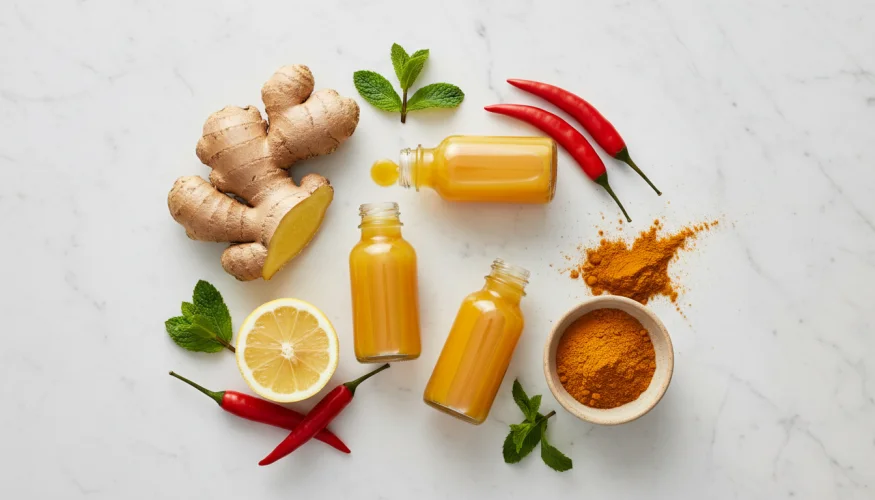
An interesting perspective is offered by a comparison with home preparation. A fresh ginger shot can easily be made at home – simply juice a piece of fresh ginger root, add lemon juice, and optionally a pinch of cayenne pepper or turmeric. Such preparation is not only cheaper, but also allows full control over the ingredients. If someone is considering regular use of ginger shots, a homemade version may be a more practical and transparent solution than most commercial products.
Nor can we ignore the broader context of why ginger shots are so popular. We live in an era when interest in preventive healthcare and natural alternatives to pharmaceutical products is growing significantly. People are looking for ways to actively contribute to their health without having to visit a doctor or take medication. A ginger shot fits perfectly into this picture – it is natural, quick, relatively accessible, and carries with it the feeling that one is doing something good for oneself. This feeling has its own value, even if it cannot be measured in a clinical study.
It is also important to mention for whom ginger shots are not suitable. Ginger in high doses can interact with blood-thinning medications such as warfarin, and is not appropriate for people with certain stomach problems or before planned surgery. Pregnant women should consult a doctor about ginger intake, although in moderate doses ginger is generally considered safe during pregnancy. The National Institutes of Health in the USA provides clear information about possible interactions between ginger and medications, which is worth reading for anyone who takes any medication regularly.
Ginger shots thus stand at the intersection of two worlds: they are a product of the modern wellness industry with everything that entails – exaggerated marketing, premium pricing, and Instagram aesthetics – but at the same time they are rooted in a real, scientifically supported tradition. The key is neither blanket rejection nor uncritical acceptance, but an informed decision based on composition, quality, and one's own health needs.
A healthy lifestyle is not about a single product or a single ritual. It is about the overall approach – quality sleep, exercise, a varied diet, and the ability to think critically about what we consume. A ginger shot can be a pleasant and functional complement to this whole. But only when we know what to realistically expect from it – and what not to.