

# Recognize the Difference Between Autumn Blues and Seasonal Depression Autumn brings shorter days,
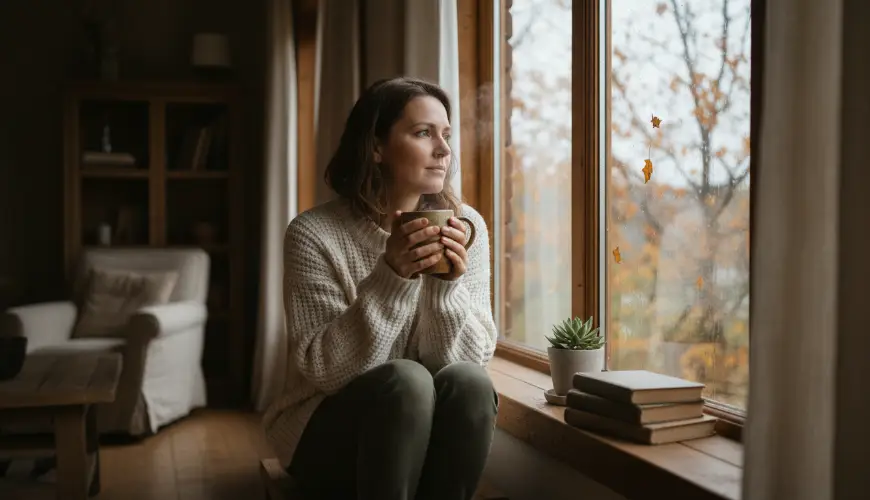
Shorter days, grey skies, and the first truly cold morning when you can't bring yourself to get out of bed. Autumn arrives each year with its characteristic tinge of melancholy, one so familiar to people that they have dozens of words for it – the blues, sadness, a foul mood, autumn gloom. Most of us know the feeling: October arrives, grey days multiply, and with them comes a sense that energy has disappeared somewhere and the world has shrunk a little. But where exactly is the line between this natural mood fluctuation and something that deserves professional attention? And how can you tell whether it's a normal response of body and mind to the change of season, or a genuine seasonal depression?
These questions are not merely academic. Every year, thousands of people ask them as they sit by the window, watching the rain, wondering whether something is wrong with them – or whether they are, in fact, perfectly normal.
Try our natural products
Autumn blues are a natural thing
The human body is not a machine that functions the same way regardless of the season. We are biological beings who evolved over thousands of years in direct contact with natural rhythms – the alternation of light and dark, warmth and cold, abundance and scarcity. The shortening of days in autumn is therefore something the body perceives in very concrete terms: less sunlight means less serotonin, the hormone associated with good mood, and at the same time more melatonin, which induces sleepiness. The result is a natural slowing down, a greater desire for rest, warm food, and quiet.
Autumn blues are therefore, to a significant degree, a physiological response of the organism to a change in its environment. A person feels a little more tired, less motivated, perhaps even sadder than in summer – but they still function, go to work, meet friends, and are able to enjoy pleasant moments. The blues come and go, responding to circumstances. A beautiful autumn trip into nature dispels them, a good book over a cup of tea eases them, a gathering with loved ones keeps them at bay for a while. It is a state that has a natural dynamic and is not impenetrable.
Many people even welcome autumnal melancholy as part of the annual cycle. Poets and philosophers have celebrated it for centuries – it is no coincidence that autumn has inspired so many works of art. As Czech writer Jan Neruda wrote, autumn has its own beauty, rooted precisely in that transience and quiet sadness that compels us to slow down and reflect.
The blues, then, are not an illness. They are a signal that it is time to ease the pace a little, to attend to one's inner life, and to adapt to change. The problem arises when this state grows into something deeper and more lasting.
Seasonal depression: more than just a bad mood
Seasonal affective disorder – known in English by the acronym SAD – is a clinically recognised condition affecting approximately 1 to 3 percent of the population in its more severe form, and a further 10 to 20 percent in a milder form sometimes referred to as "winter blues". The Czech Psychiatric Society and international health organisations classify it among depressive disorders with a marked seasonal component, with symptoms typically appearing in autumn or winter and subsiding with the arrival of spring.
But how can you tell it is not simply ordinary blues? The answer lies in the intensity, duration, and impact on everyday life. Seasonal depression manifests through symptoms that are qualitatively different from transient autumnal melancholy. Persistent feelings of hopelessness, loss of interest in things that once brought pleasure, significant changes in sleep and appetite, difficulty concentrating, and in more serious cases thoughts of self-harm – these are warning signs that cannot be ignored.
Consider a concrete example: Jana, a thirty-four-year-old teacher from Brno, told herself every autumn that she was simply "an autumn person" and that winter didn't suit her. But one year she noticed that she had stopped looking forward to things that used to bring her joy – weekend trips with friends, cooking new recipes, even her favourite television series. She woke up feeling exhausted despite sleeping ten hours. She stopped responding to messages, made excuses to avoid social events, and felt as though someone had covered her with a heavy blanket she couldn't escape. It was only when a close friend told her she had been like this every year from October to March that Jana began to consider whether it might be something more than the blues.
Jana's story is typical – and at the same time it illustrates one of the key differences between the blues and seasonal depression: a recurring pattern that returns every year at roughly the same time and lasts for months. According to research published in the Journal of Affective Disorders, this very seasonal regularity is one of the main diagnostic criteria for seasonal affective disorder.
The causes of seasonal depression are complex and not yet fully understood by scientists, but a lack of natural light plays a central role. This disrupts circadian rhythms, affects the production of serotonin and melatonin, and can cause a biochemical imbalance that is too powerful for many people to overcome through willpower or lifestyle changes alone. Seasonal depression is not a weakness of character or an inability to "pull yourself together" – it is a condition with a biological basis that deserves the same attention as any other health problem.

How to distinguish the blues from depression in practice
The practical boundary between the blues and seasonal depression lies in three fundamental areas: duration, the depth of symptoms, and whether the condition responds to the usual "remedies" such as exercise, social contact, or enjoyable activities.
If a person feels more tired and less motivated but can still find joy in small things, if their mood improves after a walk in the park or time spent with friends, and if the whole state lasts days rather than weeks, it is most likely a natural case of autumn blues. By contrast, if symptoms persist for more than two weeks, interfere with work and personal life, and do not respond to ordinary activities, this is a signal that it would be worthwhile to speak with a professional.
There are several approaches that can help in both cases – differing in their intensity and focus. For managing autumn blues, supportive measures are usually sufficient: regular outdoor exercise even in overcast weather, since even diffuse daylight has a demonstrable effect on serotonin levels; attention to sleep hygiene; a nutritious diet rich in vitamin D and omega-3 fatty acids; and a conscious slowing of pace. Rituals that create a sense of cosiness and safety also help – a phenomenon the Danes named "hygge" and which has become an inspiration to the world in recent years.
For seasonal depression, these measures remain useful as a complement, but are insufficient on their own. Proven therapeutic methods include light therapy, in which the patient spends 20 to 30 minutes each morning in front of a special lamp emitting light at an intensity of 10,000 lux – a method that, according to the Mayo Clinic, has an efficacy comparable to antidepressants for mild to moderate forms of the disorder. Cognitive-behavioural therapy tailored to seasonal depression has also proven effective, and in more serious cases, pharmacotherapy under the supervision of a psychiatrist.
What a person eats and how they care for their body as a whole also matters. Research has repeatedly shown that a diet rich in probiotics, fermented foods, and fibre supports the health of the gut microbiome, which has a direct influence on serotonin production – up to 90 percent of this neurotransmitter is produced in the gut. Organic and natural foods free from unnecessary additives and pesticides can play a role in this context, as can limiting sugar and industrially processed foods, which may improve mood in the short term but destabilise it over time.
The home environment has a greater impact on mental wellbeing than most people realise. Natural materials, houseplants, good air quality, and minimising chemical substances in everyday life all contribute to overall wellbeing and can help create an environment that supports mental health – particularly during the months when we spend more time indoors.
Autumn need not be an enemy. It can be an opportunity for reflection, for regrouping, and for caring for oneself in ways that the fast pace of summer leaves no time for. But if melancholy turns into a weight that will not lift, having the courage to ask for help is the best step a person can take – for themselves and for those who love them. The boundary between the blues and depression is not always sharp, but attention paid to one's own experience is the most reliable compass any of us has at our disposal.