

# Archiving and Shredding Documents: A Practical Guide for the Household
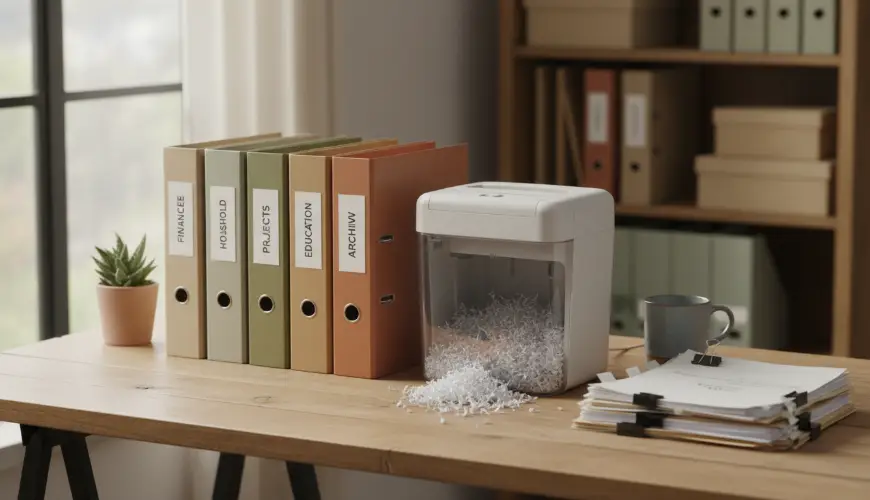
Everyone knows it. A drawer full of papers that you're afraid to pull a single document from, because the entire carefully (or rather carelessly) layered chaos would collapse. Or a binder labelled with a vague "miscellaneous," into which everything disappears that you don't know where to file. Keeping documents organised is a topic that most people put off just as persistently as they put off the papers themselves – until one day. But that one day can come at a moment when you're frantically searching for the warranty card for a washing machine that has just flooded the bathroom, or a tax return from 2019 that the tax office is asking for.
The good news is that document archiving doesn't have to be rocket science. You just need to know what to keep, for how long, and what to shred without regret. And that is precisely the aim of this article – to guide you through what is often unnecessarily complicated, in a clear and straightforward way.
Try our natural products






Why it actually matters what we keep
Before we get into specific retention periods and categories, it's useful to understand why it matters at all. Papers aren't just papers. They are evidence, guarantees, obligations and rights. A missing document can mean a lost court case, an unenforceable complaint, or money paid unnecessarily. On the other hand, needlessly hoarding papers that have long since expired leads to chaos in which important things get lost among unimportant ones.
According to surveys, the average person spends approximately four weeks a year looking for things, with paper documents making up a significant portion of this lost time. That's not just inconvenient – it's literally a waste of life. And yet all it takes is one afternoon with some binders and a bit of a system for the situation to change fundamentally.
Interestingly, the need to keep documents is not just a personal matter. The law in many cases directly stipulates how long you must archive certain records. Exceeding these periods – whether by shredding too early or, conversely, keeping things unnecessarily – can have legal and practical consequences. It is therefore worth knowing the basic rules that apply in the Czech Republic.
Imagine Markéta, a forty-something from Brno, who after moving into a larger flat finally decided to go through a box of papers she had been carting from flat to flat for the past ten years. Inside she found payslips from 2008, warranty cards for appliances she had long since thrown away, and three copies of the same insurance form. But also – and this was the key thing – a loan agreement with a friend that both of them had forgotten about, and a birth certificate whose existence she hadn't been sure of. That box contained both useless clutter and irreplaceable documents. That is precisely the problem with unsystematic paper storage.
What to archive and for how long – a practical overview
The key to a functional system is to divide documents into categories according to how long it is necessary or advisable to keep them. Some records have a clear statutory retention period; others deserve a permanent place in a binder regardless of time.
Documents for permanent retention form the foundation of any archive. These include birth certificates, marriage certificates, divorce judgements, educational certificates (apprenticeship certificates, school-leaving certificates, university diplomas), as well as wills, gift deeds for real estate, and all documents relating to ownership – purchase contracts for flats, houses and land, mortgage agreements and title deeds. These papers are not reviewed, sorted or shredded. They simply stay. Ideally in a folder clearly labelled and stored in a safe place that more than one person in the household knows about.
A separate chapter covers documents with a longer retention period, typically ranging from five to ten years. Tax returns and all supporting documents (invoices, income receipts, income confirmations) should be kept for a minimum of three years from the date of filing, but in practice ten years is recommended, as the tax office can in certain cases reach back even further into the past. Employment contracts should ideally be archived for the entire duration of employment and a further ten years after it ends, as they may be relevant for pension calculations. Payroll records and income confirmations have a statutory retention period of thirty years – a figure that surprises most people, but pension insurance contributions are calculated across an entire working career.
Insurance policies should be archived for the entire duration of the insurance cover and for at least three years after it ends. Loan, mortgage and leasing agreements should be kept for the entire duration of the obligation and for ten years thereafter – in case of disputes over limitation periods or confirmation of repayment.
At the other end of the spectrum are documents with a short lifespan that most of us needlessly hoard. Warranty cards are worth keeping only for the duration of the warranty – once it expires, the document loses its value. The exception is warranty cards for valuable items where the seller or manufacturer has offered an extended warranty. Bills for energy, telephone and internet need only be kept for one year, or until they have been paid and any complaint has been resolved. Bank statements are nowadays available online going back several years, so paper versions can be shredded after a year. The same applies to till receipts – unless they serve as proof for a warranty claim or a tax-deductible expense, they are redundant after three months.
How to summarise this clearly? A basic guide might look like this:
- Permanently: birth certificates, diplomas, property contracts, wills
- 10–30 years: payroll records, employment contracts, tax returns with supporting documents
- 3–10 years: insurance policies, loan agreements, contracts for work
- 1–3 years: utility bills, bank statements, tax documents for minor purchases
- Until warranty expires: warranty cards and warranty terms
How to shred correctly and safely
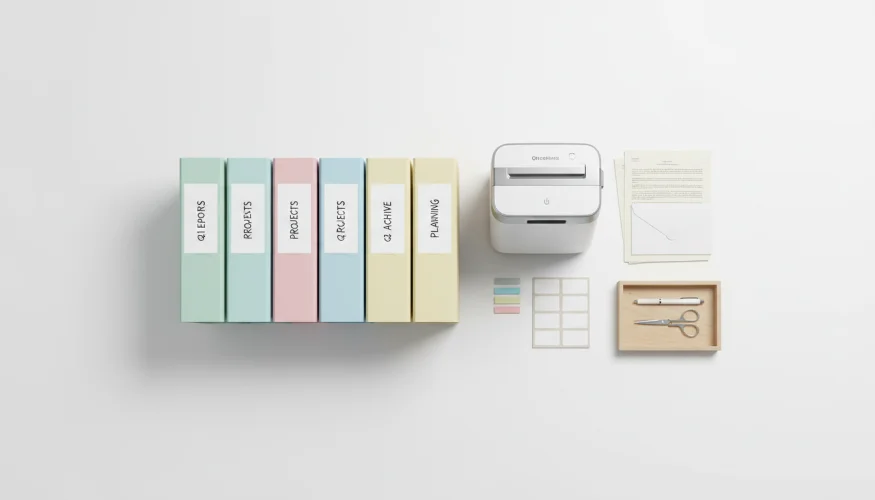
Knowing what to shred is half the battle. The other half lies in doing it correctly. Simply throwing papers in the bin can be a security risk. Documents contain personal data – national identification numbers, account numbers, addresses, signatures – and their misuse is a reality today, not paranoia.
A shredder should therefore be a basic piece of equipment in every household. Modern models are available at a reasonable price and can handle not only paper but also credit cards and CDs. For home use, a cross-cut shredder is sufficient, as it cuts documents into small pieces. If you don't have a shredder, there is an alternative in the form of specialist shredding services that accept documents from private individuals.
For those who decide to switch to digital archiving, different rules apply. Scanned documents should be saved in PDF format, ideally electronically signed or accompanied by a note of the date of scanning and the original document. Cloud storage offers convenient access from anywhere, but it is important to choose trustworthy providers and protect documents with a strong password. As the Office for Personal Data Protection points out, digital documents are also subject to personal data protection rules and sharing them should be conscious and secure.
However, digitalisation is not a solution for everything. Originals of certain documents – birth certificates, notarised contracts or court decisions – carry legal weight precisely as physical documents with original signatures and stamps. A scanned copy is useful as a backup, but does not replace the original.
An interesting question is whether switching to digital documents actually reduces the amount of paper in a household, or merely shifts the problem elsewhere. Research shows that people who switch to digital archiving initially do print fewer papers – but over time the tendency to print "just in case" grows again. True order in documents is therefore not just about format, but about the habit of regularly sorting, deleting or shredding what is no longer needed.
Writer and organisational consultant Peter Walsh put it aptly: "Clutter is not just physical. It is deferred decisions." And that is the crux of the matter. Every paper in a binder or drawer where you don't know whether to throw it away or keep it is a decision you haven't made. And these non-decisions accumulate – literally and figuratively.
A practical approach that works for many households is to establish an annual "paper day" – ideally at the start of the year or after filing a tax return. On that day, all folders and binders are reviewed, documents whose retention period has expired are removed, and new documents from the past year are filed in the right place. Such a ritual typically takes two to three hours, but saves dozens of hours of unnecessary searching for the rest of the year.
Alongside the annual review, an ongoing system also helps – instead of putting papers "on the pile," make an immediate decision: is this for archiving or for shredding? If for archiving, exactly where does it belong? This habit is slightly more demanding at first, but after a few weeks it becomes automatic and the chaos in documents stops accumulating.
Order in documents is ultimately not an end in itself. It is a tool – a tool for peace of mind, clarity and the reassurance that at the moment you need a specific piece of paper, you know exactly where to find it. And that is worth one afternoon with the binders.