

# Why We Postpone Pleasant Things Even When We Look Forward to Them It may seem paradoxical – you'v
Procrastination
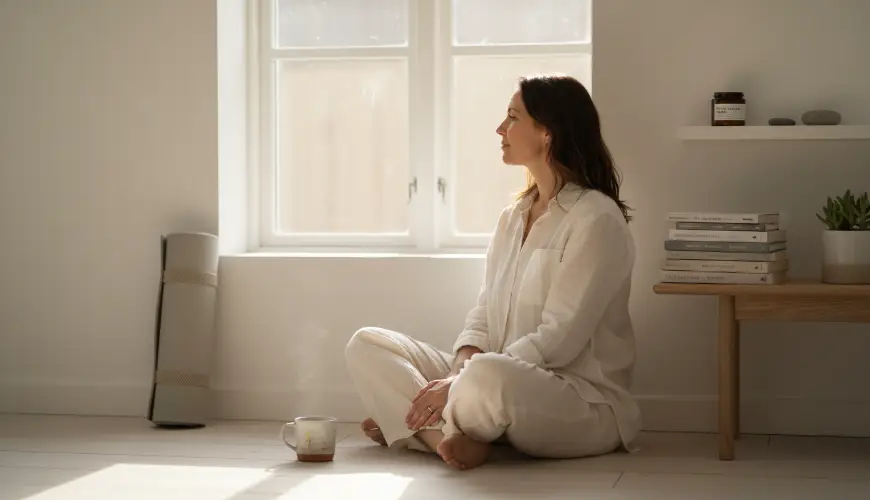
Procrastination. A word most of us know very well – and probably know all too intimately. We usually associate it with putting off unpleasant tasks: filing taxes, visiting the dentist, having a difficult conversation with our boss, or cleaning out a wardrobe full of things that have been sitting there for years. Yet psychology has been surprising us in recent years with one unsettling finding – we postpone things we look forward to just as readily. A holiday we've been saving up for years. A yoga class we've been wanting to start. A book sitting on our bedside table. A new self-care ritual. Why do we do this?
The answer isn't simple, but it is fascinating. And understanding this mechanism can fundamentally transform the way we approach our own lives.
Try our natural products

Procrastination isn't just laziness
The popular image of a procrastinator as someone who simply doesn't want to work is a gross oversimplification. Research repeatedly shows that procrastination is primarily driven by emotional regulation, not a lack of willpower or organisational skills. At its core, procrastination is a way of avoiding an unpleasant feeling – and paradoxically, even something we look forward to can trigger that unpleasant feeling.
Psychologist Timothy Pychyl from Carleton University, one of the world's leading experts on procrastination, explains it this way: people don't procrastinate because of the task itself, but because of the emotions they associate with it. And these emotions can be surprisingly complex even when we're talking about seemingly joyful activities.
Take a specific example: Jana, a thirty-four-year-old graphic designer from Brno, tells herself every January that she'll finally start attending a ceramics class. It has always been her dream – working with her hands, creating, taking a break from screens. The class exists, it's accessible, the price is reasonable. And yet every year February comes, then March, April... and Jana is still just thinking about it. What's stopping her? She herself says that "the time isn't right yet." But the right time doesn't come on its own.
When joy becomes a burden
The phenomenon of postponing enjoyable things has several names and causes in psychology. One of the most interesting is the so-called delayed reward effect – our brains are evolutionarily wired to prioritise immediate gratification over something more distant. This works in reverse too: a pleasant thing that requires planning, preparation, or a decision is automatically filed by the brain into the "later" category, because it requires some effort now.
On top of this comes another psychological phenomenon that researchers call the "anticipated pleasure gap" – the gap between how we imagine a pleasant thing will be and what it will actually be like. The longer we postpone and idealise something, the greater the risk of disappointment. And the brain perceives this threat of disappointment as a reason to postpone further. It's a circular trap that's difficult to escape without conscious effort.
There is also a less-discussed but very real factor: fear of one's own pleasure. Many people – especially those who grew up in environments where self-care was considered selfish or unnecessary – subconsciously don't believe they deserve pleasant things. A holiday? "I still need to finish that project." A massage? "That's a luxury I can't afford." New skincare made from natural ingredients? "I'll wait until I've used up that old cream that's left over." The result is that pleasant things are postponed indefinitely – not because they're inaccessible, but because the person feels as though they don't have the right to them.
Psychologist Kristin Neff, a pioneer in self-compassion research, repeatedly demonstrates in her studies that people with lower levels of self-compassion have a significantly greater tendency to postpone activities related to their own wellbeing. This isn't about excessive self-praise – it's about the basic ability to treat ourselves as kindly as we would treat a good friend.
What lies behind "the time isn't right yet"
The phrase "the time isn't right yet" is one of the most widespread forms of procrastination rationalisation. It's dangerous precisely because it sounds reasonable. After all, who would want to start something at the wrong moment? Yet the right time is, in most cases, a fiction – a construct that our brain creates in order to postpone the discomfort associated with a decision or change.
This discomfort can take many forms. With enjoyable things, it often involves fear of anticipation – if I plan something, I also have to prepare myself for the possibility that it might go wrong or fail to meet my expectations. If I don't do it, it remains safely in the realm of possibilities. Psychologists call this "keeping options open" – maintaining open possibilities, which gives us an illusion of control and freedom, but in reality paralyses us.
Another factor is identity. The pleasant things we postpone are often connected to who we want to be – to our ideal version of ourselves. A person who buys eco-friendly products, sports equipment, or a meditation course but never uses them maintains the feeling of being "that type of person" without having to undergo any real change. Sociologists speak of so-called symbolic consumerism – purchasing as a substitute for actual action.
It's no coincidence that consumer behaviour research shows that people read, on average, fewer than a third of the books they buy, complete fewer than half of the online courses they sign up for, and use fewer than 60% of the self-care products they purchase. The act of buying itself provides a short-term dopamine rush – and that is sometimes enough to make us feel as though we have already "done" the thing.
How to break free
Understanding the mechanism is the first step, but it's not sufficient on its own. So what actually helps?
One of the most effective approaches is the so-called implementation intention – a concrete plan in the format of "when X happens, I will do Y." Research by psychologist Peter Gollwitzer from New York University shows that people who set a specific time, place, and trigger for a planned activity are significantly more likely to actually carry it out. It's not enough to say "I'll do yoga." You need to say "on Tuesday at seven in the evening, after work, I'll roll out my mat in the living room."
Equally important is reducing the first step to a minimum. Want to start with morning meditation? You don't begin with twenty minutes – you begin with two. Want to establish a skincare ritual using natural products? You don't start with a complete nine-step routine – you start with one product, one minute. The brain is far more willing to begin when the entry barrier is low.
It also helps to consciously work with what psychologists call "future self connection" – connecting with your future self. People who vividly imagine how they will feel after actually experiencing a pleasant thing have greater motivation to overcome the initial resistance. This isn't about visualisation in the sense of magical thinking – it's about a concrete, sensory imagining of the outcome. What will your skin look like after a month of care? How will you feel after your first ceramics class? How will you be transformed after two weeks of the holiday you've been waiting years for?
As American author and coach Martha Beck once said: "Putting off pleasant things isn't just a loss of joy. It's a loss of yourself." This sentence contains more truth than it might appear at first glance. When we systematically postpone what fulfils us, we gradually lose touch with who we truly are and what has meaning for us.
The question of environment naturally belongs here too. We also postpone pleasant things because nothing reminds us of their importance. Unpleasant obligations have deadlines, invoices, reminders. Pleasant things are quiet – they wait patiently until we make space for them. One practical strategy is therefore deliberately creating reminders and an environment that makes pleasant things visible. A yoga mat visibly in the corner of the room. A book on the bedside table rather than on the shelf. Natural cosmetics on the bathroom counter, not hidden in a drawer.
Community and sharing also play their role. Research repeatedly shows that a commitment to another person increases the likelihood that we will actually begin an activity. It doesn't have to be a formal accountability partner – it's enough to tell a friend "I'm going to that class next week" or to sign up for an activity together with someone close to you. Social commitment is a powerful motivator that works even when inner motivation fluctuates.
There is yet another dimension that is less often discussed: postponing pleasant things as a cultural pattern. In many Central European cultures, including Czech culture, a deeply rooted ethos of work as the primary value persists. "Work first, play later" – a phrase virtually every generation has heard from their parents – has its place, but taken to an extreme, it leads to "later" never arriving. Work always comes first. Obligations are always more pressing. And pleasant things wait – for years, decades, sometimes an entire lifetime.
It's no coincidence that the World Health Organization classified burnout syndrome in the International Classification of Diseases as a legitimate occupational phenomenon. One of its key symptoms is precisely the inability to allow oneself rest and joy – not because the person doesn't want to, but because they don't know how, or don't permit themselves to. Self-care is not a luxury. It is a prerequisite for long-term functionality, creativity, and a meaningful life.
So next time you tell yourself "not yet, I'll wait for the right moment" – pause for a moment and ask yourself: what exactly am I waiting for? And what will I lose if I keep waiting? Pleasant things are not a reward for completed obligations. They are part of life itself – and life doesn't wait for the right moment. It is lived now.