

Crispy Spicy Oven-Baked Cauliflower Wings with Marinade
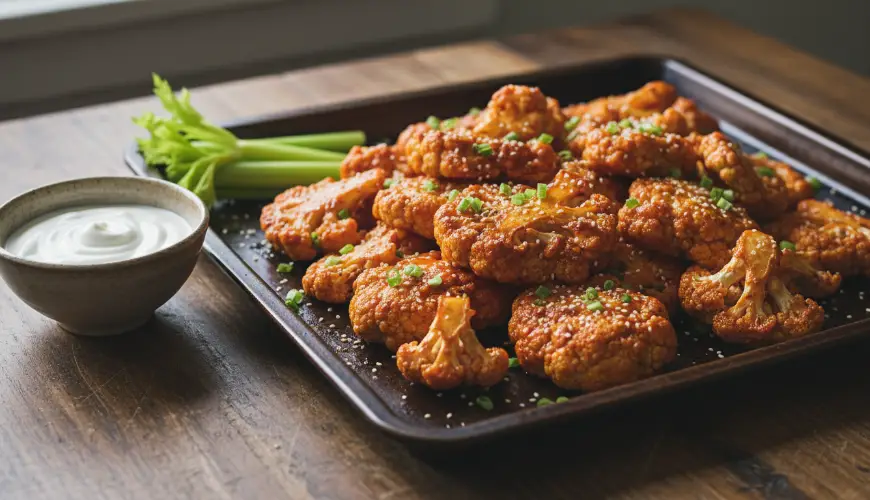
Is there a dish that can make even die-hard meat lovers forget there are no chicken wings on their plate? Oven-baked cauliflower "wings" in a spicy marinade are exactly the kind of recipe that shatters prejudices and wins hearts — one bite at a time. This is not just a trendy plant-based fad. It is proof that vegetables can be just as satisfying, bold, and addictive as their meat counterparts.
Cauliflower as the star of the kitchen has been experiencing a true renaissance in recent years. While just ten years ago it was condemned to the role of a boring side dish or baked mash, today we find it in the form of steaks, burgers, pizza dough, and yes — wings. The reason is simple: cauliflower has a neutral flavor that perfectly absorbs marinades, spices, and sauces, while also offering a surprisingly meaty texture when prepared correctly. When roasted in the oven at a higher temperature, its surface browns and slightly caramelizes, while the center remains gently soft — a combination that closely resembles well-cooked chicken.
Try our natural products






What makes a spicy marinade truly exceptional
The marinade is the foundation of the entire recipe, and this is where it is decided whether the result will be average or absolutely unforgettable. Traditional chicken wings get their characteristic flavor from a combination of fat, acid, heat, and salt — and the spicy marinade for cauliflower works on exactly the same principle. The most common approach uses a combination of hot sauces such as sriracha or gochujang, soy sauce, garlic, smoked paprika, maple syrup or honey, and a splash of lemon juice. This mixture creates a complex flavor profile in which heat, sweetness, umami, and a light acidity intertwine.
A key step that many people skip is coating the cauliflower in a layer of batter or starch before roasting. Potato or cornstarch creates a light crust on the surface that holds the marinade in place while also preventing the vegetable from becoming mushy during baking. It is precisely this technique that is responsible for the enticing crunchiness that makes cauliflower wings a truly memorable experience. Without it, the result would still be tasty, but would lack the texture that makes the whole dish so satisfying.
Interestingly, Asian cuisines have been using similar logic for centuries. The technique of coating vegetables or tofu in a light starchy batter and then frying or baking them is the foundation of Japanese tempura and Korean pojangmacha street food. Transferring this principle to cauliflower and combining it with the American tradition of buffalo sauce is exactly the kind of culinary crossover from which new classic dishes are born.
Renowned chef and plant-based cooking advocate Yotam Ottolenghi once remarked: "Vegetables are not a limitation. They are a canvas." And it is with this philosophy that the best cauliflower wing recipes approach their main ingredient — not as a meat substitute, but as an independent, fully-fledged material with its own potential.
How to properly prepare wings at home
Home preparation is surprisingly simple and truly anyone with an oven and basic pantry staples can manage it. The whole process begins with breaking the cauliflower into smaller florets — ideally shaped to resemble actual chicken wings, meaning elongated and roughly the same size so they roast evenly. Florets that are too small will dry out; those that are too large will remain raw in the middle.
Before marinating, it is important to thoroughly dry the florets — moisture is the greatest enemy of crunchiness. Many cooks recommend letting the cut cauliflower rest on a paper towel for at least fifteen minutes. Only then comes the starch or batter. The simplest option is to toss the florets in cornstarch mixed with a little salt and garlic powder, after which they are dipped in the marinade, or the marinade is added after the first phase of baking — depending on the specific recipe and desired consistency.
The oven should be preheated to a high temperature, ideally between 200 and 220 degrees Celsius. Baking takes place in two stages: the first roughly twenty minutes, during which the foundation of crunchiness is formed, and then the marinade is added and baking continues for another ten to fifteen minutes until the surface caramelizes and takes on a dark golden-brown color. The result should be slightly crispy on the outside and gently soft on the inside — not mushy, but not hard either.
A great real-life example is the experience of Markéta, a thirty-year-old graphic designer from Brno, who decided to prepare cauliflower wings for a party with friends, half of whom ate meat. She had worried in advance that she would need to supplement them with some meat dish. The result surprised her: the bowl of wings disappeared first, even before the grilled sausages, and several friends asked for the recipe that same evening. Experiences like this show that this is a dish that needs no special audience or "vegan food" label — it simply tastes good.

Serving, variations, and why this is more than just a trend
The traditional way of serving chicken wings calls for a dip — and with cauliflower wings this is doubly true. The classic combination is tzatziki or a yogurt herb dip, which cools the heat of the marinade and adds a fresh contrast. Also popular are tahini sauce with lemon, avocado dip, or a simple creamy ranch dressing. Alongside the dip, fresh vegetables work well — celery, carrots, or radishes — and of course good bread or tortillas if you want to turn the wings into a full lunch.
When it comes to variations, the possibilities are practically endless. The marinade does not have to be spicy in the American buffalo style — a teriyaki version with soy sauce, ginger, and sesame works equally well, as does an Indian variant with yogurt, garam masala, and turmeric, or a Mediterranean one with lemon, oregano, and garlic. Each of these versions brings a completely different character, while the basic technique remains the same. It is precisely this versatility that makes cauliflower wings a recipe people return to again and again.
From a nutritional standpoint, this dish is an interesting alternative not only for vegans and vegetarians, but for anyone who wants to eat more diversely and lightly. Cauliflower is rich in vitamin C, B vitamins, potassium, and fiber, while containing very few calories — approximately 25 calories per 100 grams of raw cauliflower. According to data from the Harvard T.H. Chan School of Public Health, cauliflower belongs to the so-called cruciferous vegetables, which are associated with a reduced risk of certain types of cancer and support digestion thanks to their high fiber content.
The growing popularity of plant-based alternatives to classic dishes is no coincidence. A report from the Good Food Institute from recent years shows that interest in plant-based foods is growing even among people who do not identify as vegan or vegetarian — they are simply looking for variety and lighter versions of their favorite dishes. Cauliflower wings are exactly the type of recipe that illustrates this shift: they require no ideological conviction, just a willingness to try something new.
It is also interesting that this trend resonates across generations. While younger generations reach for plant-based alternatives for ecological or health reasons, older generations are discovering them as a way to lighten their diet without a sense of deprivation. A grandmother who has cooked svíčková and schnitzel her whole life may not be willing to go vegan — but cauliflower wings as a Saturday snack during football? That is an entirely different conversation.
The recipe also works beautifully as part of the broader concept of so-called flexitarianism — an approach to eating that sets no rigid boundaries but simply increases the proportion of plant-based foods in everyday meals. According to research published in The Lancet, even a moderate reduction in the consumption of animal products and an increase in the intake of vegetables, legumes, and whole grains can have a measurable positive impact on both health and the environment.
And that is precisely why cauliflower wings are worth trying — not because they are "healthy" or "vegan," but because they are simply delicious. Spicy, crispy, aromatic, and surprisingly satisfying. A dish that began as a culinary experiment has gradually become a permanent fixture of modern cooking — and therein perhaps lies its greatest success. It needs no apologies or explanations. It speaks for itself — one bite at a time.