
# Why Some Exercises Feel Embarrassing and How to Overcome Shame
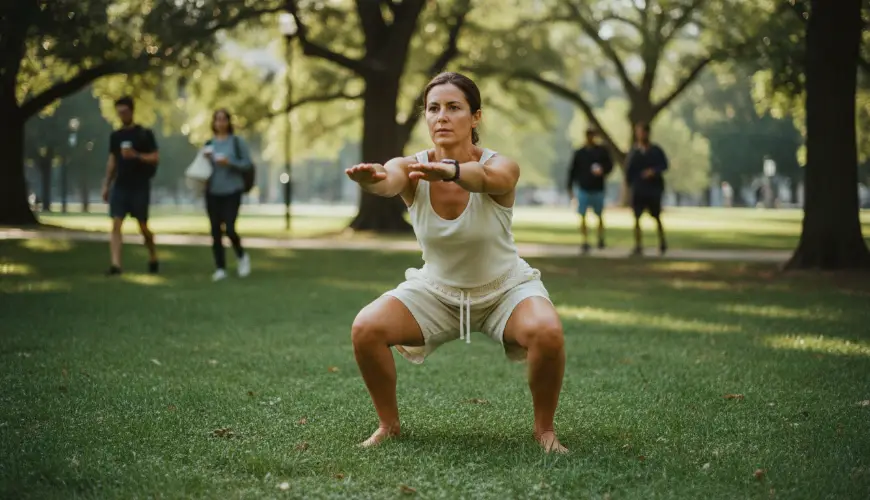
Everyone who has ever walked into a fitness center or tried to exercise in public knows that uncomfortable feeling. You're standing in the middle of a park, about to do a squat with your arms stretched forward, and suddenly you notice a group of people walking by. Your hands automatically drop, the movement stops, and instead of focusing on proper form, you're thinking about how you look from the outside. This phenomenon is far more widespread than it might seem, and it has deep psychological roots worth exploring.
Embarrassment during exercise is not a weakness or hypersensitivity. It's a natural human reaction rooted in how we are wired as a social species. Evolutionarily, we lived for thousands of years in small groups where the gaze of others could literally determine our survival. Being excluded from the group meant death. And that is precisely why the brain still responds to social evaluation with such intensity, as if it were a matter of survival.
Try our natural products





The Psychology of Embarrassment and Exercise
Psychologists call this phenomenon social evaluative threat – the fear of negative judgment from others. In the world of fitness, it manifests in a specific way: we fear looking incompetent, ridiculous, or unprofessional. What's interesting is that this fear is not necessarily related to how well or poorly we actually exercise. It's more about how we think we look – and these two things are often surprisingly far apart.
Research in sports psychology repeatedly shows that beginners are significantly more prone to feelings of shame during exercise than experienced athletes. A study published in the journal Psychology of Sport and Exercise found that so-called "exercise embarrassment" directly influences people's motivation for regular physical activity. In other words – shame literally discourages us from movement that is essential for our health. That's a paradox worth paying attention to.
There are exercises that trigger this feeling far more strongly than others. Movements that are slow and deliberate, such as yoga or pilates, attract more social attention than fast, dynamic activities. Exercises that require unusual body positions – deep squats, various plank variations, or floor movements – create a sense of vulnerability. And finally, exercises that are new and unfamiliar to a person automatically bring a higher degree of uncertainty, because we don't know whether we're performing them correctly.
Take a specific example: a thirty-year-old woman, let's call her Petra, decides to start exercising and attends a group yoga class for the first time. She spends the entire session watching others instead of focusing on her own body, because she's afraid of getting into the wrong position or being laughed at by the instructor. After the class, she leaves feeling that yoga "isn't for her," even though the problem wasn't yoga itself, but the social anxiety that accompanied her. This experience is unfortunately very common and leads many people to give up physical activities before they've had a chance to bring any benefit.
It's important to realize that this problem doesn't only affect complete beginners. Even experienced athletes have exercises that make them feel uncomfortable. Men who regularly go to the gym often avoid dance or aerobics classes. Women who are fit in cardio exercise may feel inhibited when working with heavy weights in the part of the gym dominated by men. The boundaries of embarrassment are individual and shaped by a combination of personality traits, previous experiences, and cultural environment.
Cultural context plays a greater role than we usually acknowledge. Different countries and communities have different ideas about what constitutes "normal" physical behavior in public. In countries like Japan or South Korea, group exercise in public spaces is completely commonplace, and no one looks twice at someone stretching in the middle of a park. In the Czech environment, the perspective tends to be different – a certain restraint toward public displays of physicality persists, which can complicate exercising in public.

How to Deal with the Feeling of Embarrassment
The good news is that embarrassment during exercise is not an unchangeable part of one's personality. It's a learned response, and what has been learned can be unlearned or at least reduced. The key is not to stop perceiving the gaze of others – that would be unrealistic and not even desirable. The key is to change our relationship to that perception.
Psychologist Albert Bandura, who devoted his life to researching self-confidence and motivation, said: "People with high beliefs in their own efficacy approach difficult tasks as challenges to be mastered rather than as threats to be avoided." This idea is enormously relevant to the world of exercise. If we perceive a new, unfamiliar exercise as a threat to our social standing, our response will be fitting – escape or freezing. If we can reframe it as an opportunity for learning, the entire inner experience changes.
One of the most effective tools is gradual exposure. Not starting with what feels most embarrassing, but building confidence gradually, from less demanding situations to more demanding ones. Someone who is embarrassed to exercise in public can start at home, then move to a less frequented part of the park in the morning or evening, and only gradually get used to the presence of other people. The brain learns that the situation is safe and gradually reduces the alarm response.
Shifting attention inward rather than outward also helps greatly. Most embarrassment arises when we move our attention away from our own body and experience toward how others see us. Sports psychologists recommend a technique called "internal focus" – consciously reminding ourselves how the movement feels, what we sense in our muscles, how we are breathing. This approach not only reduces social anxiety but also improves exercise technique and overall performance.
A group environment can paradoxically be both a source of embarrassment and its remedy. A well-chosen group or class with an accepting and non-judgmental atmosphere can significantly reduce feelings of shame. This is precisely why communities built around physical activities are so important – it's not just about motivation, but about creating a safe social space. If you're unsure where to find such an environment, the World Health Organization's research on physical activity repeatedly emphasizes that social support is one of the key factors in long-term adherence to exercise.
Another approach that has proven effective is cognitive reframing – a conscious change in the way we interpret a situation. When the thought "everyone is looking at me and laughing" arises, it's useful to ask: is that actually true? In reality, the vast majority of people in a gym or park are focused on themselves and their own performance. Psychologists call this the "spotlight effect" – we overestimate how much others are focused on us. Research from Cornell University has shown that people systematically overestimate how much attention others pay to them, by approximately two to three times the actual amount.
Worth mentioning is also the role of physical environment and equipment. The feeling of embarrassment tends to be stronger when we feel inappropriately dressed, inadequately equipped, or simply "out of place." Investing in clothing that makes us feel comfortable and confident is not superficial vanity – it's a legitimate psychological strategy. When we feel good in our body physically, it's easier to overcome psychological barriers. Sustainable sportswear made from natural materials offers the added advantage of being comfortable, functional, and not creating unnecessary environmental burden – and that's an added value worth considering.
It's also important to speak openly about the fact that embarrassment during exercise is normal. Tabooizing this topic causes people to believe they are alone with this feeling, which only deepens their isolation and shame. When instructors, trainers, or experienced athletes share their own experiences with discomfort and overcoming inhibitions, it creates a space where beginners feel accepted and less alone.
Movement should never be a source of shame. It is one of the most natural expressions of human existence, something we as a species were made for. Our bodies are designed for movement – for jumping, climbing, dancing, running, carrying. The way modern society creates hierarchies of fitness, performance, and aesthetics around movement is a cultural construct, not a natural state of affairs. And cultural constructs can be questioned, changed, and overcome.
Every exercise that feels embarrassing to us is in fact a challenge not only for the muscles, but also for the mind. And that is where its true value lies – not just in caloric balance or muscle mass, but in the gradual building of courage to be oneself even when someone is watching. This courage then transfers to other areas of life in ways that are not always visible, but are all the deeper for it. Starting to exercise despite feeling embarrassed is a small but extraordinarily powerful act of self-confidence.