

Proper and healthy digestion begins at the table when you eat mindfully and slowly.
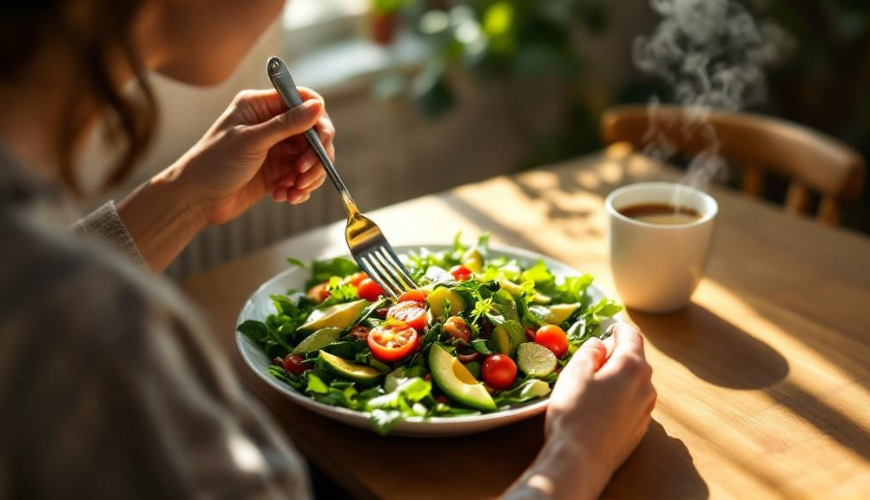
Digestion is the quiet engine of daily well-being. When it works, you hardly notice it. But when it starts to make its presence known – with bloating, heartburn, abdominal pressure, or fatigue after eating – it can ruin your day faster than bad weather. Often, it's not just about what you eat, but also how you eat. This is where mindful and slow eating comes into play: a simple habit that costs nothing, yet can be surprisingly effective. So why does slow eating help digestion, and how can you set up proper and healthy digestion without complicated rules?
In the usual work rhythm, eating easily becomes "a task among tasks." A quick snack at the computer, a lunch eaten in ten minutes, dinner in front of the TV. And then you wonder why your body protests. However, digestion is not a switch that can be turned on at will. It's a harmony of nerves, hormones, enzymes, bowel movements, and also the signals that the brain sends to the whole system. And the brain follows what we give it during meals: calm, attention, time – or on the contrary, stress, haste, and distraction.
Try our natural products






Why Slow Eating Helps Digestion More Than It Seems
It starts in the mouth. When food is swallowed quickly, digestion misses the first important step: thorough chewing. This isn't just an old wives' tale. In the mouth, food is mechanically broken down, mixed with saliva, and saliva contains enzymes that begin the breakdown of certain nutrients (such as starches). The better the bite is prepared, the less work the stomach and intestines have to do. And the less likely it is that the body will have to "fight" with the food longer than necessary.
Moreover, there's another often overlooked effect: a slow pace gives the body time to activate the digestive mode. Digestion is closely linked to the nervous system. Under stress, the body prefers the "fight or flight" mode, and digestion takes a back seat. In calmness, however, the "rest and digest" mode kicks in. It's no coincidence that problems often arise on days when the head is overwhelmed. Slow eating acts as a subtle brake: when movements slow down, breathing calms, and attention returns to the plate, the body receives the signal that it's safe and can invest energy in digestion.
Satiety is also important. Hormones and nerve signals announcing "that's enough" don't come immediately. When eating quickly, you often consume more than you actually need because the satiety signal comes with a delay. The result is a feeling of heaviness, stomach pressure, and sometimes heartburn. On the other hand, mindful and slow eating helps discern when hunger is real and when it's just momentum or craving.
The so-called "cephalic phase of digestion" – when the body starts preparing for food even before the first bite – is also worth mentioning. The smell, the sight of food, the anticipation of taste... all of this supports the production of saliva and gastric juices. When eating in a rush "on autopilot," this natural start is often diminished. A basic explanation of the digestive process can be found on the NHS website or a broader context of organs and their functions on Britannica – digestive system. It's not the only truth, but a solid framework into which practical experience can fit.
And then there's one more thing that isn't talked about much: fast eating often means fast drinking, bigger bites, fewer pauses, and sometimes worse choices. When you pause, it's easier to notice that some combinations don't sit well, that the portion is too large, or that you're eating more "for nerves" than hunger. Proper and healthy digestion isn't just about the ideal diet but how the body feels on real days.
"When you slow down at the table, the comfort after eating often speeds up."
Mindful and Slow Eating in Practice: Small Changes That Make a Big Difference
The idea of "mindfulness" at meals might sound like a luxury for people with an hour for lunch and silence in the kitchen. But mindful and slow eating can be practiced in everyday life – and it doesn't have to be perfect. It's more about returning the main role to food: to nourish the body and calm the system, not just quickly fill a pause.
A simple example from real life nicely illustrates this. Imagine a typical situation: a work lunch, between meetings, one hand holding a phone, the other a fork. The meal "disappears" within a few minutes, and half an hour later comes fatigue, abdominal pressure, and a craving for sweets. When the same person decides the next day to try a small experiment – sit down, put the phone away, take three calm breaths, and really chew each bite – lunch might take five to ten minutes longer, but the afternoon is surprisingly lighter. Not because the menu changed, but because the conditions in which digestion works changed.
You can slow down with a few discreet tricks that feel natural, not like "rules":
How to Eat and Have Good Digestion: A Few Habits You Can Manage Right Away
- Start with the first three bites slower than usual. The start sets the pace. When you slow down at the beginning, the rest of the meal often adjusts on its own.
- Put down the cutlery between bites. Not all the time, just occasionally. It helps interrupt the automatic "loading of the next bite" before the previous one is even tasted.
- Chew so that the bite is really soft. No need to count how many times, but the goal is clear: don't send large pieces to the stomach that will take unnecessarily long to digest.
- Eat while sitting and without walking. Even if it's "just a roll". The body digests better in calm than on the go.
- Notice the signal "I've had enough". Not "I'm stuffed", but that subtle moment just before. That's key for lightness after eating.
What's nice about these steps is that they're not ascetic. They don't dictate what can and cannot be done. They just create space for the body to do what it knows how to do.
It's also fair to say that slow eating isn't a magic solution for everything. If someone has long-term issues, severe pain, blood in the stool, significant weight loss, or trouble swallowing, it should be addressed by a doctor. But for common functional issues – where digestion "gets stuck" due to stress, irregularity, and pace – changing the rhythm at the table is often one of the most accessible and gentle steps.
Slowness often naturally leads to better choices. When eating calmly, the taste of quality ingredients stands out more, so there's no need for as much sugar, salt, or "something extra". You can also more easily notice that simpler meals, enough fiber, and regularity suit you. By the way, fiber is a crucial topic for digestion, and it's worth having a verified foundation – for example, information on fiber from Harvard T.H. Chan School of Public Health can clearly explain why it's so important for the intestines.
Proper and Healthy Digestion Isn't Just About Food, But Also About the Rhythm of the Day
Once you open the topic "how to eat and have good digestion", it quickly becomes clear that the pace at the table is just one piece of the puzzle. But it's unique in that it acts as a bridge: it connects diet with stress, sleep, movement, and the environment in which you eat. And that's often what determines whether the body feels light or heavy after a meal.
One of the biggest enemies of digestion is chronic haste. Not the occasional rush, but the long-term one. When eating under stress, the body may produce less saliva, the stomach may react more sensitively, and the intestines may change rhythm. Some people then struggle with constipation, others with diarrhea, others with bloating. Not always is a specific food to blame; sometimes it's a combination of speed, tension, and irregularity. Mindful and slow eating in this sense is a small daily "reset" that says: for now, nothing is rushed.
The environment helps too. Eating by a screen means divided attention. The brain registers messages, emails, conflicts in a series – and food is just a backdrop. The result? You pay less attention to taste, chew less, and often eat more. Plus, the ability to notice what specifically makes the body feel good deteriorates. When at least some meals happen without screens, digestion and the relationship with food often calm down.
Sleep is also important. A poorly rested body often has disrupted hunger and satiety signals and more easily falls into quick energy replenishment. On such days, slow eating is all the more valuable – as insurance against "eating" fatigue. Similarly, movement works: a light walk after a meal (say ten minutes) tends to be more pleasant for digestion than an immediate collapse on the couch. It's not about performance, but rather gentle movement.
Interestingly, slow eating often affects the composition of the plate. When eating quickly, the body tends towards foods that provide quick rewards – sweet, very fatty, very salty. When eating more slowly, the taste of carefully cooked soup, quality bread, legumes, vegetables, fermented foods stands out. And fermented foods (yogurt, kefir, sauerkraut, kimchi) are often associated with supporting the gut microbiome. Here, too, it's good to stick to reasonable, verified sources; a useful overview of the role of the gut microbiome is offered by Cleveland Clinic – clearly and without sensationalism.
When it all comes together, it actually comes down to a simple idea: proper and healthy digestion is largely about giving the body good conditions. Not perfect, just good. Eat more regularly, sometimes calmly, don't skip meals to the point of ravenous hunger in the evening, and allow time for chewing. In everyday reality, this might mean, for example, moving lunch ten minutes earlier so it doesn't have to be "swallowed", or having a snack so dinner doesn't become a race against time.
And what if it seems there's no room for slow eating? Then it's worth asking a simple rhetorical question: Is the problem really those few extra minutes, or rather that eating has become the last priority of the day? Sometimes a small change is enough – eating part of the portion mindfully, the rest more quickly. Even that is progress. Digestion responds to the trend, not perfection.
In the end, slow eating has a peculiar side effect: it returns dignity to food and peace to the person. And that's often the biggest difference between a day when the stomach "endures something" and a day when the body cooperates. Just slow down, chew, perceive – and let digestion do its work as it has always been set up to do.