
Small rituals build a sense of security in children
Every parent knows it. A child who has behaved surprisingly well all day long falls apart in tears in the evening at the slightest deviation from established routines. The bedtime story must be the right one, the pillow must lie in exactly the right position, and the goodnight farewell must unfold in precisely the prescribed way. What may appear at first glance to be spoiledness or stubbornness is actually something else entirely – it is a child's natural need to feel safe in a world they still do not fully understand.
Rituals in children's lives are not unnecessary luxuries or signs of excessive care. They are anchors that help young people orient themselves in time, space, and relationships. And science backs them up on this.
Try our natural products



Why the child's brain loves predictability
To understand why rituals are so powerful, it is worth pausing for a moment to consider how the child's brain works. Unlike adults, who have years of experience and well-developed strategies for managing uncertainty, a child faces an enormous number of new stimuli, situations, and emotions every single day. The prefrontal cortex – the part of the brain responsible for emotional regulation and rational thinking – continues to develop until early adulthood, roughly until the age of 25.
This means that children are literally neurobiologically wired to seek patterns and predictable structures. When they know what is coming, the brain does not need to expend energy processing the unknown, and can instead focus on learning, play, and forming relationships. Predictable environments lower cortisol levels – the stress hormone – and promote the production of oxytocin, the hormone of trust and belonging. Research from Harvard University focused on child development repeatedly shows that a stable and responsive environment in early childhood is one of the strongest protective factors for mental health in adulthood.
Rituals are therefore essentially a way of telling a child: The world makes sense. You know what will happen. You are safe.
Consider, for example, four-year-old Tommy, who wakes up every morning and the very first thing he waits for is his dad bringing him a glass of water and saying: "Good morning, champ." This small moment may last perhaps ten seconds. But for Tommy, it is a signal that the world is working as it should, that he is being looked after, and that the day can begin. If dad forgets one morning or arrives late, Tommy may become upset in a way that seems disproportionate to the situation. But for him, it is entirely proportionate – because his safety signal did not come.
What rituals actually work
Rituals can take thousands of forms, and there is no universal prescription. More important than their specific shape is their regularity, meaningfulness, and the fact that they are shared with someone close. It is precisely this triangle – repetition, meaning, and relationship – that transforms everyday routine into a true ritual.
Morning rituals help a child start the day with a sense of security. This might be a shared breakfast at which everyone says what they are looking forward to that day, or a small physical greeting – a hug, five seconds of holding hands, or a special "secret handshake" that the child and parent invent together. Such rituals are especially important during moments of transition – at the farewell before nursery or school, when a child must leave the safe environment of the family and step into a world they do not yet fully command.
Bedtime rituals are probably the best-known and most extensively researched category. A settled sequence of bath, tooth-brushing, a story, and a goodnight farewell is not merely a hygiene routine – it is a psychological transition from an active day into restful sleep. Children who have a regular bedtime ritual fall asleep more easily, sleep longer, and have fewer nightmares, as shown, for example, by a study published in the journal Sleep Medicine. The bedtime story, moreover, does not only serve as entertainment – it is a space where a child can safely encounter emotions, conflicts, and their resolution, without being personally exposed to real danger.
Rituals, however, do not need to be tied exclusively to the beginning or end of the day. There are rituals around food – cooking Sunday lunch together, in which each family member has their own task, or the family tradition of baking Christmas cookies that repeats year after year with the same participants and the same roles. There are rituals around illness – a special tea, a favourite blanket, and a particular film that is only allowed when the child is sick. And there are rituals around special moments – the way a family celebrates birthdays, how they say goodbye before a longer journey, or how they welcome the arrival of spring.
As the Swiss psychiatrist Carl Gustav Jung once remarked: "Ritual is a way of giving shape to what is otherwise intangible." And that is precisely what a child needs – a structure that helps them give shape to their inner world.
Rituals in times of change and uncertainty
Rituals carry particular power at moments when something in the life of the family or the child is changing. Parental divorce, moving house, starting a new school, the arrival of a sibling, or the loss of someone close – all of these are situations that shake the foundations of a child's safe world. And it is precisely then that rituals matter most.
It is no coincidence that psychologists working with children in crisis situations place great emphasis on preserving or quickly restoring everyday rituals. When the surrounding world is changing, a ritual says: This remains. This is ours. It can be as simple as a parent who no longer lives with the child calling every evening after a divorce and saying the same goodnight phrase. Or it can be the fact that the very first thing after moving into a new flat is unpacking the child's room together and arranging everything exactly as it was in the old one.
Rituals are a bridge between what was and what is coming. They give the child a sense of continuity – that despite the changes, they are still themselves, still part of the family, and still safe.
Parents do not need to devise complicated or costly rituals. Research repeatedly shows that the most effective ones are the simplest – because they are the most sustainable. A child does not need grand gestures; they need small, reliable moments they can count on day after day.
It is also important to recognise that rituals can arise spontaneously and naturally. A parent who sits down with their child on the front steps one evening and gazes at the stars together may not even realise that they are founding a tradition the child will remember for the rest of their life. A ritual does not need to be consciously designed – it simply needs to be repeated and experienced together.
An interesting perspective on this topic is also offered by the field of mindful parenting, which has been attracting growing attention in recent years. Mindful parenting emphasises presence in the moment – and rituals are precisely the tool that structures and makes that presence visible. Parents looking for inspiration on how to bring more intentionality and calm into family life might turn, for example, to the books of child development expert Daniel J. Siegel, whose work on the brain and parenting is among the most influential in the field.
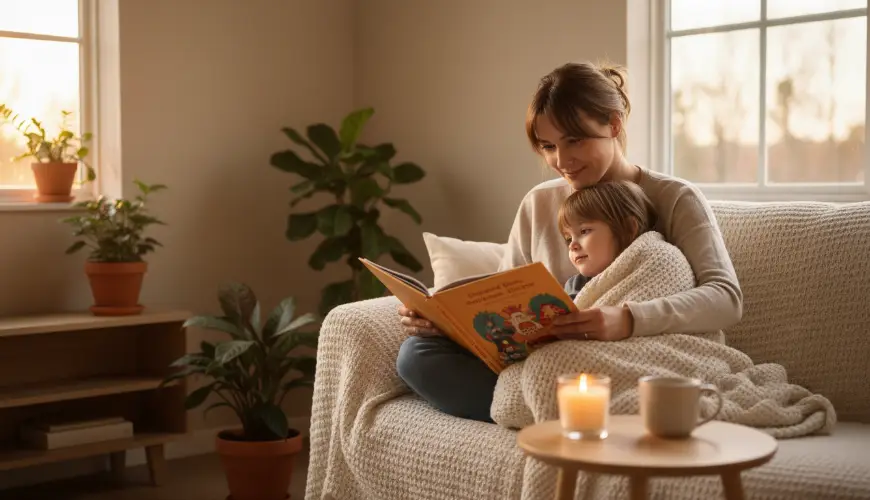
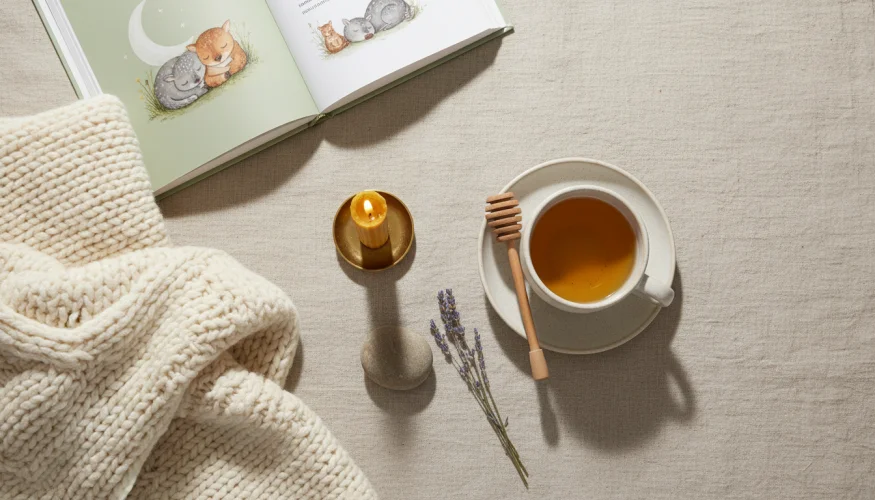
The environment in which rituals take place also plays a role. A calm, uncluttered space free of unnecessary visual noise helps the child focus on the ritual itself and on the person present with them. This is why many families consciously reach for simple, natural props – a candle lit during the evening story, a herbal tea prepared according to a family recipe, a knitted blanket that is only brought out for reading time. These small sensory anchors deepen the experience of the ritual and help the child's brain recognise: Now is that time. Now I am safe.
There is no need to buy expensive things or organise elaborate programmes. A ritual can be looking out of the window every morning and naming one cloud. It can be watering a plant together every Sunday. It can be a special word the family says instead of "goodbye." It is in precisely this simplicity that their beauty lies – and their power.
Children who grow up with firm, loving rituals carry into adulthood more than just fond memories. They carry with them a deeply rooted sense that the world is a place in which it is possible to find one's bearings, that there are people who can be relied upon, and that every day brings something to look forward to. And that is a foundation upon which an entire life can be built.